Late autumn usually brings the most precipitation to Port Townsend and the eastern part of the Olympic Peninsula. Atmospheric rivers dump rain. Strong winds blow and fallen leaves swirl. The sun is low in the sky.
The winter vegetable garden is producing, but most growth happened before the fall equinox. Garden beds covered with hoops and floating row covers will be protected from frosts. Fresh salad greens, kale, Swiss chard, and leeks can be harvested throughout the winter. Monitor vegetables for slugs and cut worms. The wet weather favors slugs and snails. Get them now and there will be less generations come spring. Also cut worms are a problem and can be found during routine weeding.
Fruit Trees
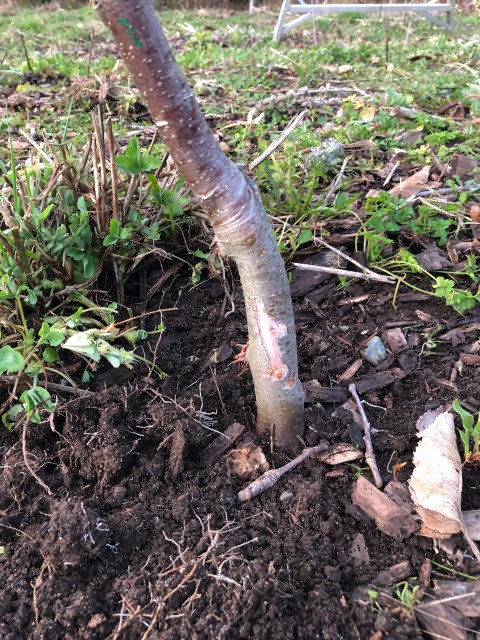
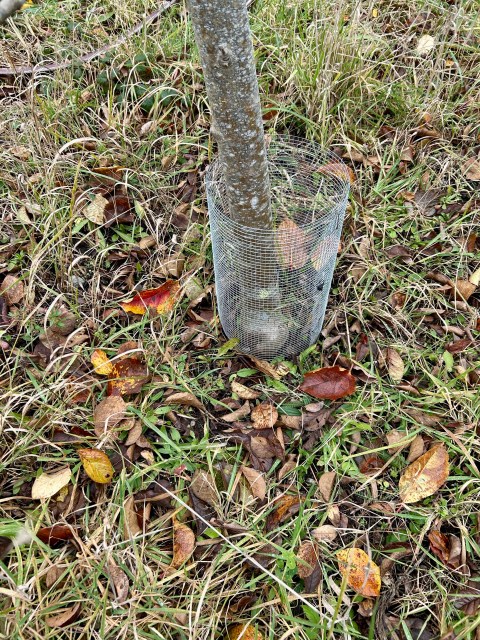
Keep the base of young trees free of tall grass. Better yet, place mulch around the trunks. Winter is the time when voles chew bark and roots. If you have a serious vole problem wrap the trunks with hardware cloth to prevent the rodents from gnawing the bark. Some gardeners even use pea gravel as a mulch to discourage voles.
Late winter is a better time for pruning apple and pear trees, ornamentals and raspberries. The reason not to prune now is because we could have a warm, sunny spell in January that could encourage plants to grow—only to be blasted by a deep cold in early February. Better to wait until mid- February for most pruning. Because wet weather promotes bacterial and other diseases, many gardeners prune plums and cherries after flowering during a sunny spell.
This is a good time for large garden projects that warm the body. Pushing wheelbarrows of manure, woodchips, and making large compost piles. Building planter boxes and retaining walls. Cutting down dead trees or cutting up branches for firewood or hauling them to the yard-waste facility. If you live in the woods, think about a larger tree-free area around the home as future fire-prevention.
Going within
And then there are times to slow down, take walks and notice the birds. Different birds are here for the season. Watch for Pacific wren, red-breasted nut hatch, northern flicker, pine siskin, golden-crown kinglet and spotted towhee.
Winter is a good time to dream about the garden. A garden mentor once said that the garden is forgiving—we can always try again next year. It’s a time to think about rearranging perennial beds and planting more drought tolerant flowers. Or perhaps it is time to think about simplifying a high maintenance garden. For some gardeners seed catalogs arrive in January and planning the edible gardens begin. Now you can think about how you can extend the season or create a garden sanctuary.
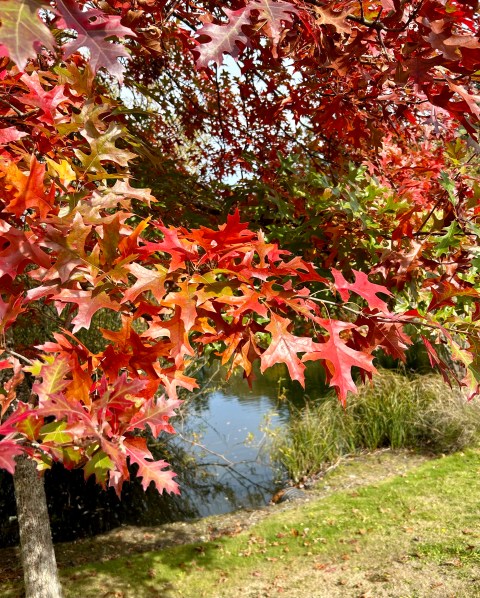
We know it’s autumn when the leaves start turning color. Here a Pin Oak brightens the landscape. It’s time to harvest winter squash and pumpkins, but if your squash isn’t quite ready, perhaps it will have time to continue ripening.
In Port Townsend, our typical first killing frost arrives by the end of November. If autumn temperatures drop slowly over time, plants get acclimated. The high concentration of sugars acts as ‘antifreeze’ in the protoplasm and this is what gives kale and other crops a sweeter flavor after the first frost. But if warm weather prevails until a sudden hard frost hits, then plants are not prepared. Sometimes in November the temperature can suddenly drop twenty degrees! Next month pay attention to the weather forecast and be ready to use floating row covers on crops and newly planted broad-leaf evergreen ornamentals. Forecasts for the next three to six months seem to be leaning toward La Niña but one forecaster described it as “a weak event”. NOAA posted this
Garden Chores
Leaves: Rake and compost, or save for mulch.
Lawns: Over-seed existing ones with white clover, yarrow, English daisy and other flowering plants for pollinators.
Mulch: shrubs and garden beds for winter protection and weed suppression. The increased organic matter will eventually feed the soil ecosystem. (This repeat from last month reinforces how important it is!)
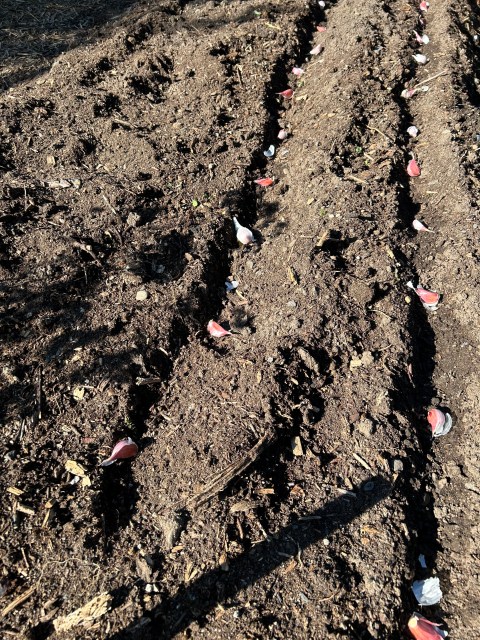
Plant garlic: 2” deep in well-drained soil. Space cloves 5 inches apart with the tip up. Mulch with straw. Prevent disease by rotating crop every 3-5 years. Certified disease free garlic or saving your own is best.
Fruit Trees: Rake and remove any diseased dried leaves, rotten- and mummy-fruits to prevent disease.
Apple tree pests: Examine fruits for coddling moth larvae damage. The Hortsense link offers preventative measures for next year.
Winter squash can be slow to fully mature. One way to encourage this is to remove all small and new squash in September. This allows all the energy to go to the larger, more mature squash. The signs that a squash is mature include a bright yellow spot where the squash touched the ground, the stem becomes brown and corky-textured. Also, as the squash skin toughens up, it becoming duller, and even a bit waxy. It may difficult to make an indentation with your fingernail. These contribute to a good storage crop.
Tinker loved growing the Lower Salmon River winter squash. This variety of Cucurbita maxima is one of the few heritage crops from the PNW, and is known from the Salmon River area of Idaho. It has a distinctive flavor and texture. Seeds are available from Adaptive Seeds.
If you want to taste Lower Salmon River, Midori Farm grows it and the Food Co-op has some now. It takes about 90 days to mature. It can withstand a couple of light frosts although the first one will probably kill the foliage. For Cucurbita maxima aficionados, check out this Johnny’s Seeds critique of flavor and yield for varieties.
After the fall equinox, plant growth slows. We have not had frost yet in early October 20224, so crops are still growing well. Plants are able to sense cold temperatures and respond by producing carbohydrates. In vegetable crops, the high concentration of sugars acts as ‘antifreeze’ in the protoplasm and this is what gives kale and other brassicas a sweeter flavor after the first frost. For more on winter gardens see the OSU Extension Publication
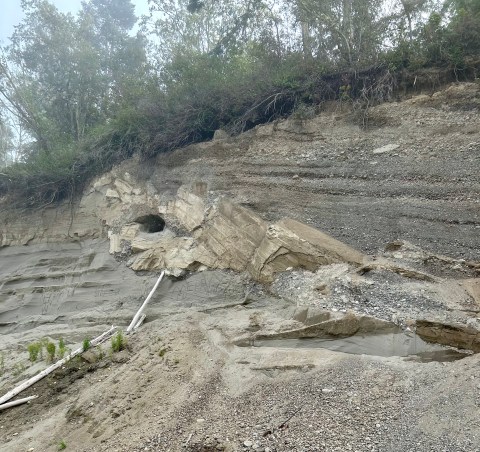
Looking at the natural history of our area deepens our sense of place and helps us grow more resilient gardens. Climate, geology and ecology have shaped the land. Tinker would always comment on the landslides along the bluff between North Beach Park and Point Wilson lighthouse. She enjoyed reading the landscape and imagining the geologic forces at work.
By looking at the bluff, we see what is below the surface of much of Quimper Peninsula, and begin to understand our soils. The above photo shows layers of deposited sediment.
Just imagine—a massive sheet of ice 3,000 ft deep covered East Jefferson County, 15,000 years ago. This last glacier bulldozed and deposited rocks, gravel, and sand. The beach bluffs reveal that much of our soil is glacial deposits. There are pockets of clay, sand and a bit of sandy loam. The thin topsoil is often sandy, gravelly loam. If this intrigues you, check out the Quimper Geological Society!
If you have ever felt your garden soil is not as good as it could be, you are not alone! Most areas of the Puget Lowlands are too young for deep topsoil. ( Of course there is prime agricultural land that formed on marine terraces or alluvial outflow from rivers.) A soil profile is a cut through section of the land revealing topsoil, layers of subsoil and even bedrock. Soil scientists dig profiles to examine the existing soil.
The curious gardener can look online for a digital copy of the 1975 soil survey of the county, where aerial photographs are overlaid with maps roughly indicating soil types and descriptions. I have an old paper copy that I highly value.
Again, this is just a brief summary and I am no expert! The climate working on the land determines the native flora. The Puget Sound area has mild winters and cool dry summers, and is commonly known as a Mediterranean climate. Winter rains tend to be continuous and light to moderate rather than heavy downpours. The marine layer—a deep, low cloud bank is a defining feature.
Rainshadow
What makes our area unique is that the Olympic Mountains block the moisture-laden clouds coming from the Pacific. The west side is a rainforest while the northeast side, in the shadow of the mountains is rainshadow. I have seen native Opuntia fragilis on the Quimper Peninsula and on Whidbey Island. Port Townsend’s average rainfall is around 20 to 23 inches. Often the marine layer breaks apart late in the day.
Prevailing winds from the Pacific often reach us from the south and southwest. As the clouds move around the Olympics, dumping precipitation from Olympia to Brinnon, they are wrung out by the time they reach Port Townsend. Eastern Jefferson County is largely a peninsula on a peninsula. It juts out to the northeast and catches the winds from the south. Mostly in summer winds blow from the northwest down the Salish Sea.
Arctic Blasts
In general our gardens are more prone to winter damage when arctic blasts roar down through the Fraser River Valley of British Columbia. It used to be that we only needed to track this during El Niño- Southern Oscillation years but the polar vortex is wobbling now and this leads to less predictability. Last winter we had cold temperatures that were the lowest in 30 years. Keeping an eye on the weather allows us to bring out sheets or burlap to cover plants. Even wind-blown Doug fir boughs shield vulnerable plants.
Moving here in 1988, with a background in organic horticulture, I was very curious about weather. Trying to get a grasp on seasonal cycles and weather, I asked many questions. It seemed like every season someone would say “This is the coldest summer” or “This is the wettest spring,” or “Its the driest winter”—I could not find a predictable pattern!
But there were and still are weather trends: Spring came early and lasted until the fourth of July; summer was somewhat predictable for August and September, although any day could become rainy and windy. Then autumn arrived. The snow was visible on the mountains until September. Several people who grew up here said the mountains were always snow-covered when they were children.
What I recall is the first snowfall would brighten the Olympic Mountains by mid-October, and might bring a cold snap to sea level, with occasional early frosts. Then mild weather would return for much of October. Often November would be the rainiest time of the year. Temperatures would get cooler and cooler until a frost. The darkest time of the year was and still is late November, December and January.—the sky colored many shades of gray. But then storms blew in from the south, after wrapping around the Olympics, bringing windy weather and sun-breaks in the dramatic skies. Red flowering currant could bloom as early as mid-February. There does seem to be an increased occurrence of multi-year La Nina. Nature magazine 2023.
Resilient Gardens
Climate change is real and part of gardening is responding to the changes. We live in a place for garden lovers, where flowers can bloom in the winter and a large number of evergreen shrubs thrive. The native vegetation offers a plethora of interesting plants for our gardens. Berries and fruit trees thrive in our mild climate. Winter vegetable gardens provide leeks and greens all winter. Knowing that most soils here are excessively well-drained and that we can’t rely on summer rains, drought-tolerant ornamentals are a smart choice. Tinker respected our rainshadow ecosystem. Here is how she grew resilient gardens:
Recognizing the importance of the soil ecosystem
Caring for the soil through making compost & sheet mulch
Selecting plant varieties that are bred for pest-resistance
Growing open-pollinated heirlooms that we can nurture as landraces
Developing a strong curiosity about our local weather
Committing to living lightly on the Earth, however we define it
Tinker was involved with Abundant Life Seed Garden from its inception in the 1980’s until 2001. She and John Gilardi were garden managers in the latter years. In the above photo, Tinker and an apprentice named Nicole are stripping the flower heads of dried amaranth to remove the seeds. Next steps include winnowing and screening. Later amaranth was one of the crops Tinker experimented with in the dryland farm project.
Amaranth’s importance is twofold—its super nutritious and easy to grow.
Unlike grains, the seeds of amaranth contain all the necessary amino acids. The protein content is 16 percent, more than rice or wheat. Like quinoa, this offers complete protein for vegans. Amaranth is considered a pseudograin (only plants in the grass or Poaceae family are considered true grains)
Grain Amaranth comes from one of three species. All are white-seeded whereas the leafy greens amaranth tend to have black seeds and may become weedy.
A. cruentus, Purple Amaranth: Day-length neutral and most widely adapted. Typically white-seeded from Mexico, this is made into “Alegria”, the popped seeds mixed with molasses pressed into a small cake or bar.
A. hypochondriacus, Prince’s-feather is day-length sensitive. I know little about this species.
A. caudatus , Love Lies Bleeding is native Peru. Sometimes called Inca wheat, it is an important staple in the Andes.
While young foliage can be confused with weedy amaranth, (A.hybridus, A. viridis, A. retroflexus. A. spinosus.) grain amaranth has apical panicles, or seed heads forming only at the top. Grain amaranth can withstand drought conditions because their roots can grow several feet deep.
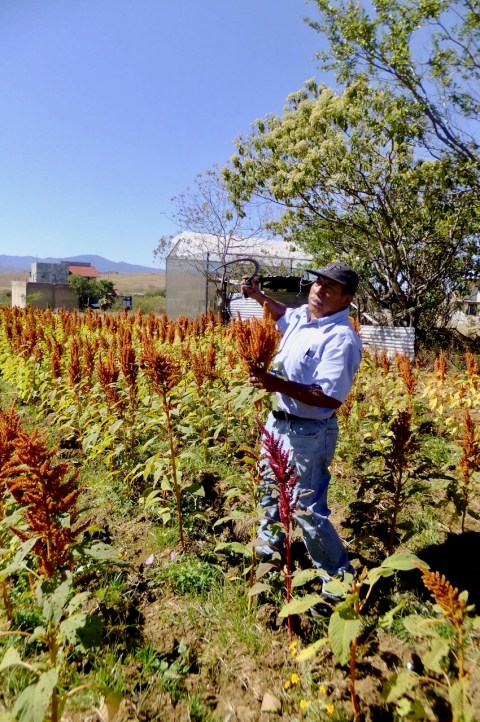
Early strains of A. cruentus were cultivated as far back as the time of the first maize in Oaxaca. The Jardin Etnobotanico de Oaxaca includes a section of early cultivated food crops. I was lucky to volunteer in the garden during the winter of 2019 and had the privilege to work with Roberto Chavez Rendon. Here he is with an early strain of Amaranthus cruentus.
Open-pollinated grain amaranth species can be variable. Many selected strains have full heads laden with seeds. Seed breeders are selecting for shorter plants that don’t shatter. University breeders are developing F-1 hybrids for food production.
Although claims vary, Amaranthus cruentus and A. hypochondriacus were cultivated before 1,000 BC in Mexico. Grain amaranth was an important food source from the Aztecs until European missionaries put a stop to eating or using amaranth in ritual. It is again popular and is best known as “Algeria” , the popped seeds mixed with molasses and pressed into a small cake or bar. An NGO in the Etla Valley of Oaxaca, Puente a la Salud promotes food sovereignty with a focus on grain amaranth not only for cakes but to add as an ingredient in many dishes ground into flour; boiled and used as a thickener in soups; toasted and popped as a cereal. They encourage farmers to grow the crop and teach communities how to make appropriate tech ovens and poppers for cottage industries with amaranth.
Amaranthus cruenthus. Farmer demonstrating harvesting with sickle.
Amaranth has the potential to be an important crop as we move into greater climate change. It is drought-, heat- and pest-tolerant. The nutty flavor can add more nutrients to oatmeal or ground into gluten-fee flour. Try growing this beautiful plant in the edible landscape, or in rows for production. Available from Adaptive Seeds, Bountiful Gardens and Johnny’s selected Seeds.
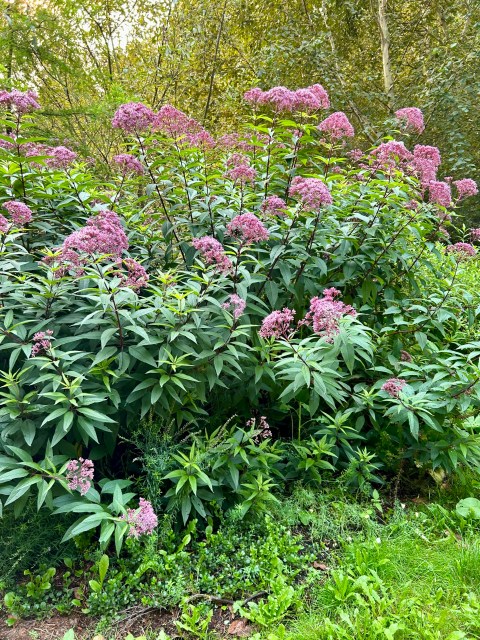
My earliest memories of Joe-Pye-Weed are from the coastal town in MA where I grew up. In late summer the purple flowers towered over other plants growing wild in what we then called swamps. I would bicycle down the country lane and cut stems of the flowers to make dried flower arrangements. Joe-Pye-Weed was likely named for Joseph Shauquethqueat, a Mohican medicine man who cured settlers.
Although the plants are found throughout the East Coast on moist sites, they can tolerate drought conditions. For this reason, they make a good addition to our landscapes. A myriad of hybrids is available for this popular genus. Formally known as part of the genus Eupatorium, botanists have recently reclassified this group into a distinct genus, Eutrochium.
One hybrid has been bred to grow only 3 feet tall. They can grow in part shade and look more robust with regular watering. If the intention is to encourage them to be drought-tolerant, plant them in lots of compost. After three years divide the plants. They will ocassionally reseed, mostly they spread slowly from the crown.
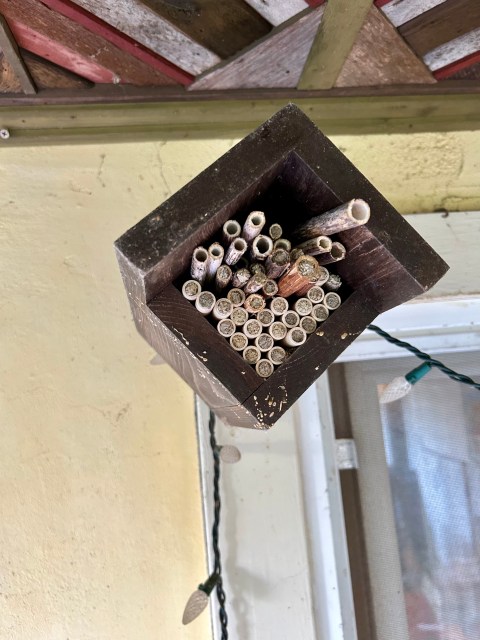
The 6 ft tall hybrid plants I have were divided from a friend’s clump. The hollow stems are a deep purple and after the perennial is finished for the season, these stems make excellent disposable tubes for Mason bee homes!
Landscape uses:
Consider this for outside the deer fence. Eupatorium works well with Miscanthus, perennial sunflower and cardoon for a dramatic late summer perennial display. After growing vigorously in spring and summer, they come into their own in August and September. Rain gardens need plants that can withstand inudated soils.
Other Uses
If you raise mason bees, see my earlier post, then the dried stems of this plant make great disposable nesting tubes for the mothers to lay their brood.The right photo shows the Joe-Pye stems on left and the purchased tubes on right.
By August the garden is often humming along on autopilot, although sometimes the garden (or more likely the gardener) feels tired by late summer. This year, July only got a bit of rain on the last day. The current forecast for the remainder of August is cooler than normal— great for the cool-season vegetable starts, but not so encouraging for the warm season crops that have just started to pump out vegetables like zucchini, beans and tomatoes.
This is a time to reflect on garden priorities. What thrives in your garden? Do you have an intention or a vision for it? Are you in a phase of expansion or contraction? This changes with how the garden matures and ages along with our own interests and energy levels. Walk around and make notes. Beth Benjamin, one of my favorite garden teachers from when I was an apprentice at Camp Joy, in the Santa Cruz Mountains, always said, “The garden is forgiving. Next year we can try again or change how we garden.”
Garden Chores
Shrubs and Trees: Don’t add any more fertilizer that is high in nitrogen to shrubs and trees. Plants need to harden off before the winter cold settles in. All-purpose natural fertilizer with fertilizer ratios in single digits are okay. Apply the last fertilizer to roses by mid-August. Aged compost is also okay.
Perennials: Continue deadheading, ease up on watering and fertilizing. Consider which large perennials could be divided and moved around to fill in gaps in the garden. Determine which plants are aligned with your watering regime. Plan to move or divide perennials in September or October.
Rockrose: They typical rock rose, Cistus hybridus tops out at 3 ft. But, here in Jefferson County can grow to 5 ft. and sprawl. Older shrubs can be completely renovated. Remove dead branches and then prune with a combination of thinning and heading cuts. Sometimes these plants can be pruned into artistic sculptural forms. Remove splayed and sprawling branches.
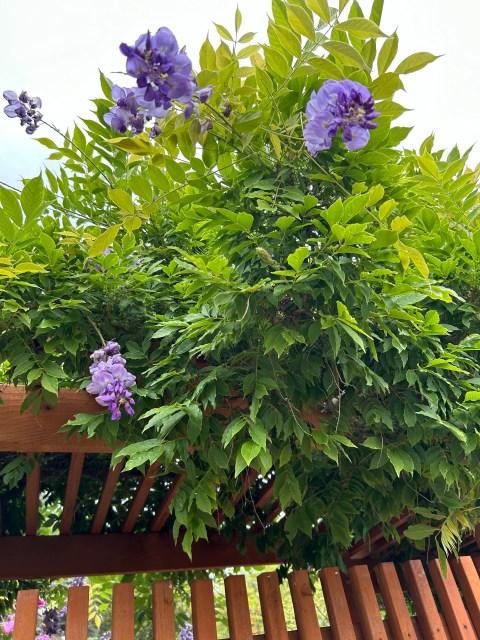
Wisteria: flowers better if pruned regularly. Prune the vine now after flowering and also when the vines are dormant in January/February. Now cut back new growth, leaving five or six leaves on a branch. This will encourage flower buds. In the winter cut back to three buds. These become spurs that will flower next year.
Wisteria was cut back about 2 weeks ago after prolific flowering earlier. Pruning encourages vines to grow flowering spurs
Raspberries: Summer bearing canes (floricanes) that have finished fruiting on the previous seasons wood. Cut these canes to the ground and remove. Any new growth thinner than a pencil should be prune to the ground. Then look at the canes that started this year—primocanes. Select 6-8 canes per plant spaced about 3-4 inches apart. When the plants go dormant in winter cut these canes back to just above top wire. These will produce lateral flowering and fruiting branches next summer.
Fruit Tree late summer pruning: Plum and cherry. Did your trees grow vigorously this summer? If so, prune back branches that pumped out two feet or more new growth. This can reduce next year’s vegetative vigor and encourage fruit buds. But if the tree grew moderately, then wait until winter or even after next year’s flowering before pruning. Poorly executed summer pruning can stunt a tree.
Apples: Sometimes apples get in a cycle of over-producing fruit one year and then the next one the tree is recuperating and has no fruit. Biennial fruit-bearing can happen for numerous reasons. If too many fruit form one year and are not thinned out then the tree doesn’t have the energy to form many flowers the next year. Some apple varieties like Honeycrisp and heirloom Brambley Seedling are naturally biennial fruiting. Other trees fall into this pattern through lack of nutrients, irregular watering, or one winter frost destroys the blooms. RHS always has good information. Thinning flowers (once you confirm they are pollinated) is more effective than thinning young fruit. Advanced gardeners can look at the Royal Horticulture Society’s post on summer pruning of apples and pears.
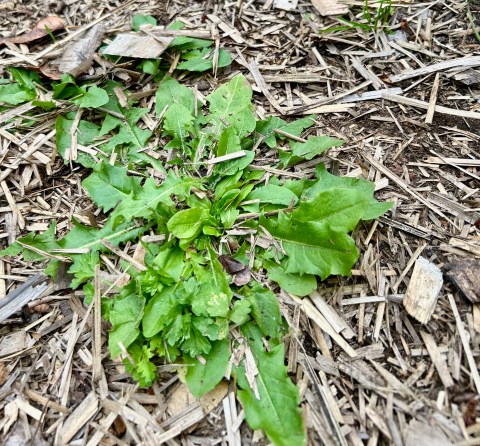
When I would help Tinker in her garden, often she dug up dandelion plants as if they were precious. The roasted roots made a delicious tea that she savored. Imagine if the plants we detested somehow changed in our mind to become useful resources. So much in life is how we frame something. If we look at a weed and notice a couple insect pollinators insects sipping the nectar, maybe the ‘weed’ isn’t so bad. That doesn’t mean we have to keep the plant. I have had weeds that I once hated and then learned to accept them, even as I removed them.
Gardeners who take the time to identify the plant can be more effective. Knowing a plant lets you determine the best way to control it. Sometimes a weed can be an indicator of environmental conditions: the soil is wet or heavy, or it is very acidic. Some tough weeds will die out if the roots don’t get nutrients from foliage. This requires diligence—regular weed-eating. Small, less-hardy weeds will die from deep mulch that smothers small plants and suppresses weed seeds. Proper ID is key to control.
Weed Identification
Botanical identification begins with a plant’s flower. We can’t rely on the foliage because weeds are by their nature adaptable and have a lot of variety. Vegetative characteristics are malleable. Here’s a short digression: years ago I managed the UCSC agroecology program greenhouse and was responsible for transplanting seedlings. In wood flats full of vegetables or flowers that required pricking out, there would be a number of weed seedlings from the compost. The young weeds could look almost identical to the some of the crops—so much so, that a number of the apprentices I supervised would pot up the weed seedlings! So identify your weed when it is flowering and then start to recognize the plant in all its stages, from young seedling to flowerings going to seed.
I’m old-school and like books. My favorite book for weed identification is Weeds of the West, University of Wyoming Press. Our cooperative Extension had it for sale decades ago. Now it can be downloaded for free from the website or used books can be found online. 900 color photos include the weed at young stages.
Online resources include Hortsense from Washington State University, with 90 fact sheets listed by alphabetical order. University of California, Davis has a useful online weed identification key
Weed Ecology
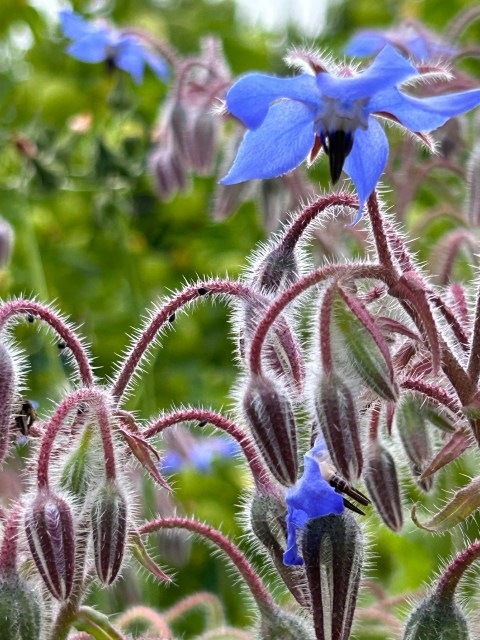
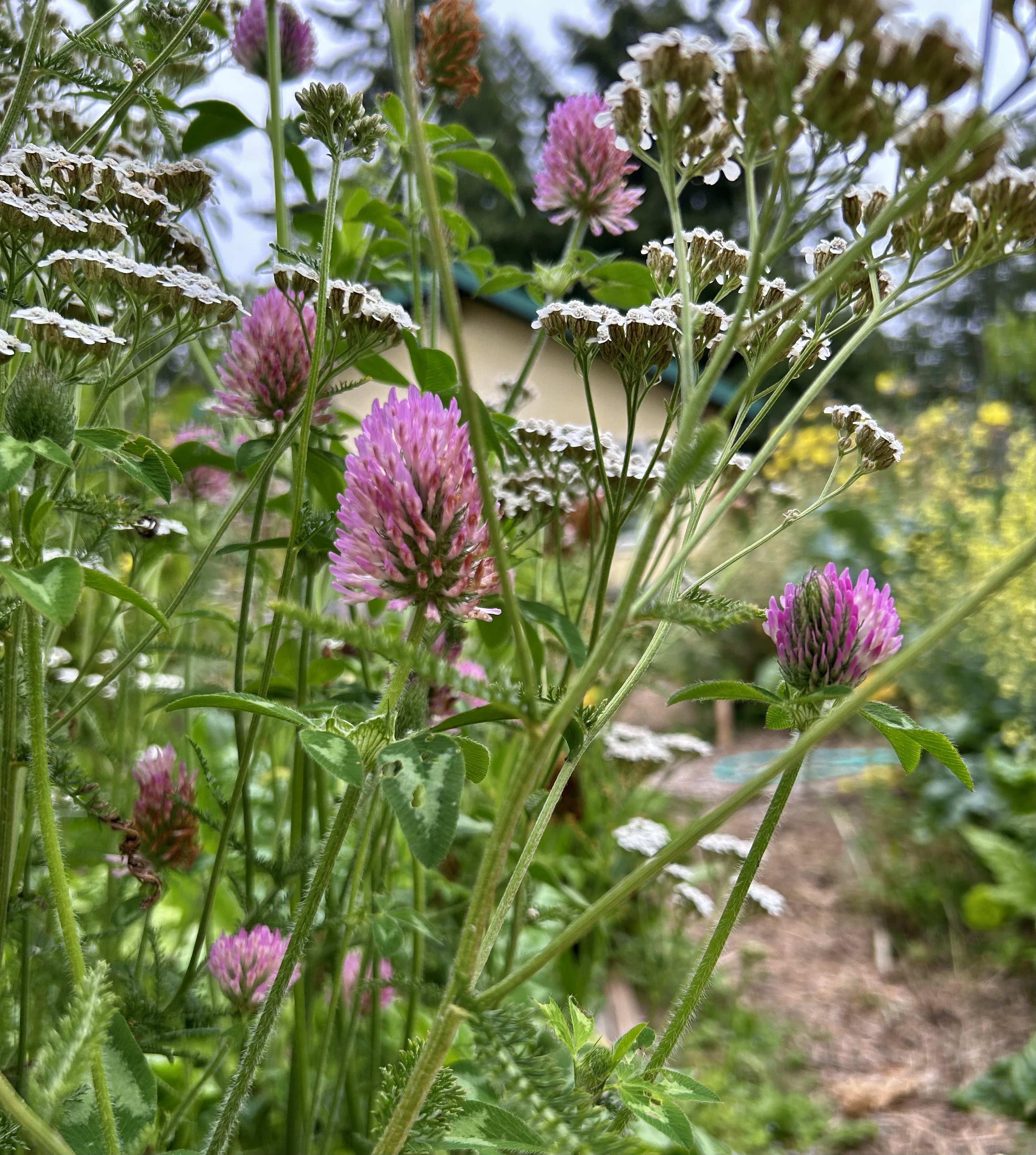
Many weeds are species that have adapted to colonize disturbed sites, such as landslides; after a wildfire has burned off vegetation; along roadsides; or at building sites where excavators have exposed mineral soil. Alan Chadwick, the famous gardener who developed the French-Intensive-Biodynamic method, always said nature abhors a vacuum. That’s why in my garden I sprinkle around borage, red clover, phacelia, or calendula. By regularly weeding out unwanted plants, I have mostly replaced the disturbed areas with annual flowers that are easy to pull and have many benefits. There’s not much room for weeds.
Weeding Techniques
Start weeding early spring, when the ground is still moist and the plants are young. Weed annual gardens regularly. Use lots of mulch around perennials and woody plants. Since weed seeds can remain dormant for decades, it’s important not to let weeds good to seed.
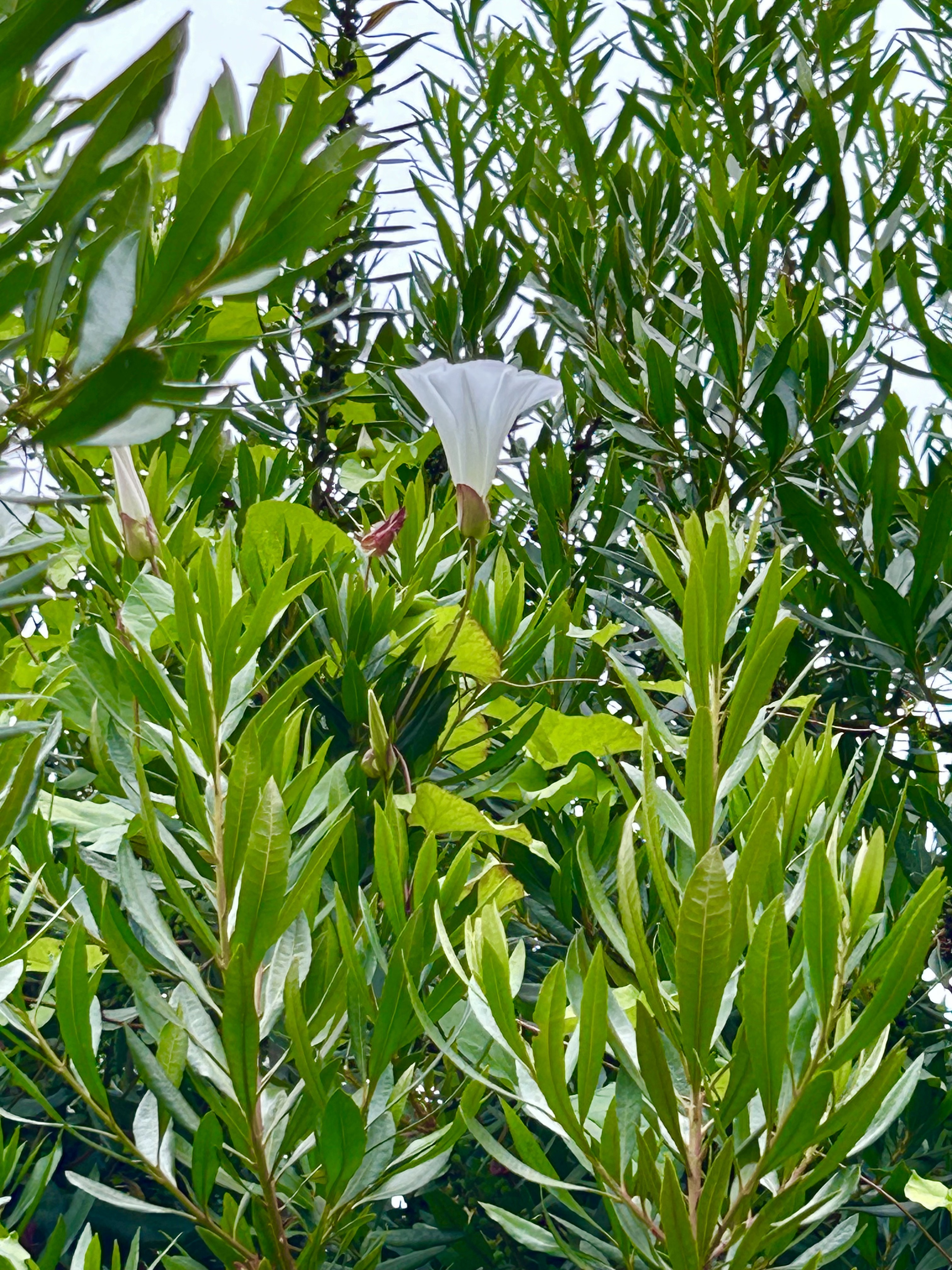
Certain perennial weeds can become one’s nemesis, for example horsetail, bindweed,Canada thistle . If you do nothing else, make sure to cut flower heads before they go to seed, bag them and send to the dump. The county noxious weed board doesn’t want what the state includes as noxious plants in our yard waste. If you cut the flower or seed heads and bag them, then the rest of the material is yard waste and can go to the compost facility. Thick mulch prevents seeds from sprouting. Everyday weeds can go into yard-waste. I have a big pile of plant debris that I will not use as compost, but will let it rot in place. In it I include weeds that have gone to seed but are not listed as noxious.
At one time I added woody plant material to this pile, but now wild roses, native blackberries and branches from hedges and ornamental shrubs go to yard waste. I don’t want excess fuel for potential wild fires.
If you are still using herbicide on weeds in pavement cracks or gravel, please consider a vinegar solution. Horticultural vinegar—at 35% strength is a lot stronger than kitchen vinegar—5% sold at grocery stores, so take more precautions! Wear gloves, glasses and long clothing. Although flame torches are used in agriculture to control weeds ( by boiling the sap, not turning foliage black), when I called our fire dept about using them for weeds in cracks I was informed that we had two wildfires in the county start that way!
For woody plants or deep-rooted perennials, such as Scotch broom, Himalayan blackberry, and poison hemlock, a weed wrench can be used to yank out the entire plant. The county weed board has wrenches they loan out.
A lot of weeds are my friends. I make flower bouquets, or add them to salads. Others are a haven for pollinators. Some are good sources of carbon for my compost piles.
One of my favorite permaculture shrubs is Goumi, Elaeagnus multiflora. This multifunctional plant is easy to grow! The fragrant tiny yellow flowers bloom in April, followed by astringent and sweet fruit by the end of June. In 2018 I ordered plants from One Green World and they recommend planting two varieties, so I planted two Sweet Scarlet and two Red Gem. The former is more robust with dense foliage that hides the fruit from the birds whereas Red Gem has a more open framework, with less foliage and is more productive. If you have limited space and prefer to cook the fruit with a sweetener, then Red Gem is a winner. I mostly eat the fruit raw and share the crop with birds. For the sweetest flavor wait until the fruit is a deeper red.
The genus Elaeagnus is recognized for having a symbiotic bacteria, Frankia that grows in the soil and fixes nitrogen from the air, making it available to the plant. I prune Sweet Scarlet several times a season and use the leafing branches as compost.
Goumi, an Asian native has been cultivated here for at least one hundred years. In Japan it is known as natsugumi. The fruits of this shrub are high in lycopene I wrote a more thorough account here
My attitude about growing flowers changed the day I visited my friend Renee at her cabin in the Santa Cruz mountains, California. At the time I was a twenty-three-year-old horticulture student. I sat at her kitchen table, eyeing the room, when I noticed a bouquet on the kitchen table.
It was an arrangement of fragrant flowers with lavender, roses, delphinium, and baby’s breath. My internal dialog commented, “Oh those are probably from the UC Santa Cruz Farm and Garden.” It was a dismissive thought. You can’t eat them, what’s the point.
Then it dawned on me—I had picked those flowers and arranged this very bouquet, just two weeks before. My sister was then apprenticing at UCSC Farm and had invited me to gather a bouquet for Renee, a new mother. Stunned, I saw my bias. Flowers seemed frivolous, when I was on the revolutionary-edge of organic food growing in 1980.
That was the incident that changed my life, it was okay to love flowers as I always had. After getting my Horticulture degree, I apprenticed at Camp Joy in Boulder Creek, CA. I learned to sow seeds in wood flats; tend young seedlings in the greenhouse; and plant them in double-dug raised beds.
Twice a week, before the sun rose over the mountain ridge, we harvested flowers and placed them in large tin cans in the shade of the gazebo. I was taught that the key to selecting young flowers was in the reproductive parts. I became skilled at noting if a flower’s stamens were moist with fresh pollen or not. Daisy-like flowers, with their disk and ray flowers were easy, once the secret was revealed. Bending down to look closely at the yellow center one could see if the rings of tiny flower parts were all open, if so then the flower was old. But if just a couple of outer rings of disk flowers were open, it was prime for harvesting.
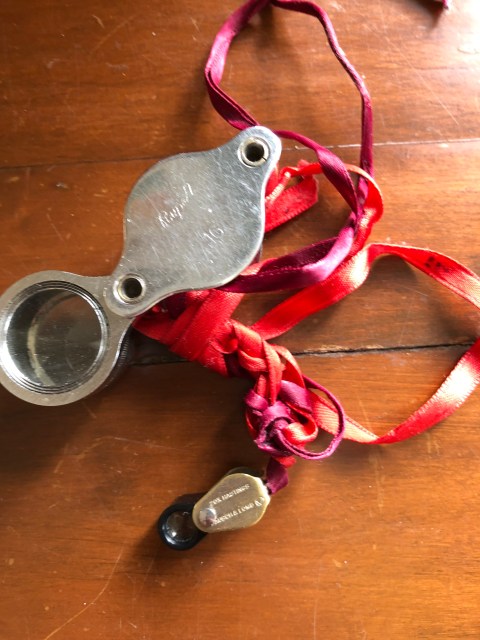
The day I purchased my 20-magnification hand lens, the world of insects opened up. Looking through this loupe was like landing on a planet. By placing the lens close to my face, my hand on my cheek bone to steady the lens, I moved in close, a spaceship landing on a miniature floral world. The intricate textures of leaves, flowers and seeds were mesmerizing. I peered deeply into a flower chamber, translucent in color, while male and female flower parts became giant. I imagined myself a tiny creature crawling over these exquisite sculptures.
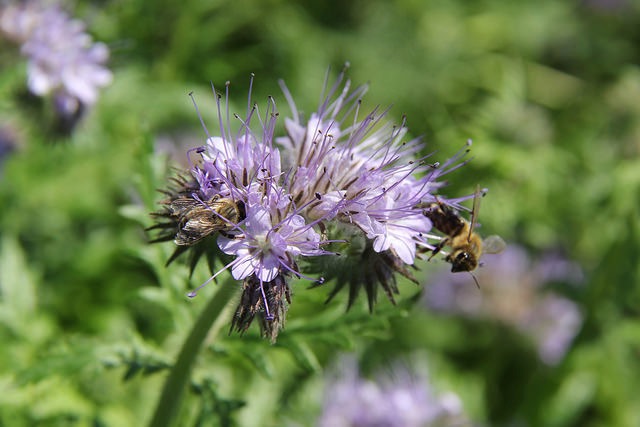
Honey bees on Phacelia
I had to study insects in the horticulture program, after all the little buggers ate our crops. But we also learned of beneficial insects–predators and pollinators. There was humor in considering the caterpillar as a juvenile delinquent chomping on the parsley leaves, but then when the caterpillar metamorphosed into the Swallow-tail Butterfly, it pollinated flowers like a mature, contributing citizen.
Getting to know insects became part of understanding the garden ecosystem. Like a bird-enthusiast with binoculars, I sought insects with my lens. This requires patience! At first recognizing the different creatures based on their anatomy—wings and mouth parts being essential clues, eventually I moved on to noting their behavior.
Over the years I have watched green lacewings laying eggs; each on a solitary stalk. These predators are so voracious, the emerging young would eat the surrounding eggs if they were not out of the way. Also, I have seen lady bug larvae that look like giant Gila monsters gobbling up aphids. And no lie, I have watched aphids pop out live babies.
Learning about pollinators in my backyard offered me the chance to slow down, and become curious. Did you know that a butterfly can taste with its feet? That when it lands on a petal that has nectar-bearing flowers that its siphon-like tongue unfurls? I have seen this. It takes patience, but watching insects is a form of miniature wildlife viewing.
Bees can see colors invisible to the human eye. Foxglove flowers have ultraviolet circles around maroon spots, marking a trail to lure pollinators deep into the trumpet bloom where a reward of pollen and nectar await.
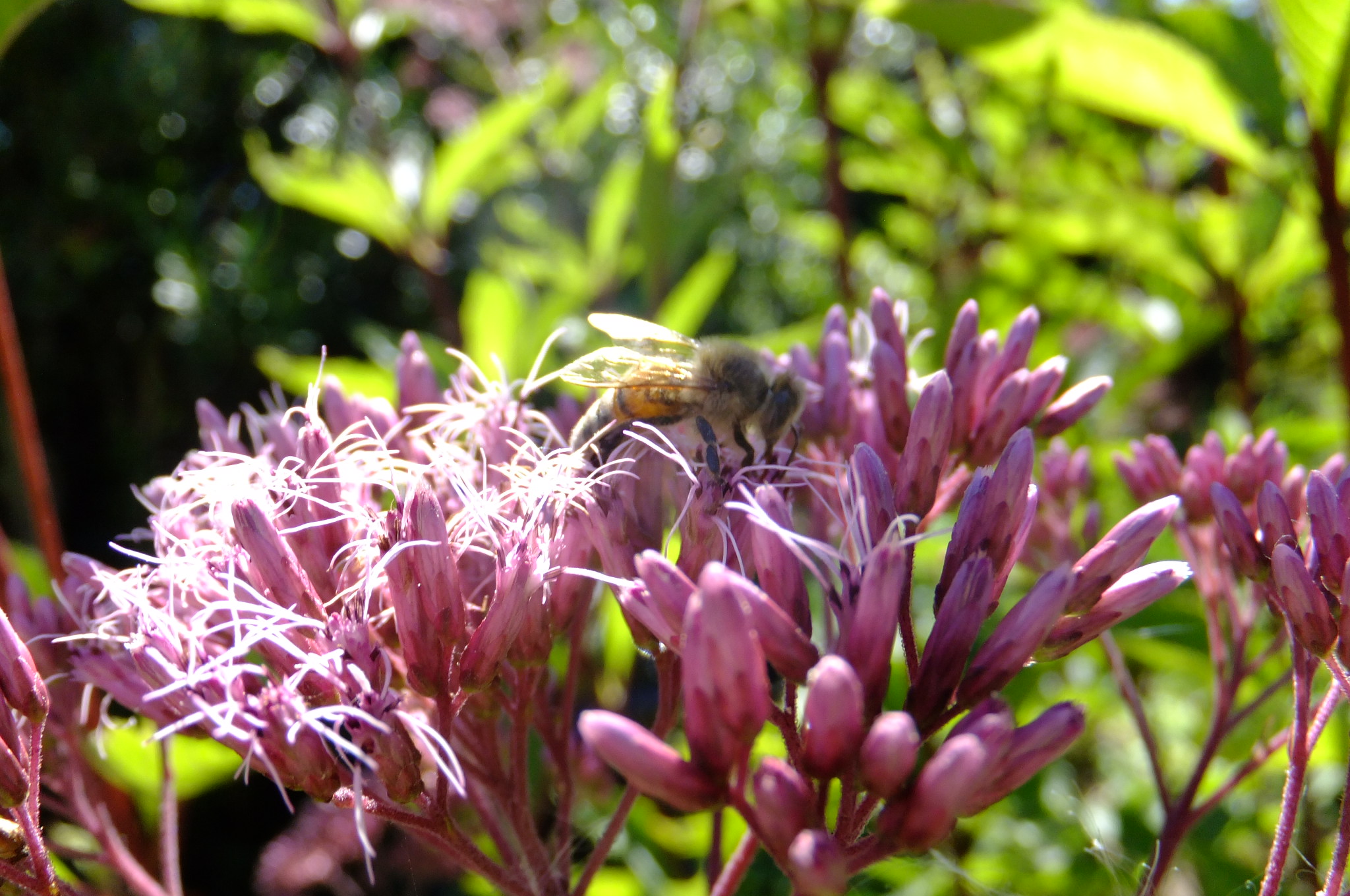
The honey bee is but one of many kinds of bee. Native to the Mediterranean, and introduced around the world, it is a generalist, pollinating many flowers. And yet, it shares a characteristic with all bees that make them the premiere partner for flower pollination—floral fidelity. This means on any given foraging trip they only gather pollen from one species. Efficient for the insect and fundamental for the plant to produce seed, bees are the most important group of insects.
Scientists now know that bees are a keystone species–creatures necessary for the survival of other organisms in an ecosystem. Keystone species are referred to as the glue that holds a system together–without them an ecosystem may not be resilient enough to adapt to climate change. There are native flowers that depend on one or two types of bee to pollinate them.
Also, bees and other pollinators are responsible for food crop pollination. According to the USDA, bees, both honey and native are responsible for the pollination of 75 percent of fruits, vegetables, and nuts in this country. Another way to look at it is one out of every four bites of food can be traced back to pollinator services.
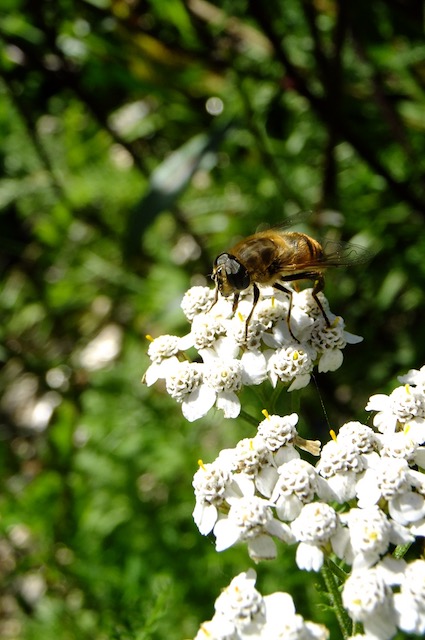
Jim Nelson at Camp Joy, a beekeeper, told me something I never forgot. “Imagine yourself tiny, the size a bee. As you approach a flat-topped white yarrow, a Sedum Autumn Joy, or a sunflower, you would see an entire field of flowers.” A bee’s-eye view of the world makes me want to plant these flowers and patiently watch the insects that come foraging.
Asparagus shoots are emerging–here is a crop to test our commitment to delayed gratification! Some clients have told me they tried growing asparagus but gave up. This perennial vegetable requires a dedicated bed and will produce for decades if well-tended. Growing asparagus well is time-consuming; let’s look at what it takes. One trick is to prepare the planting site well in advance.
Preparing the bed: Diligently remove all perennial weeds and prevent them from getting established. Add lots of organic matter and water deeply until the plants are established. If the soil is heavy clay, prepare a raised bed. Wait a couple of years before harvesting to allow the plants to get established.
Harvesting: Begins for a couple of weeks in the third year. Snap or cut the shoots at the base. After about five years, harvest for almost 8 weeks or as long as the shoots are vigorous and finger-wide. Stop harvesting before emerging shoots are spindly. By allowing the fronds to grow and nourish the plant, we prevent the plant from losing vigor.
The plants are either male or female. They are sold in nurseries as 1-year old crowns. All-male varieties have the advantage of bigger shoots. Growing them from seed means you will also have slender female plants that put more energy into producing red fruits and seed. Be sure to remove volunteer seedlings so they don’t crowd out the initial crowns. In the autumn after the plants turn yellow, cut them to the ground.
Staking: Do you lean more to the aesthetic or very efficient gardening mode? An asparagus crop is a prime candidate for edible landscaping with its ferny leaves. Stake individual plants or use a horizontal trellis (used for growing long-stemmed flowers) to allow the ferny fronds to sway a bit.
If you have a no-nonsense, efficient approach to the garden then plant them in a row and place wood or metal posts at both ends. Once the plants are tall and start to bend, string a line from post to post and pin the plants in as the plants mature. A month later twine another string about a foot or two above the first to hold them in place. In any event, asparagus is a delicious addition to the garden.