Making Compost in Jalisco

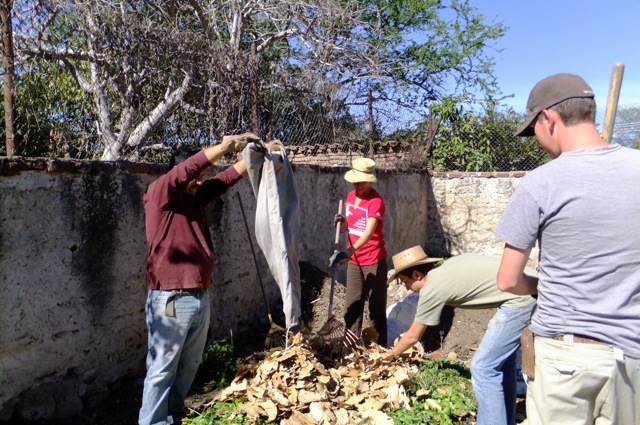
Compost making: Adding a layer of dried leaves

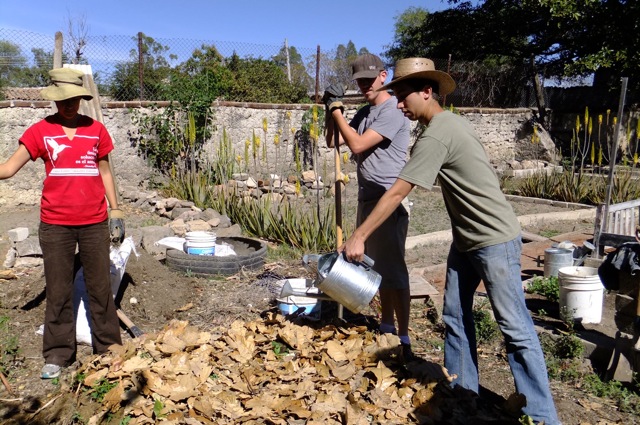
The city turns off the water during the day, so 55-gal barrels are filled for use during the day. Labor-intensive hand watering makes us appreciate when the water is flowing out of a hose.
The city turns off the water during the day, so 55-gal barrels are filled early each morning. Labor-intensive hand watering makes us appreciate when the water is flowing out of a hose.
Dried cow manure from a stockyard provides a layer of norogen
Dried cow manure from a stockyard provides a layer of nitrogen.
The day before this event several members borrowed a truck and went to the local stockyard to shovel manure into bags.

We built the pile one layer at a time, like a huge sandwich: Alternating dry material with green material, then a layer of soil. Another way to look at it is layering nitrogen-rich material with carbon-dense matter and then another layer of soil and or compost. We made the pile large enough to create an insular mass for the microbes to thrive. In the tropics 3 foot by 3 foot by 3 foot works. In temperate climates increase that to four-foot all around.
Basically, compost mimics nature's process of decomposition.
Basically, compost mimics nature’s process of decomposition.

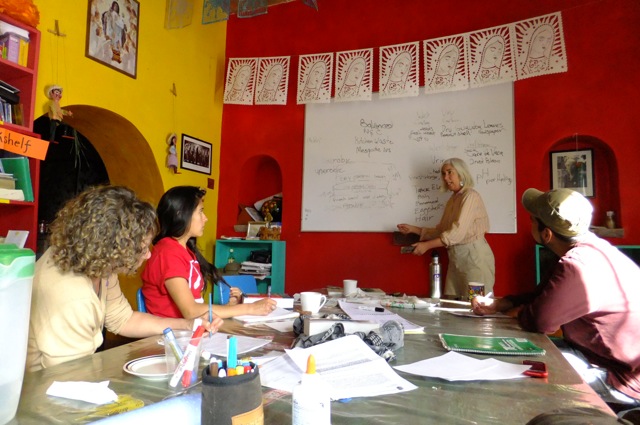
After lunch we came inside to review the soil food web and the basics of making compost.

If you explore a forest floor below the leaf litter, you find humus, the result of an entire soil food web. Compost is a way to speed up the process by providing the decomposers—soil bacteria, fungi and invertebrates with all the nutrients they need. We work with microbes when we make bread, yogurt, or sauerkraut. Compost is messier and larger but is similar in that we are creating an environment for microbes to thrive and directing their behavior to produce a product we want.

The building blocks of compost are  nitrogen-rich material for strong bodies, carbon-rich material for organisms to energetically reproduce, air so the pile stays aerobic and doesn’t go putrid, water to hydrate to microbes, and soil or aged compost to inoculate the pile with organisms.

Compost enhances the garden in so many ways:

  • It reintroduces soil microbes to soils that have been damaged by chemical fertilizer and pesticides.
  • It improves the soil ecosystem and encourages beneficial microorganisms that protect plants from pathogens while  soil fungi bind with and filter out toxins.
  • Compost prevents soil erosion by improving soil structure. Soil rich in organic matter is more porous; it allows air and water to move and be held, it has good tilth.
  •  “Feed the soil and the soil feeds the plants,” is a famous Alan Chadwick quote I learned years ago. Compost feeds soil microbes that in turn release enzymes and hormones that promote healthy plant growth. Decomposing organic matter releases nutrients. The dead bodies of microbes act as slow-release fertilizer, providing nutrients over time.

Garden Crops from an Ecological Perspective

Biological systems often unfold in cycles. The cultivated crop cycle is often interrupted: seeds germinate, seedlings sprout, plants leaf out, and crops mature. Depending on what part of the plant we value as edible, the vegetable may never fully mature before its remains are tossed on the compost pile. In seed saving we allow the crop to complete its cycle like any other flowering plant. (Some crops are completely dependent on us to reproduce, especially in cold climates.) Let’s let that carrot, lettuce, or kohlrabi complete it’s cycle. The robust plant is ready.

Soon flowers emerge, advertising a plant’s sexual maturity. Petals act as scented banners enticing flying insect cupids to sip nectar. As the visiting insect works its way through the fertile flowers it brushes up against pollen grains that cling to it.  The insect courier carries pollen to the next flower. There are two events that must happen for flowers to produce viable seed—pollination and fertilization. When a ripe anther splits open and a fertile pollen grain lands on the stigma of a female reproductive organ, the first hurdle is achieved. The next journey is internal and results in a pregnant flower that swells with the fruit of a new life—One friend remembers the difference as recreation versus procreation. Fruits can be juicy as tomatoes or hard as mustard seed. The seed itself may look inert but not only does it hold the potential to produce an edible plant, it will contribute genetic coding for generations to come.

Biodiversity assures that there are many ways for this seed-to-seed cycle to unfold. The observant seed saver begins to recognize patterns that are consistent throughout plant families. The basics of botany provide a shortcut to hone our observation skills and develop the seed-saving expertise that humans have been sharing for 10,000 years.  We use botanical terms to define plant anatomy and scientific terms to describe processes. This jargon provides a common language to convey the principles of seed saving. The important thing is to observe, understand what we see, and then apply the principles through time-honored techniques.