Gardening for the Birds

Winter is a time to step back and evaluate the garden; to appreciate how much it has grown since last year and to analyze how we can improve it. One approach is considering it from a bird’s perspective. Gardens that favor birds provide food, water, cover and a safe place to nest.

Water for drinking and bathing is essential. Place it adjacent to shrubby habitat to provide refuge from predators. Shallow moving water with a place to perch is best, but a bird bath that has clean water is also valuable.

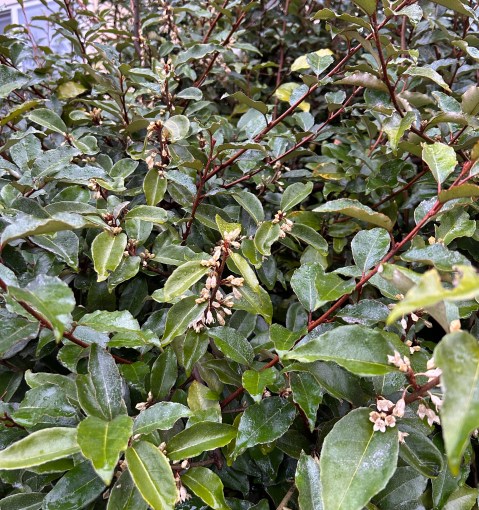
If the shrubs have berries, so much the better. Also, evergreen shrubs provide an excellent place to roost at night. Evergreen foliage provides screening from predators and insulation from winter’s cold. Above is Ebbings Silverberry, Elaeagnus x ebbingei in bloom. Hummingbirds were feeding here mid-November and new flowers keep opening. Below is Strawberry Tree, Arbutus unedo and Pacific Wax Myrtle, featured in an earlier post.

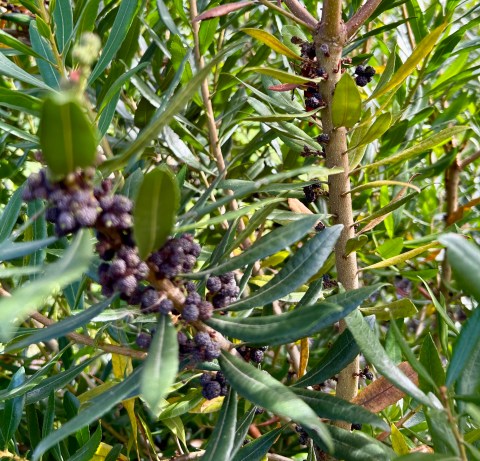
Arbutus undo

Feeding the birds

Bird feeders come to mind first and many people are committed to providing bid seed and suet. Some birds change their diet according to the season. Perennial seed-heads offer another option. Native plants have evolved with the local bird populations. In addition, perennials can be selected for architecturally interesting seed-heads. Plants in the mint family including sages, Salvia; anise hyssop, Agastache and Jerusalem sage, Phlomis. Sunflower family flowers like Joe-Pye weed, Echinacea, black-eyed Susan, Rudbeckia hirta and artichoke are attractive to birds.

Many cat owners recognize that a cat can kill up to eleven birds a year. A ‘Catio’, or cat patio is an outdoor enclosed space that protects cats from eagles and hawks and prevents cats from killing birds. Many homeowners have found ways to integrate this structure into their landscape. One of my favorite catios is that of my friends Kathleen and Pete. They constructed their catio around an existing blueberry patch, thus excluding birds from berries and cats from birds!

Watching birds is a relaxing and invigorating hobby for gardeners. People start off with bird feeders and it opens up an entire world. When David Sibley, author of The Sibley Guide to Birds, was asked why he enjoyed watching birds, he responded:

One of the most enduring attractions for me is that it gives me a chance to learn about an entire system (the natural world) by simply watching and getting to know the birds. When I can name a bird that I see, or notice subtle differences in appearance or behavior, that information gives me access to a store of knowledge about the species’ habits and preferences. I know where its travels might have taken it, what type of food it’s looking for, if it’s likely to be alone or part of a flock. In short, I know that bird and have a sense of how it fits in the world around it.

Check out The Courage of Birds: The Often Surprising Ways They Survive Winter, a new book by the birding team Pete Dunne and David Sibley.

Consider gifting a gardener/birder an online course covering everything about gardening for birds:

Cornell Lab Bird Academy

Gardening for the Senses

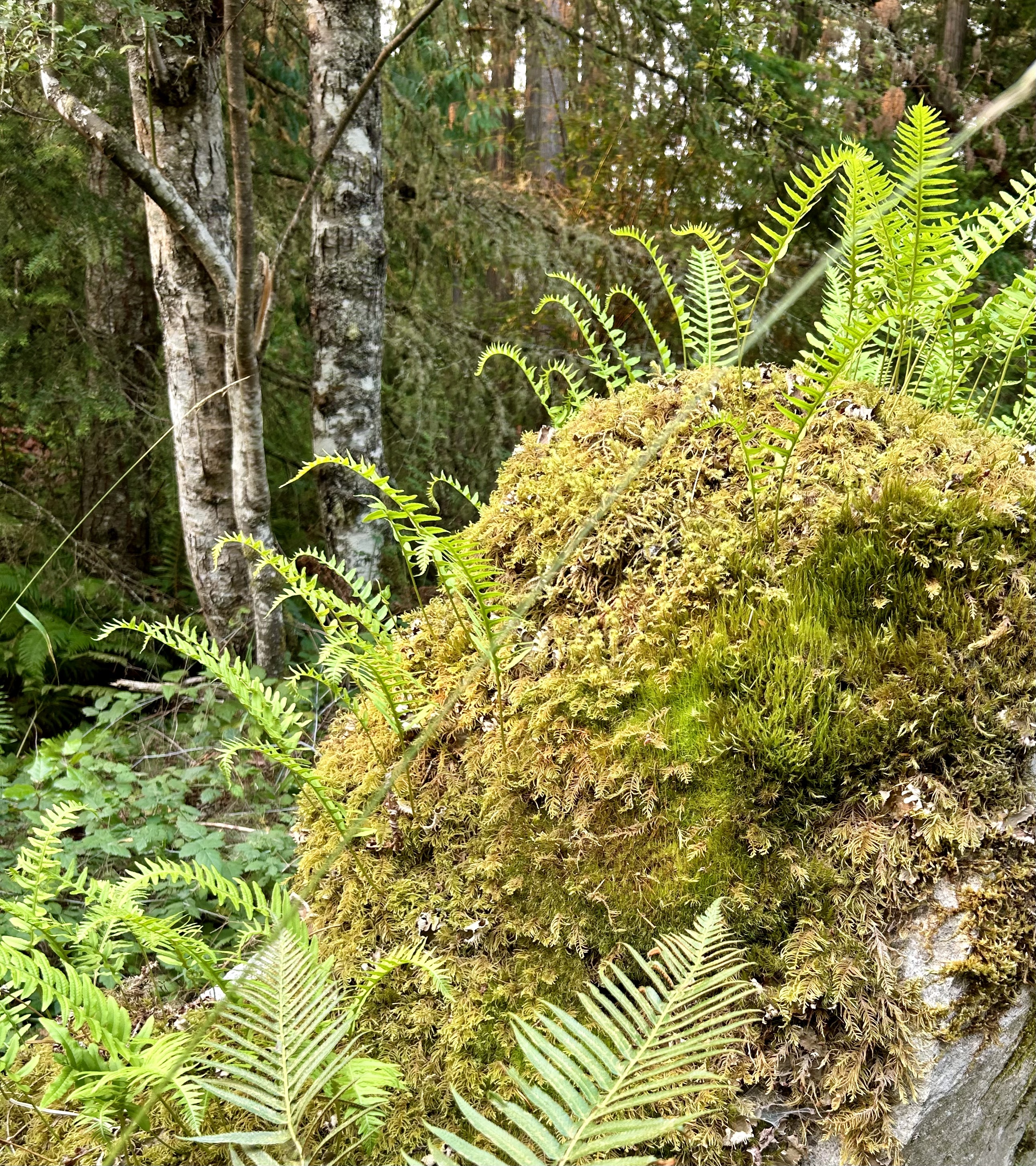
Plants with textured foliage invite us to touch or pluck a leaf and stroke it, even caress our face!

Gardens can stimulate or relax us by how they influence the five senses. A relaxing ambiance can come from blending in with the existing natural environment. When we are alive to our senses, we are in the moment. The frargrance of a rose or the soft texture of a leaf slid across the face, contrasting colors in the garden, all influence us through our senses. A repetitive pattern has a soothing or harmonious influence.

Gardens that stimulate and bring the energy up often have bold colors and strong scents. Patterns that contrast and colors that contrast are powerful. Think magenta and orange flowers with combined with chartreuse foliage; ornamental grasses next to large-leaf shrubs like Fatsia; canna lily with ornamental onion, the list goes on! Whimsical garden features like colored globes or blown glass spikes and sculptures with mirrored surfaces all add to an energetic feel. Mahonia media and unusual hebes along with weeping dwarf conifers all add an element of excitement.

Sound

Most of us in Jefferson County are fortunate to live where it is quiet enough to hear natural sounds: wind through conifers, rain on roofs, treefrogs singing, and geese flying overhead. We can create or muffle sounds in the garden. A water feature outside our open window will bubble, gurgle and splash.

Birdsong is another feature we can add to our garden by offering habitat, water and food. Humans have evolved with birds—when they are singing, all is safe. The melodious calls of songbirds encourage us to relax.

Large ornamental grass like Miscanthus grouped together can whisper in the wind. Bamboo make a soft sound as the wind passes through.

Windchimes create different moods. Determine if high-pitch tinkling sounds or deeper, resonant bass notes bring you joy. Listen to different ones to choose

Science has shown how auditory input impacts us, based on variation of pitch and length of time the sound The rhythmic sound of water on the shore is similar to the sound of humans breathing thus it is often soothing. When we hear many sounds at once it can be discordant and confusing. We can create a peaceful soundscape by muffling unwanted sounds with hedges and berms.

Scent

Flowers come to mind first when we think of scent—roses and lavender. Other scents include volatile oils in foliage and resins in conifers. Ambient temperature affects how strong the scent is. A sunny day will bring out the aroma of ponderosa pine bark or the resin dripping from a spruce. Walkable groundcovers are prostrate plants that can be placed  in pathways or between stepping stones—in the shade Corsican mint and in sunny spots plant caraway thyme or pink ripple thyme. As you walk past fragrant plants along a pathway brush against them or let your hand glide over the surfaces. Better yet, pinch a bit and bring it to your nose, inhale deeply and set the bit in your pocket.

Scented plants along the path are easily pinched as we walk by, sniffed and placed in one’s pocket

Touch

Don’t forget the tactile dimension of the garden. Many gray foliage plants have textured surfaces of fine hairs to reduce water loss. Lambs ears, Stachys byzantina; giant silver Mullein, Verbascum bombyciferum; and the artemisia are ever so soft. Ferns have feathery foliage as does dwarf Japanese plume cedar, Cryptomeria japonica elegans. Moss is plush.

Taste

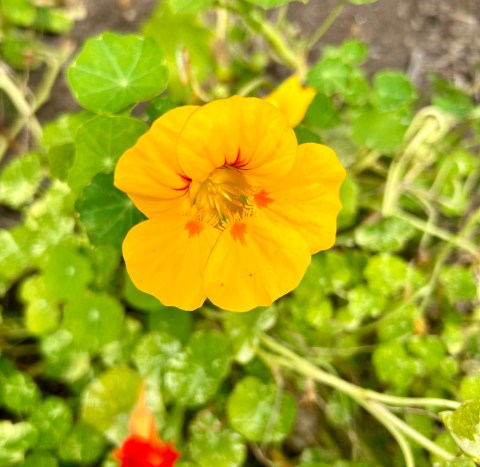
Edible flowers in the garden add an element for our tastebuds. The sweet-licorice flavor of anise hyssop, the peppery bite of nasturtium blooms, or the citrus notes of lemon thyme, all add to the multidimensions of the garden.

Grain Amaranth

Abundant Life Seed Foundation Gardens 1999

Tinker was involved with Abundant Life Seed Garden from its inception in the 1980’s until 2001. She and John Gilardi were garden managers in the latter years. In the above photo, Tinker and an apprentice named Nicole are stripping the flower heads of dried amaranth to remove the seeds. Next steps include winnowing and screening. Later amaranth was one of the crops Tinker experimented with in the dryland farm project.

 Amaranth’s importance is twofold—its super nutritious and easy to grow.

Unlike grains, the seeds of amaranth contain all the necessary amino acids. The protein content is 16 percent, more than rice or wheat. Like quinoa, this offers complete protein for vegans. Amaranth is considered a pseudograin (only plants in the grass or Poaceae family are considered true grains)

Grain Amaranth comes from one of three species. All are white-seeded whereas the leafy greens amaranth tend to have black seeds and may become weedy.

A. cruentus, Purple Amaranth: Day-length neutral and most widely adapted. Typically white-seeded from Mexico, this is made into “Alegria”, the popped seeds mixed with molasses pressed into a small cake or bar.

A. hypochondriacus, Prince’s-feather is day-length sensitive. I know little about this species.

A. caudatus , Love Lies Bleeding is native Peru. Sometimes called Inca wheat, it is an important staple in the Andes.

While young foliage can be confused with weedy amaranth, (A.hybridus, A. viridis, A. retroflexus. A. spinosus.) grain amaranth has apical panicles, or seed heads forming only at the top. Grain amaranth can withstand drought conditions because their roots can grow several feet deep.

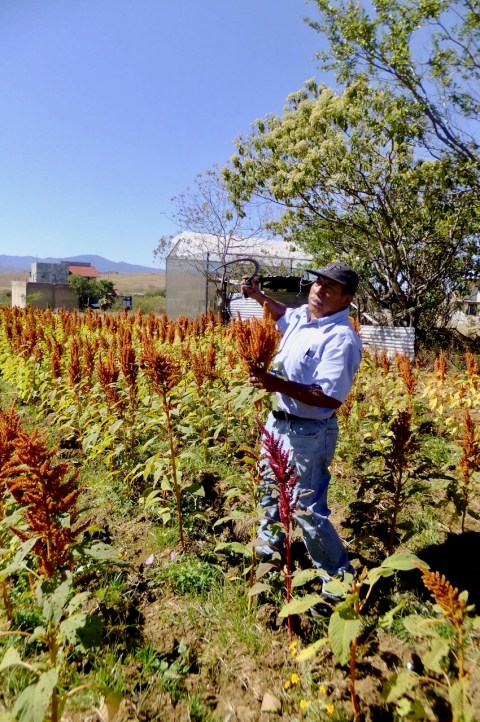
Early strains of A. cruentus were cultivated as far back as the time of the first maize in Oaxaca. The Jardin Etnobotanico de Oaxaca includes a section of early cultivated food crops. I was lucky to volunteer in the garden during the winter of 2019 and had the privilege to work with Roberto Chavez Rendon. Here he is with an early strain of Amaranthus cruentus.

Open-pollinated grain amaranth species can be variable. Many selected strains have full heads laden with seeds. Seed breeders are selecting for shorter plants that don’t shatter. University breeders are developing F-1 hybrids for food production.

Although claims vary, Amaranthus cruentus and A. hypochondriacus were cultivated before 1,000 BC in Mexico. Grain amaranth was an important food source from the Aztecs until European missionaries put a stop to eating or using amaranth in ritual. It is again popular and is best known as “Algeria” , the popped seeds mixed with molasses and pressed into a small cake or bar. An NGO in the Etla Valley of Oaxaca, Puente a la Salud promotes food sovereignty with a focus on grain amaranth not only for cakes but to add as an ingredient in many dishes ground into flour; boiled and used as a thickener in soups; toasted and popped as a cereal. They encourage farmers to grow the crop and teach communities how to make appropriate tech ovens and poppers for cottage industries with amaranth.

Amaranthus cruenthus. Farmer demonstrating harvesting with sickle.

Amaranth has the potential to be an important crop as we move into greater climate change. It is drought-, heat- and pest-tolerant. The nutty flavor can add more nutrients to oatmeal or ground into gluten-fee flour. Try growing this beautiful plant in the edible landscape, or in rows for production. Available from Adaptive Seeds, Bountiful Gardens and Johnny’s selected Seeds.

Joe-Pye Weed: Pollinator-friendly Perennial

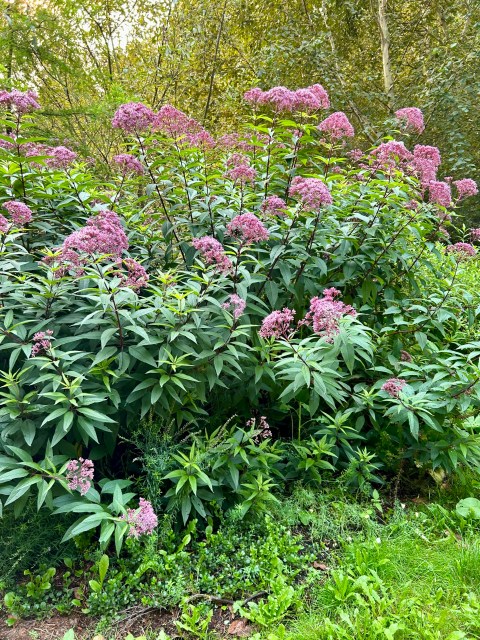
My earliest memories of Joe-Pye-Weed are from the coastal town in MA where I grew up. In late summer the purple flowers towered over other plants growing wild in what we then called swamps. I would bicycle down the country lane and cut stems of the flowers to make dried flower arrangements. Joe-Pye-Weed was likely named for  Joseph Shauquethqueat, a Mohican medicine man who cured settlers.

Although the plants are found throughout the East Coast on moist sites, they can tolerate drought conditions. For this reason, they make a good addition to our landscapes. A myriad of hybrids is available for this popular genus. Formally known as part of the genus Eupatorium, botanists have recently reclassified this group into a distinct genus, Eutrochium.

One hybrid has been bred to grow only 3 feet tall. They can grow in part shade and look more robust with regular watering. If the intention is to encourage them to be drought-tolerant, plant them in lots of compost. After three years divide the plants. They will ocassionally reseed, mostly they spread slowly from the crown.

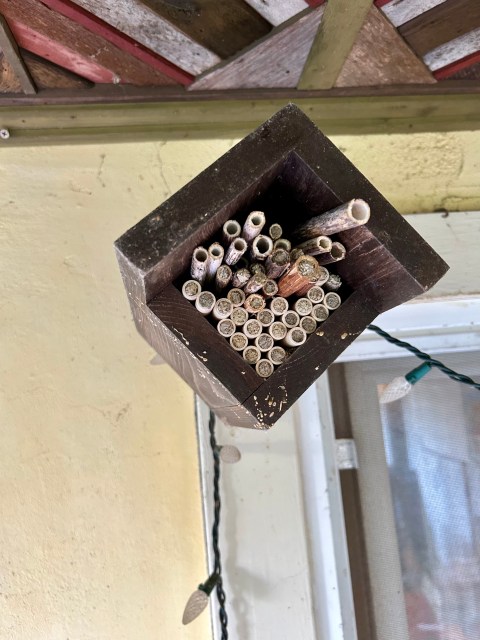
The 6 ft tall hybrid plants I have were divided from a friend’s clump. The hollow stems are a deep purple and after the perennial is finished for the season, these stems make excellent disposable tubes for Mason bee homes!

Landscape uses:

Consider this for outside the deer fence. Eupatorium works well with Miscanthus, perennial sunflower and cardoon for a dramatic late summer perennial display. After growing vigorously in spring and summer, they come into their own in August and September. Rain gardens need plants that can withstand inudated soils.

Other Uses

If you raise mason bees, see my earlier post, then the dried stems of this plant make great disposable nesting tubes for the mothers to lay their brood.The right photo shows the Joe-Pye stems on left and the purchased tubes on right.

Matilija Poppy

Romneya coulteri

This beautiful grey-grey foliage plant with fragrant large white poppies does best where it has room to spread. It is both drought tolerant and—knock on wood—deer resistant.

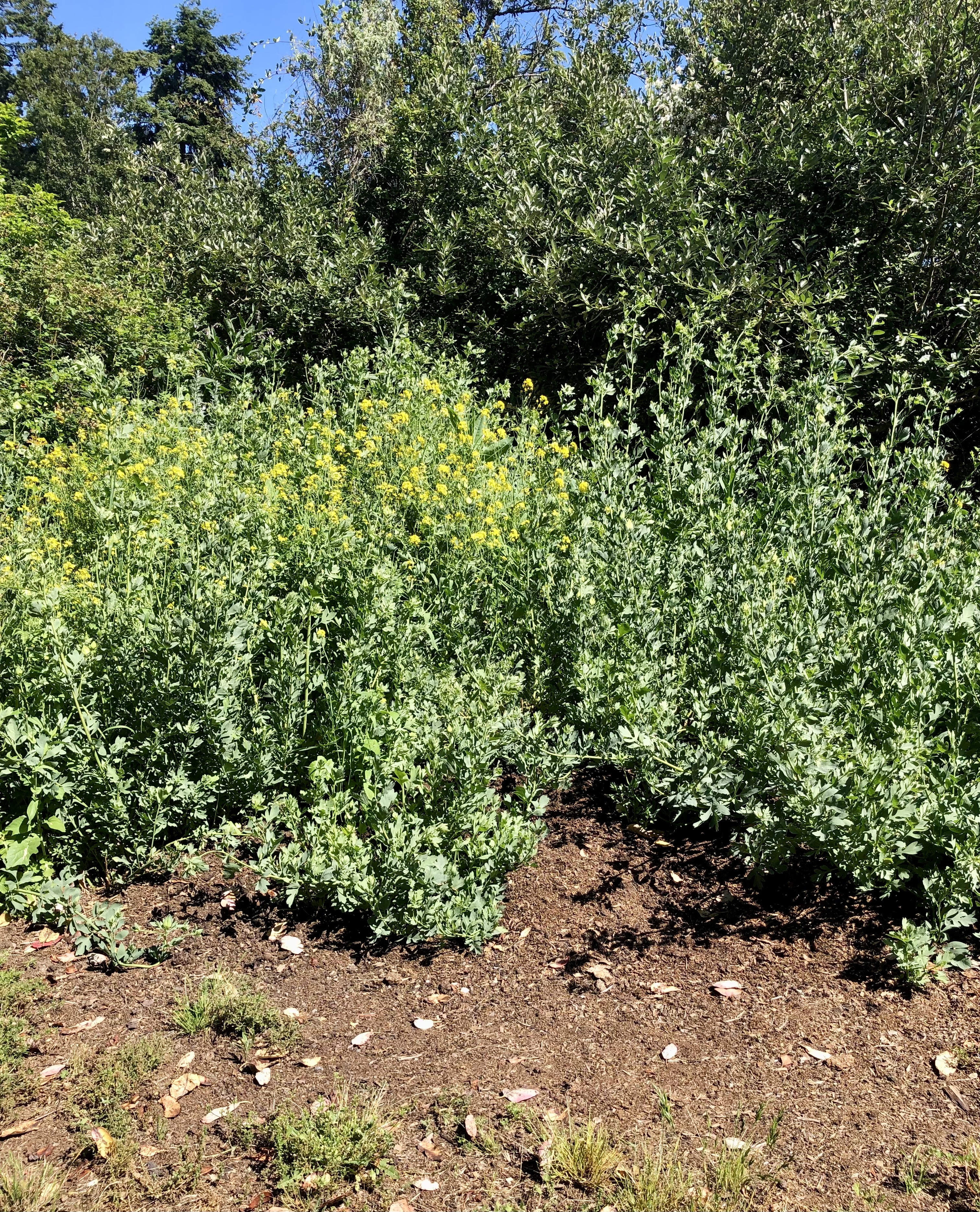
Matilija grows well on the loose soil of landslides. I planted some on a mound about 20 years ago and rarely weed it. After a time, the Nootka rose spread across the mound pushing out the poppy. Not much can hold its own against Nootka rose. (That’s why I only suggest it for creating wildlife hedges where it will be kept in check by mowing or weedeating lawns and fields.) Matilija poppy migrated over to a pile of soil and rotting sod. Last year I had a dump truck load of horse manure delivered near the Matilija planting. Some of the plants were buried in the manure. Instead of suffering, the plant spread throughout what was left of the manure after I moved most of it.

Description

  • Perennial flower growing 3 to 6 feet tall
  • Gray-green foliage
  • 4”-8”  fragrant flowers. Described as fried-egg flower

Growing requirements and care:

  • Full sun
  • Drought-tolerant once established
  • Soil: flexible, needs good drainage
  • Cut back to the ground in late fall

Matilija Poppy spread to adjacent aged-manure pile. Wild mustard’s yellow blossoms in the middle of plants.

The Chumash, an indigenous tribe of central -southern coastal California, values the antimicrobial properties. In fact the name Matilija comes from a Chumash tribal leader. The plant’s alkaloids and other secondary substances make it useful for sensitive gums and preventing plaque. Herbalist Micheal Moore describes Matilija as a good first aid plant: the foliage makes a good external wash for sunburn, and inflammation from allergic reactions. At one time this plant was seriously considered as the state flower of California.

In the landscape, plant this majestic plant with other tall drought-tolerant ornamentals like Miscanthus and cardoon. In the foreground use Russian sage, and red hot poker. Once established these are all deer-resistant.

Growing Flowers and Meeting Their Pollinators

My attitude about growing flowers changed the day I visited my friend Renee at her cabin in the Santa Cruz mountains, California. At the time I was a twenty-three-year-old horticulture student. I sat at her kitchen table, eyeing the room, when I noticed a bouquet on the kitchen table.

It was an arrangement of fragrant flowers with lavender, roses, delphinium, and baby’s breath. My internal dialog commented, “Oh those are probably from the UC Santa Cruz Farm and Garden.” It was a dismissive thought. You can’t eat them, what’s the point.

Then it dawned on me—I had picked those flowers and arranged this very bouquet, just two weeks before. My sister was then apprenticing at UCSC Farm and had invited me to gather a bouquet for Renee, a new mother. Stunned, I saw my bias. Flowers seemed frivolous, when I was on the revolutionary-edge of organic food growing in 1980.

That was the incident that changed my life, it was okay to love flowers as I always had. After getting my Horticulture degree, I apprenticed at Camp Joy in Boulder Creek, CA. I learned to sow seeds in wood flats;  tend young seedlings in the greenhouse; and plant them in double-dug raised beds.

Twice a week, before the sun rose over the mountain ridge, we harvested flowers and placed them in large tin cans in the shade of the gazebo. I was taught that the key to selecting young flowers was in the reproductive parts. I became skilled at noting if a flower’s stamens were moist with fresh pollen or not. Daisy-like flowers, with their disk and ray flowers were easy, once the secret was revealed. Bending down to look closely at the yellow center one could see if the rings of tiny flower parts were all open, if so then the flower was old. But if just a couple of outer rings of disk flowers were open, it was prime for harvesting.

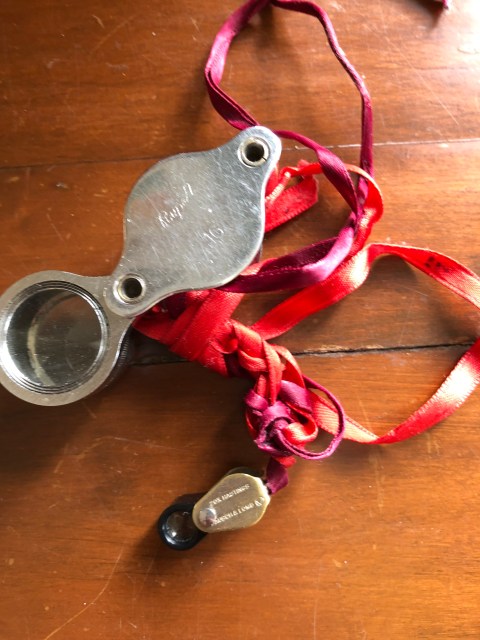
The day I purchased my 20-magnification hand lens, the world of insects opened up. Looking through this loupe was like landing on a planet. By placing the lens close to my face, my hand on my cheek bone to steady the lens, I moved in close,  a spaceship landing on a  miniature  floral world. The intricate textures of leaves, flowers and seeds were mesmerizing. I peered deeply into a flower chamber,  translucent in color, while male and female flower parts became giant. I imagined myself a tiny creature crawling over these exquisite sculptures.

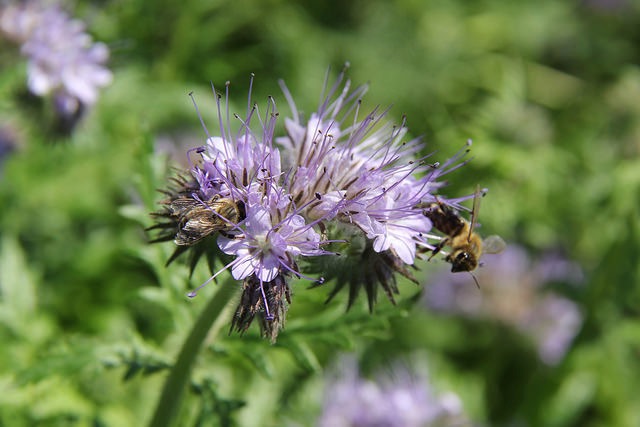
Honey bees on Phacelia

I had to study insects in the horticulture program, after all the little buggers ate our crops. But we also learned of beneficial insects–predators and pollinators. There was  humor in considering the caterpillar as a juvenile delinquent chomping on the parsley leaves, but then when the caterpillar metamorphosed into the Swallow-tail Butterfly, it pollinated flowers like a mature, contributing citizen.

Getting to know insects became part of understanding the garden ecosystem. Like a bird-enthusiast with binoculars, I sought insects with my lens. This requires patience! At first recognizing the different creatures based on their anatomy—wings and mouth parts being essential clues, eventually I moved on to noting their behavior.

Over the years I have watched green lacewings laying eggs; each on a solitary stalk. These predators are so voracious, the emerging young would eat the surrounding eggs if they were not out of the way. Also, I have seen lady bug larvae that look like giant Gila monsters gobbling up aphids. And no lie, I have watched aphids pop out live babies.

Lady bug larvae

Learning about pollinators in my backyard offered me the chance to slow down, and become curious. Did you know that a butterfly can taste with its feet? That when it lands on a petal that has nectar-bearing flowers that its siphon-like tongue unfurls? I have seen this. It takes patience, but watching insects is a form of miniature wildlife viewing.

Bees can see colors invisible to the human eye. Foxglove flowers have ultraviolet circles around maroon spots, marking a trail to lure pollinators deep into the trumpet bloom where a reward of pollen and nectar await.

The honey bee is but one of many kinds of bee. Native to the Mediterranean, and introduced around the world, it is a generalist, pollinating many flowers. And yet, it shares a characteristic with all bees that make them the premiere partner for flower pollination—floral fidelity. This means on any given foraging trip they only gather pollen from one species. Efficient for the insect and fundamental for the plant to produce seed, bees are the most important group of insects.

Scientists now know that bees are a keystone species–creatures necessary for the survival of other organisms in an ecosystem. Keystone species are referred to as the glue that holds a system together–without them an ecosystem may not be resilient enough to adapt to climate change. There are native flowers that depend on one or two types of bee to pollinate them.

Also, bees and other pollinators are responsible for food crop pollination. According to the USDA, bees, both honey and native are responsible for the pollination of 75 percent of fruits, vegetables, and nuts in this country. Another way to look at it is one out of every four bites of food can be traced back to pollinator services.

Jim Nelson at Camp Joy, a beekeeper, told me something I never forgot. “Imagine yourself tiny, the size a bee. As you approach a flat-topped white yarrow, a Sedum Autumn Joy, or a sunflower, you would see an  entire field of flowers.” A bee’s-eye view of the world makes me want to plant these flowers and patiently watch the insects that come foraging.