Designing a Native Hedgerow for the Quimper Peninsula

Before we begin, let’s distinguish between a hedge and a hedgerow. A hedge is typically made of one type of plant, often evergreen. Hedges are sheared to control the size and to form a dense green wall. This requires annual maintenance. (Lately in Port Townsend many hedges are browsed by deer, leaving the lower branches without foliage, and exposing the garden within. Homeowners  wishing to re-establish the visual screen place temporary fencing to restrict access and allow the foliage to regrow.)

Although hedges are useful in tight spaces, most plants are healthier when allowed to grow loosely allowing air and light within. Hedgerows are more diverse including several species and allowing for a mixture of plant types. The biodiversity encourages more birds and pollinators. Also, hedgerows may be several shrubs deep, with small trees on the outer perimeter.

Overview: Points to consider when designing a hedgerow

Dream big and then check in with yourself about how much you can accomplish, including the initial expenses and labor and then the ongoing upkeep. It may be better to plant a 30-foot section and determine how the plants are responding rather than plant the entire 150-foot hedgerow. 

The more you prep the site before planting the easier it will be to maintain. 

Determine how much competition from pests (deer, voles, invasive plants) and how much loss you  are willing to accept. Plan accordingly.

What to plant

I would strongly suggest using natives for the hedgerow’s backbone and adding plants from similar climates around the world as counterpoint. A combination of native and nonnative plants can offer a variety of fruits and seeds for birds. By using a combination of deciduous and evergreen plants you provide habitat for more creatures and seasonal variation, but for a dense visual screen year-round, plant all evergreens. One thing to keep in mind is a hedgerow of only one species can be more vulnerable to extremes of climate or to disease. One solution could be to form a tall row of one species and then a second row of mixed species.

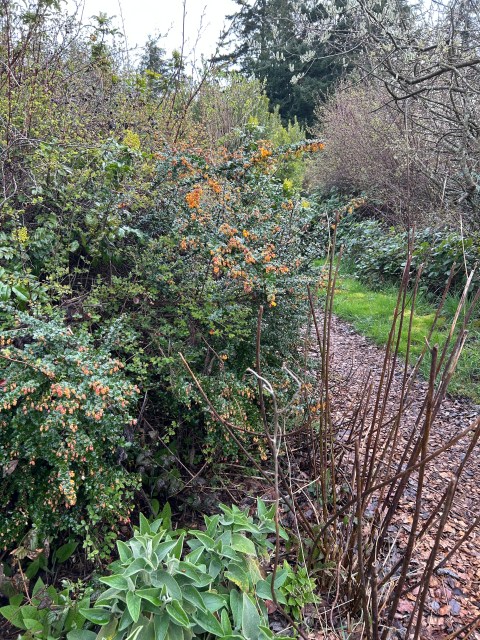
Below is a photo of a mixed plant screen including non-native Darwin’s barberry with Oregon grape in the foreground. Behind them are deciduous shrubs and immediately in front are perennial flowers. Across the path is a mowing strip and salal backed with more deciduous natives.
Trees in the hedgerow

Do you want to include trees in your hedgerow? If a windbreak is the goal, determine which direct the wind comes from. Our winter storms usually blow in from the south, wrapping around the east side of the Olympic Peninsula. In early spring when fruit trees are starting to bud, and cool-season vegetable starts are in the ground those winds can be a problem. If you need the windbreak on the south property line, consider planting trees farther apart than their mature size. The trees will slow the wind without making a wall of shade. By interspersing the hedgerow with smaller multi-trunk trees and large shrubs, sufficient sunlight will come through.

On my southern property line bitter cherry, Prunus emarginata volunteered and became established, threatening to shade out the orchard. Now every five years I have someone go through with a power hedge trimmer to lower the line of trees. (It was only after a number of years trying to control bitter cherry that I realized it spreads by rhizomes. In fact, these underground stems and roots can spread up to fifty feet from a tree and form dense thickets!)

Plant trees on the north side of the property to avoid shading surrounding gardens. Also, the coldest winter winds on the Quimper Peninsula occur when the polar vortex wobbles. A dip or a trough in the jetstream occurs and frigid air plunges south. In our case, the cold air pours down from the Fraser River Valley. Although this phenomena is not an annual event, it may become more common in time.

Potential native trees could include: shore pine, Pinus contorta var. contorta; serviceberry, Amelanchier alnifolia; Scouler’s willow, Salix scouleriana; and Garry Oak, Quercus garryana.

Patterned groups or natural mix within hedgerow

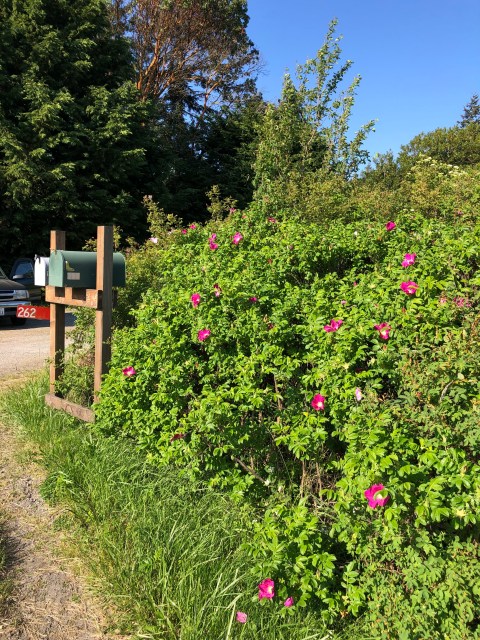
Most hedgerows are primarily functional, but if an attractive feature along a stretch of driveway is desired, consider planting several of one kind of shrub, say western mock orange, Philadelphus lewisii, interspersed with several Ceanothus thyrsifolrus” Victoria’, both drought tolerant. Or plant several Goumi, Eleagnus multiflora with beach rose, Rosa rugosa. While neither is native they provide fruit for birds and people.
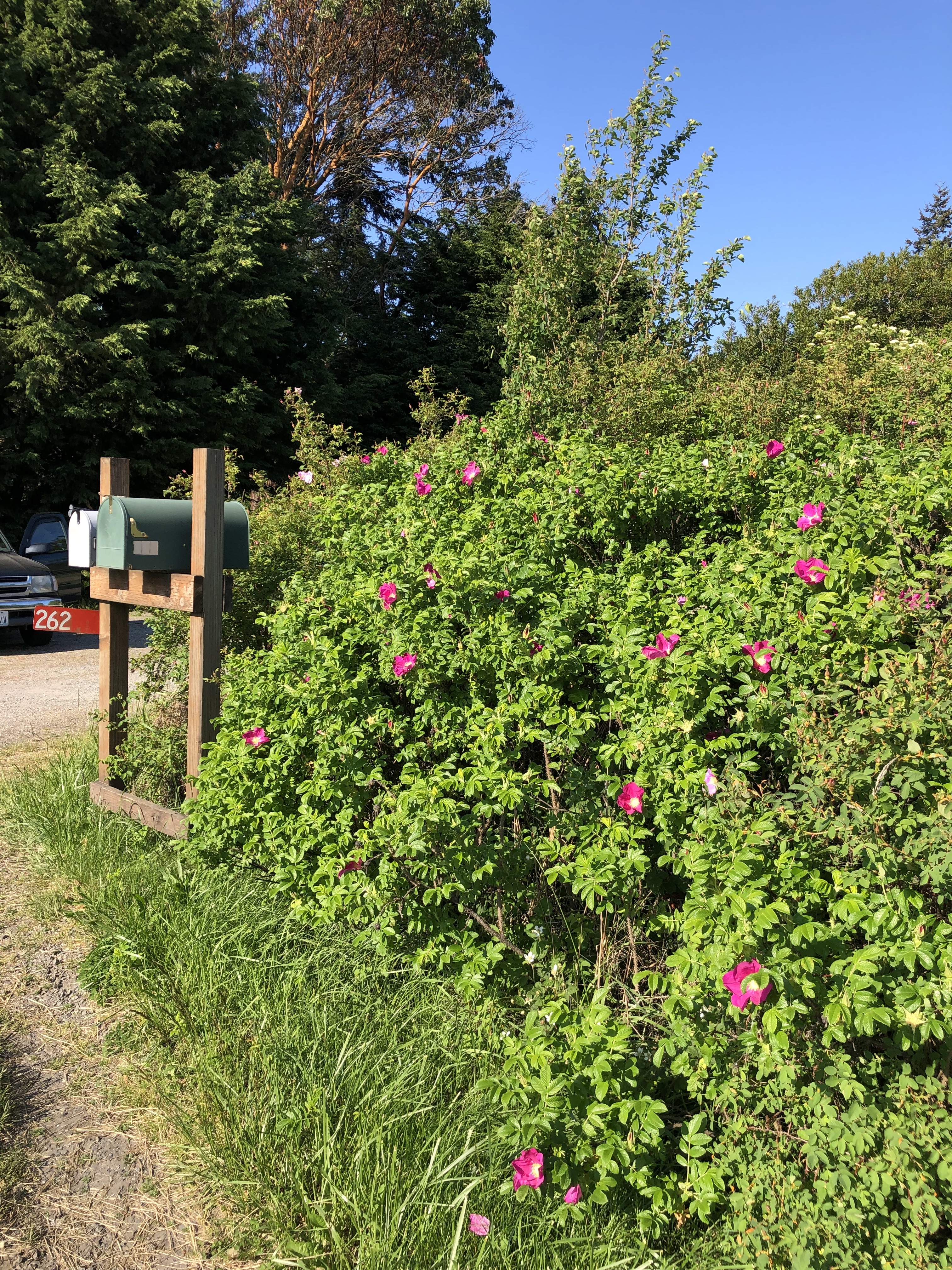
Deciduous Rosa rugosa forms a 15 foot stretch along the road

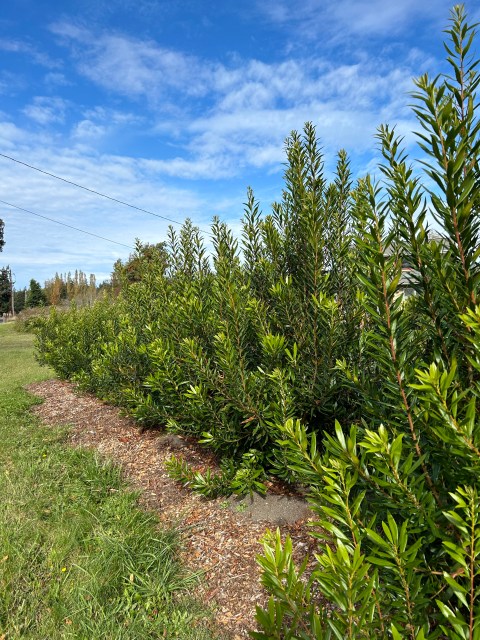
To create a more wild hedgerow, plant a mixed group of native shrubs like Nootka rose, snowberry, seviceberry, and mock-orange. Consider how long our deciduous native shrubs are without foliage and you will might want to add some evergreen shrubs, such as Pacific wax myrtle and Oregon grape.
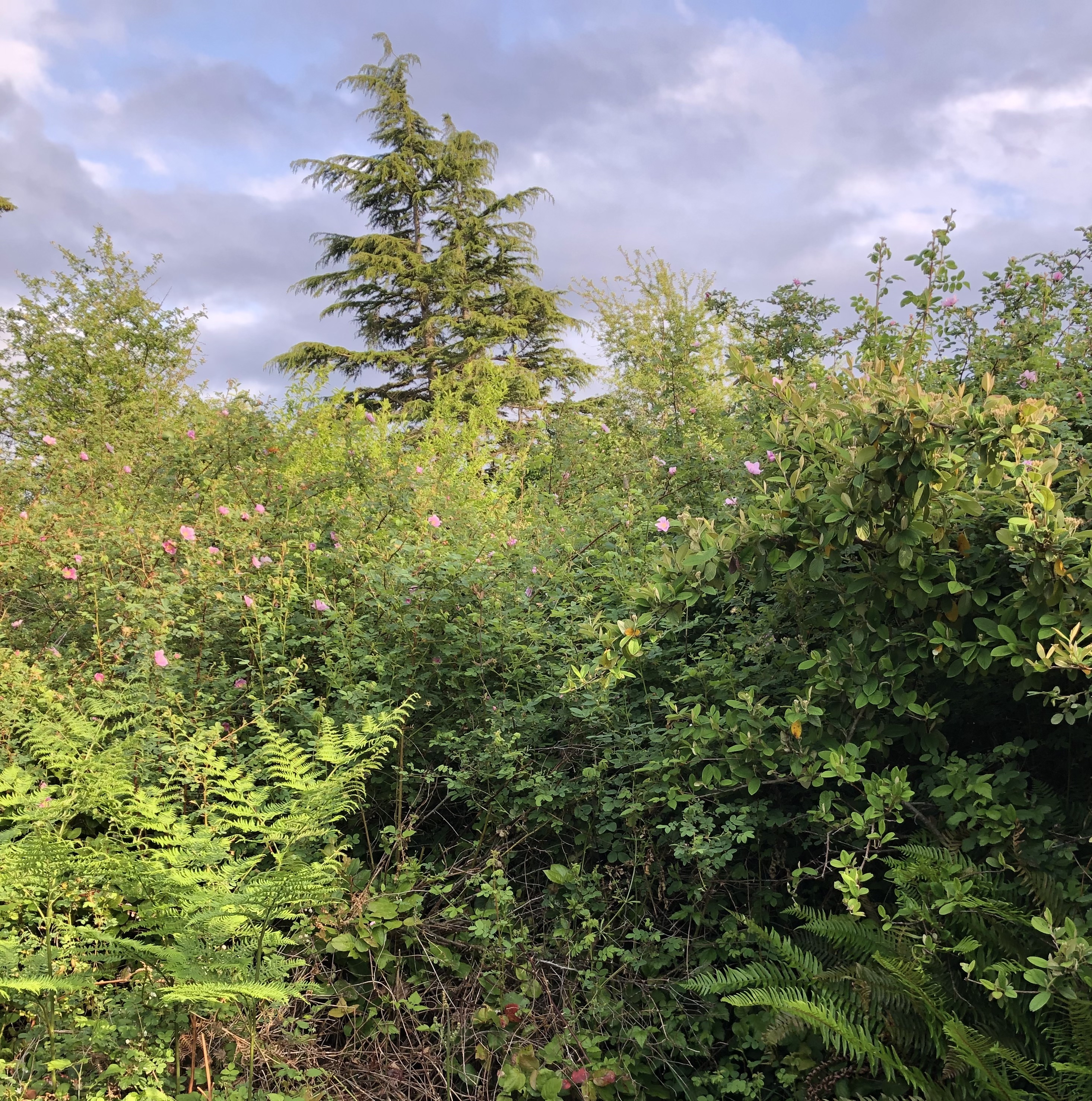
Deciduous natives and one ornamental evergreen; Cotoneaster lacteus.

Native deciduous shrubs with an ornamental evergreen Cotoneaster.

Hedgerow of native deciduous Shrubs

Create a plant list that grow well with your soil and light conditions. Note how large they well get within a desire time frame. Are you planning for the next three years or for decades from now? Most designs are based on plants at 8 to 10 years. One thing to keep in mind is…

More elaborate designs

I sometimes like to include ecological succession in my designs. By this I mean planting fast growing woody and herbaceous perennials, perhaps nitrogen-fixing ones like tree lupine, Lupinus arboreus, that fill the space quickly and flower abundantly but then die out as the shrubs and trees fill in. Other potential plants include tree mallow, Lavatera trimestris; Lemon Queen perennial sunflower, Helianthus ‘Lemon Queen’; and Joe-Pye-weed, Eutrochium purpureum.

Shorter, pollinator-friendly additions could include California poppy, yarrow, and asters. Many herbs like rosemary and sage could be planted along the sunny edges. One important limiting factor is how much competition these perennials will have with the existing vegetation you are planting into.

Designing on paper or on the ground

Once you have a list of plants you like (See the post—) that work well with your site, design on paper or directly on the ground. How ambitious is your hedgerow design? Do you imagine planting hedgerows around the entire site? I always advise starting small and building on successes. The design can be created at once but the installation depends on a number of factors. What are your constraints? Maintenance: How will you keep down competing vegetation? Water: How will you water during the first couple of summers? Deer browsing: Fence an entire planting or individual plants? Finances: bare root seedlings or larger nursery-grown potted plants? (John Barr, a gardener extraordinaire, used to say that buying a 5-gal shrub means you are paying someone else to tend to the plant for a number of years.)

Pick out two to three kinds of native deciduous shrubs, two or three kinds of native evergreen shrubs, and one or two non-natives. Do you want to stagger plants in several rows?

Some people work better directly on the ground; it is difficult for them to imagine the hedgerow on paper. For these people, measure on site with tape measure or pace out the distances. Mark out two or three rows and then place a large rock or garden pot to indicate each plant. See the post: Hedgerow Plants for Jefferson County, available February 2026.

Road right-of-way and power lines

Many property lines end some distance from the adjacent road and are bordered by county property known as right-of-way (ROW) . Also there may be ROW between you and your neighbor that could be vacated. Learn more about it here. If you want to plant near power lines it is best to stick with shrubs. Trees growing more than 15-feet-tall should be kept away from power poles and lines. Refer to Jefferson PUD guidelines and look at the picture brochure from Puget Sound Energy.
Hedgerows: an introduction

What is a Hedgerow?

A hedgerow has been described as a long, narrow forest. Or a boundary, a green fence, an enclosure for livestock, or a bio-diverse habitat between paddocks. A cultivated transition from one zone to another. The lines people have drawn across the landscape. The term itself comes from the British Isles where thickets along fields are treasured as natural habitat and historic significance. They even have their own preservation society!

Some of the hedgerows I planted in the late ‘80s are 35 years old now and I have made mistakes. The upkeep of hedgerows that are fifty-to-one-hundred years old gives me pause. Imagine a culture where a hedgerow is a respected part of the landscape—where they are planted with future generations in mind.

Robert Macfarlane wrote Landmarks, a book of terms for the cultivated and wild landscape. Although it is about the British Isles, it stirs the imagination about a language for a sense of place. By capturing these terms from an agrarian time before they are completely lost, he provides a glimpse of how people have known their land.

There is a page devoted to old terms used for hedgerows. ‘Smeuse’ refers to the gap at the base of a hedge created by the regular passage of small mammals. ‘Buckhead’ is a term for cutting the entire hedge within two-three feet of the ground and ‘bullfinch’ is a hedge that is allowed to grow tall without any ‘laying’ a horticultural technique of pruning and bending the woody thicket to keep it dense.

When I bought my property, it was enclosed with old cedar posts and barbed wire. It had been logged over and was kept mowed or perhaps grazed by a few head of cattle. Any existing hedgerow vegetation was simply where the tractor mower couldn’t get close to the fence.

My goal in planting hedgerows was to create more privacy. I had just arrived from owning a farm in the Ozarks where we planted saplings to create a riparian corridor along a creek that tended to flood. Planting trees and shrubs seemed a natural part of caring for land. We had not heard of permaculture or agroforestry, we had wanted to plant trees for preventing erosion, and future fence posts, and habitat for wildlife.

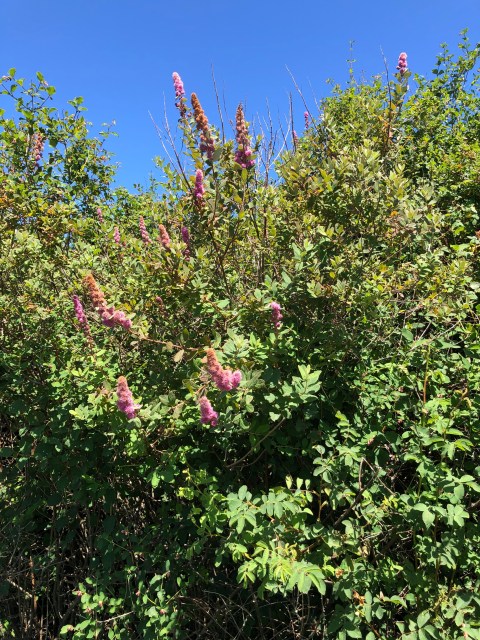
Spirea douglasii

If you are thinking of planting a hedgerow, ask yourself some questions and try to answer the best you can. What are your goals and how much time and energy are you willing to devote to the project? If you have big dreams and only little resources, phasing the project over several years will be more satisfying. If you want the hedgerow to perform too many functions, you might over burden the design.

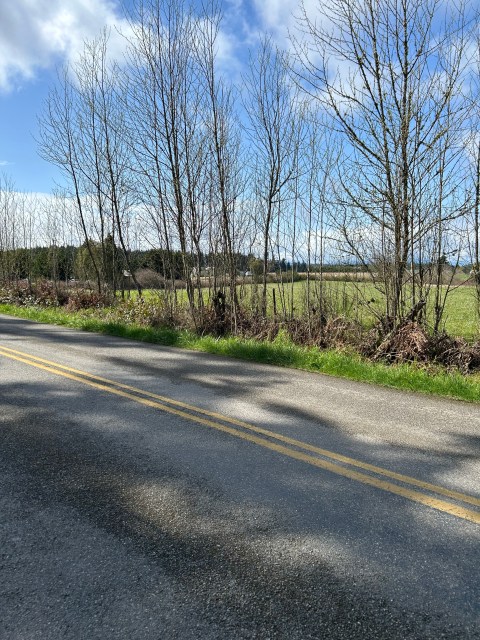
All over Jefferson County we see volunteer hedgerows that sprang up along the edges of fields. Nobody planted them, and they are thriving habitat for pollinators, birds, and small mammals.

Trees volunteer along fence lines where mowers can't control them.
Bitter Cherry, Prunus emarginata

Let’s assume your primary goal is privacy, then you can create screening or a visual barrier. By selecting mostly native plants, the hedgerow can also be pollinator-friendly, drought tolerant (once established), and provide bird habitat. If on the other hand, you want to plant hedgerows on a working farm where they will perform functions such as livestock-proof, green fences, or restore and protect degraded streams, you might want to look at the Thurston County Cooperative Extension’s  Hedgerow Toolkit.

Next see: Designing a Native Hedgerow


Late-Autumn Garden Chores

Late autumn usually brings the most precipitation to Port Townsend and the eastern part of the Olympic Peninsula. Atmospheric rivers dump rain. Strong winds blow and fallen leaves swirl. The sun is low in the sky.

The winter vegetable garden is producing, but most growth happened before the fall equinox. Garden beds covered with hoops and floating row covers will be protected from frosts. Fresh salad greens, kale, Swiss chard, and leeks  can be harvested throughout the winter. Monitor vegetables for slugs and cut worms. The wet weather favors slugs and snails. Get them now and there will be less generations come spring. Also cut worms are a problem and can be found during routine weeding.

Fruit Trees

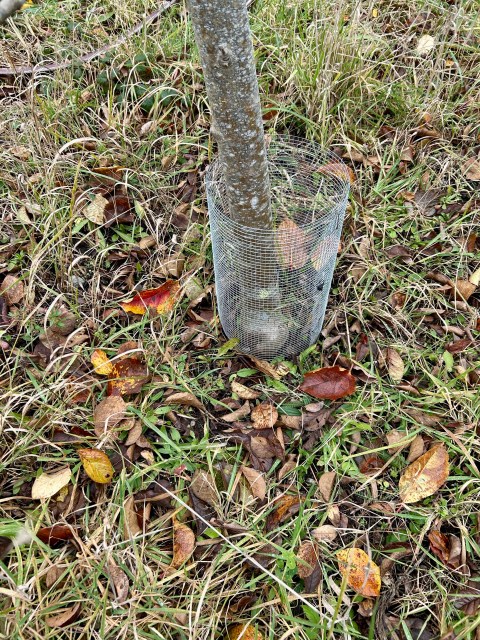
Keep the base of young trees free of tall grass. Better yet, place mulch around the trunks. Winter is the time when voles chew bark and roots. If you have a serious vole problem wrap the trunks with hardware cloth to prevent the rodents from gnawing the bark. Some gardeners even use pea gravel as a mulch to discourage voles.

Late winter is a better time for pruning apple and pear trees, ornamentals and raspberries. The reason not to prune now is because we could have a warm, sunny spell in January that could encourage plants to grow—only to be blasted by a deep cold in early February. Better to wait until mid- February for most pruning. Because wet weather promotes bacterial and other diseases, many gardeners prune plums and cherries after flowering during a sunny spell.

This is a good time for large garden projects that warm the body. Pushing wheelbarrows of manure, woodchips, and  making large compost piles. Building planter boxes and retaining walls. Cutting down dead trees or cutting up branches for firewood or hauling them to the yard-waste facility. If you live in the woods, think about a larger tree-free area around the home as future fire-prevention.

Going within

And then there are times to slow down, take walks and notice the birds. Different birds are here for the season. Watch for Pacific wren, red-breasted nut hatch, northern flicker, pine siskin, golden-crown kinglet and spotted towhee.

Winter is a good time to dream about the garden. A garden mentor once said that the garden is forgiving—we can always try again next year. It’s a time to think about rearranging perennial beds and planting more drought tolerant flowers. Or perhaps it is time to think about  simplifying a high maintenance garden. For some gardeners seed catalogs arrive in January and planning the edible gardens begin. Now you can think about how you can extend the season or create a garden sanctuary.

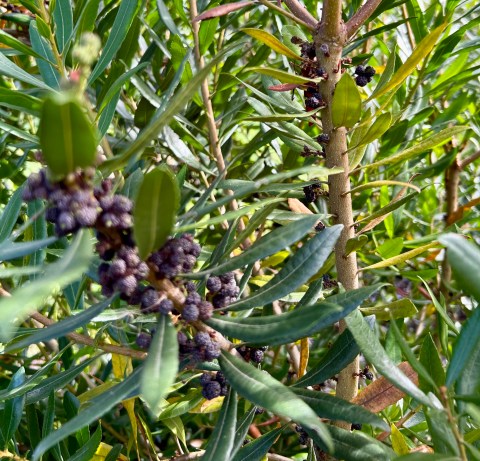
Pacific Wax Myrtle: resilient native evergreen

Pacific wax myrtle, Morella californica, is native to the coastal areas of Washington state and south to California. It is considered on of the best evergreen native shrubs for our gardens. Although the flowers are inconspicuous, the waxy black fruits are popular with birds. Knock-on-wood it is still deer resistant.

This hardy native is adaptable to many conditions from full sun to shade. Although it prefers moist, well-drained soil, it can grow in a variety of soils. The root nodules have nitrogen-fixing microorganisms that allow the plant to grow in poor soil.

Once established it is completely drought tolerant. It will grow to 30 feet tall and 15 feet wide in thirty years. For the average size garden, pruning will keep it within bounds. Late winter is best for heavy pruning, then general shaping can be made with heading-back cuts through out the season. This remarkable shrub can be pruned as a formal hedge, a loose screen or even a small tree. As a screening hedge, Pacific Wax Myrtle provides habitat for a multitude of birds including Spotted towhee, several sparrows, northern flicker, robin, goldfinch and cedar wax-wing. The latter are especially delightful in winter when small flocks gather on the shrubs. The waxy berries provide vegan fat in the winter.

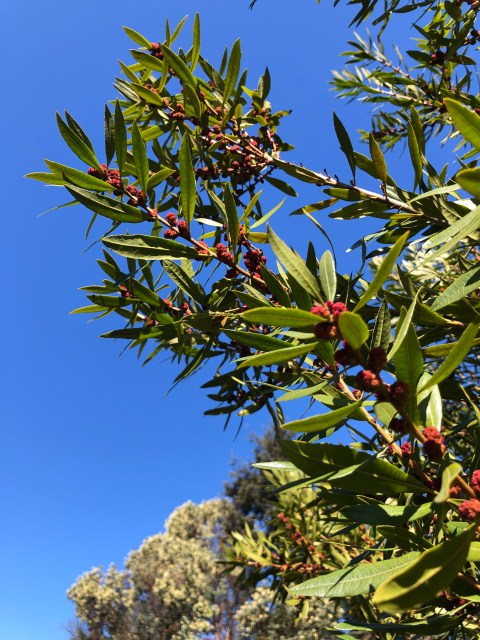
Morella californica blooming in May

Pacific wax myrtle is slow to grow at first and once established, it grows steadily. Here the tiny flowers are blooming. Within these red catkins are separate male and female flowers. To see a close up and more photos go to the OSU landscape plant descriptions. This website provides excellent plant descriptions. I have not found anything like it in Washington.

For the longest time I didn’t think any disease bothered this shrub, but I noticed some foliage die back and even some stems turning brown. The Pacific Northwest Pest Management Handbook describes a type of leaf blight caused by a phytopthera that only bothers this species. This fungal-like organism was first identified as a pest in 2009 on the Oregon coast. I have been growing several shrubs at my place for thirty years and have only noticed it recently. Some ways to prevent spreading the disease:

  • Avoid overhead watering.
  • Mulch with arborist chips
  • Increase air circulation at the base of the plant by removing weeds or other vegetation.
  • Remove any diseased plant material and throw it in the garbage, don’t compost it,
  • Don’t over-fertilize and don’t fertilize late in the season.
  • Sanitize tools with isopropyl alcohol, or prepare a mix of 1 part bleach to 9 parts water. Dip tool or wipe with moistened rag.
  • Water to get the shrub established and then only monthly during summers to grow a hedge or screen.

The leaves make a pleasant tasting tea that is medicinal. The active medicinal substances include an astringent resin. The root and bark can be tinctured and used for inflamed gums according to Michael Moore’s Medicinal Plants of the Pacific West. The plant’s botanical name was changed in 2006. Previously it was known as Myrica californica.

A native plant adaptable to sun or shade and varying soil conditions, one that can synthesize it’s own nitrogen is bound to be more resilient!

Rainshadow Gardening on glacial sediments

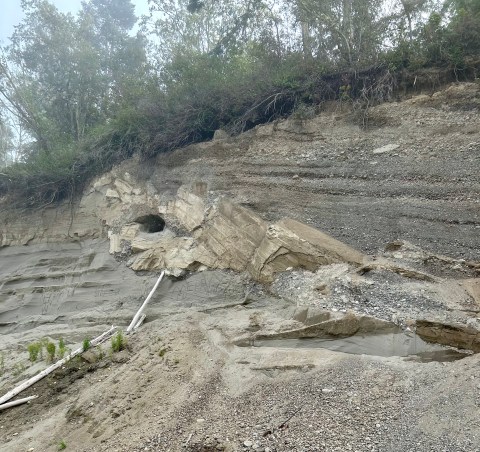
Looking at the natural history of our area deepens our sense of place and helps us grow more resilient gardens. Climate, geology and ecology have shaped the land. Tinker would always comment on the landslides along the bluff between North Beach Park and Point Wilson lighthouse. She enjoyed reading the landscape and imagining the geologic forces at work.

By looking at the bluff, we see what is below the surface of much of Quimper Peninsula, and begin to understand our soils. The above photo shows layers of deposited sediment.

Just imagine—a massive sheet of ice 3,000 ft deep covered East Jefferson County, 15,000 years ago. This last glacier bulldozed and deposited rocks, gravel, and sand. The beach bluffs reveal that much of our soil is glacial deposits. There are pockets of clay, sand and a bit of sandy loam. The thin topsoil is often sandy, gravelly loam. If this intrigues you, check out the Quimper Geological Society!

If you have ever felt your garden soil is not as good as it could be, you are not alone! Most areas of the Puget Lowlands are too young for deep topsoil. ( Of course there is prime agricultural land that formed on marine terraces or alluvial outflow from rivers.) A soil profile is a cut through section of the land revealing topsoil, layers of subsoil and  even bedrock. Soil scientists dig profiles to examine the existing soil.

The curious gardener can look online for a digital copy of the 1975 soil survey of the county, where aerial photographs are overlaid with maps roughly indicating soil types and descriptions. I have an old paper copy that I highly value.

Again, this is just a brief summary and I am no expert! The climate working on the land determines the native flora. The Puget Sound area has mild winters and cool dry summers, and is commonly known as a Mediterranean climate. Winter rains tend to be continuous and light to moderate rather than heavy downpours. The marine layer—a deep, low cloud bank is a defining feature.

Rainshadow

What makes our area unique is that the Olympic Mountains block the moisture-laden clouds coming from the Pacific. The west side is a rainforest while the northeast side, in the shadow of the mountains is rainshadow. I have seen native Opuntia fragilis on the Quimper Peninsula and on Whidbey Island. Port Townsend’s average rainfall is around 20 to 23 inches. Often the marine layer breaks apart late in the day.

Prevailing winds  from the Pacific often reach us from the south and southwest. As the clouds move around the Olympics, dumping precipitation from Olympia to Brinnon, they are wrung out by the time they reach Port Townsend. Eastern Jefferson County is largely a peninsula on a peninsula. It juts out to the northeast and catches the winds from the south. Mostly in summer winds blow from the northwest down the Salish Sea.

Arctic Blasts

In general our gardens are more prone to winter damage when arctic blasts roar down through the Fraser River Valley of British Columbia. It used to be that we only needed to track this during El Niño- Southern Oscillation years but the polar vortex is wobbling now and this leads to less predictability. Last winter we had cold temperatures that were the lowest in 30 years. Keeping an eye on the weather allows us to bring out sheets or burlap to cover plants. Even wind-blown Doug fir boughs shield vulnerable plants.

Moving here in 1988, with a background in organic horticulture, I was very curious about weather. Trying to get a grasp on seasonal cycles and weather, I asked many questions. It seemed like every season someone would say “This is the coldest summer” or “This is the wettest spring,” or “Its the driest winter”—I could not find a predictable pattern!

But there were and still are weather trends: Spring came early and lasted until the fourth of July; summer was somewhat predictable for August and September, although any day could become rainy and windy. Then autumn arrived. The snow was visible on the mountains until September. Several people who grew up here said the mountains were always snow-covered when they were children.

What I recall is the first snowfall would brighten the Olympic Mountains by mid-October, and might bring a cold snap to sea level, with occasional early frosts. Then mild weather would return for much of October. Often November would be the rainiest time of the year. Temperatures would get cooler and cooler until a frost. The darkest time of the year was and still is late November, December and January.—the sky colored many shades of gray. But then storms blew in from the south, after wrapping around the Olympics, bringing windy weather and sun-breaks in the dramatic skies. Red flowering currant could bloom as early as mid-February. There does seem to be an increased occurrence of multi-year La Nina. Nature magazine 2023.

Resilient Gardens

Climate change is real and part of gardening is responding to the changes. We live in a place for garden lovers, where flowers can bloom in the winter and a large number of evergreen shrubs thrive. The native vegetation offers a plethora of interesting plants for our gardens. Berries and fruit trees thrive in our mild climate. Winter vegetable gardens provide leeks and greens all winter. Knowing that most soils here are excessively well-drained and that we can’t rely on summer rains, drought-tolerant ornamentals are a smart choice. Tinker respected our rainshadow ecosystem. Here is how she grew resilient gardens:

  • Recognizing the importance of the soil ecosystem
  • Caring for the soil through making compost & sheet mulch
  • Selecting plant varieties that are bred for pest-resistance
  • Growing open-pollinated heirlooms that we can nurture as landraces
  • Developing a strong curiosity about our local weather
  • Committing to living lightly on the Earth, however we define it

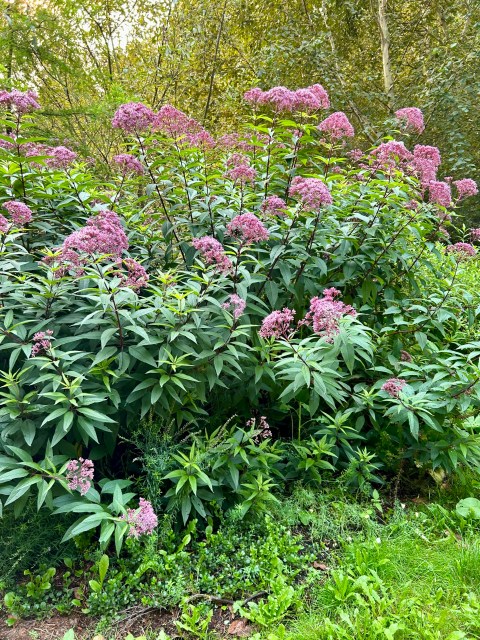
Joe-Pye Weed: Pollinator-friendly Perennial

My earliest memories of Joe-Pye-Weed are from the coastal town in MA where I grew up. In late summer the purple flowers towered over other plants growing wild in what we then called swamps. I would bicycle down the country lane and cut stems of the flowers to make dried flower arrangements. Joe-Pye-Weed was likely named for  Joseph Shauquethqueat, a Mohican medicine man who cured settlers.

Although the plants are found throughout the East Coast on moist sites, they can tolerate drought conditions. For this reason, they make a good addition to our landscapes. A myriad of hybrids is available for this popular genus. Formally known as part of the genus Eupatorium, botanists have recently reclassified this group into a distinct genus, Eutrochium.

One hybrid has been bred to grow only 3 feet tall. They can grow in part shade and look more robust with regular watering. If the intention is to encourage them to be drought-tolerant, plant them in lots of compost. After three years divide the plants. They will ocassionally reseed, mostly they spread slowly from the crown.

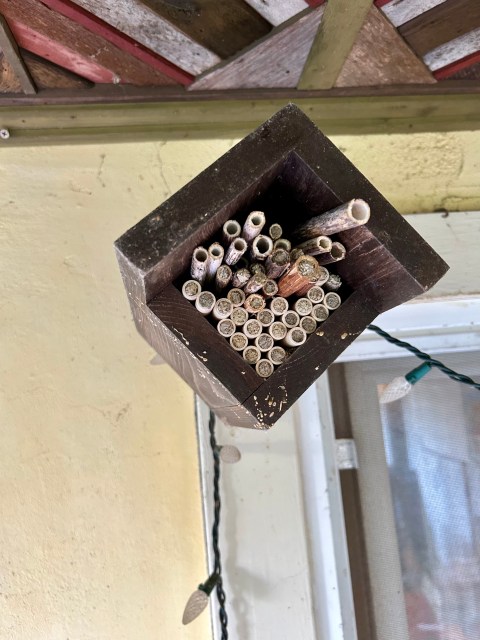
The 6 ft tall hybrid plants I have were divided from a friend’s clump. The hollow stems are a deep purple and after the perennial is finished for the season, these stems make excellent disposable tubes for Mason bee homes!

Landscape uses:

Consider this for outside the deer fence. Eupatorium works well with Miscanthus, perennial sunflower and cardoon for a dramatic late summer perennial display. After growing vigorously in spring and summer, they come into their own in August and September. Rain gardens need plants that can withstand inudated soils.

Other Uses

If you raise mason bees, see my earlier post, then the dried stems of this plant make great disposable nesting tubes for the mothers to lay their brood.The right photo shows the Joe-Pye stems on left and the purchased tubes on right.

August in the Garden

By August the garden is often humming along on autopilot, although sometimes the garden (or more likely the gardener) feels tired by late summer. This year, July only got a bit of rain on the last day. The current forecast for the remainder of August is cooler than normal— great for the cool-season vegetable starts, but not so encouraging for the warm season crops that have just started to pump out vegetables like zucchini, beans and tomatoes.

This is a time to reflect on garden priorities. What thrives in your garden? Do you have an intention or a vision for it? Are you in a phase of expansion or contraction? This changes with how the garden matures and ages along with our own interests and energy levels. Walk around and make notes. Beth Benjamin, one of my favorite garden teachers from when I was an apprentice at Camp Joy, in the Santa Cruz Mountains, always said, “The garden is forgiving. Next year we can try again or change how we garden.”

Garden Chores

Shrubs and Trees: Don’t add any more fertilizer that is high in nitrogen to shrubs and trees. Plants need to harden off before the winter cold settles in. All-purpose natural fertilizer with fertilizer ratios in single digits are okay. Apply the last fertilizer to roses by mid-August. Aged compost is also okay.

Perennials: Continue deadheading, ease up on watering and fertilizing. Consider which large perennials could be divided and moved around to fill in gaps in the garden. Determine which plants are aligned with your watering regime. Plan to move or divide perennials in September or October.

Rockrose: They typical rock rose, Cistus hybridus tops out at 3 ft. But, here in Jefferson County can grow to 5 ft. and sprawl. Older shrubs can be completely renovated. Remove dead branches and then prune with a combination of thinning and heading cuts. Sometimes these plants can be pruned into artistic sculptural forms. Remove splayed and sprawling branches.

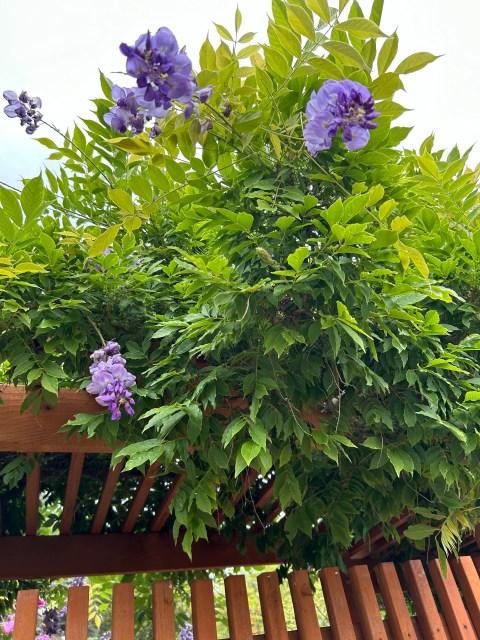
Wisteria: flowers better if pruned regularly. Prune the vine now after flowering and also when the vines are dormant in January/February. Now cut back new growth, leaving five or six leaves on a branch. This will encourage flower buds. In the winter cut back to three buds. These become spurs that will flower next year.

Wisteria was cut back about 2 weeks ago after prolific flowering earlier. Pruning encourages vines to grow flowering spurs

Raspberries: Summer bearing canes (floricanes) that have finished fruiting on the previous seasons wood. Cut these canes to the ground and remove. Any new growth thinner than a pencil should be prune to the ground. Then look at the canes that started this year—primocanes. Select 6-8 canes per plant spaced about  3-4 inches apart. When the plants go dormant in winter cut these canes back to just above top wire. These will produce lateral flowering and fruiting branches next summer.

Fruit Tree late summer pruning: Plum and cherry. Did your trees grow vigorously this summer? If so, prune back branches that pumped out two feet or more new growth. This can reduce next year’s vegetative vigor and encourage fruit buds. But if the tree grew moderately, then wait until winter or even after next year’s flowering before pruning. Poorly executed summer pruning can stunt a tree.

Apples: Sometimes apples get in a cycle of over-producing fruit one year and then the next one the tree is recuperating and has no fruit. Biennial fruit-bearing can happen for numerous reasons. If too many fruit form one year and are not thinned out then the tree doesn’t have the energy to form many flowers the next year. Some  apple varieties  like Honeycrisp and heirloom Brambley Seedling are naturally biennial fruiting. Other trees fall into this pattern through lack of nutrients, irregular watering, or one winter frost destroys the blooms. RHS always has good information. Thinning flowers (once you confirm they are pollinated) is more effective than thinning young fruit. Advanced gardeners can look at the Royal Horticulture Society’s post on summer pruning of apples and pears.

Hairy Manzanita

Arctostaphylos columbiana

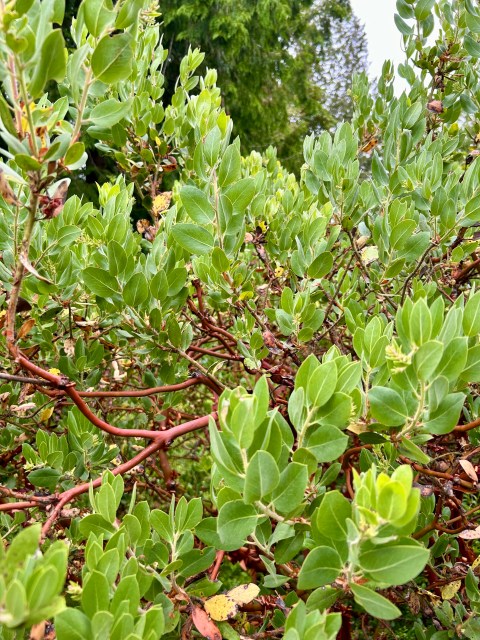
This native manzanita is uncommon on the Quimper Peninsula , but I have seen it growing wild on Cape George Road and close to Kala Point. The above photos are of a shrub that Willy Smothers grew at his place on Marrowstone Island. Recently Janet Welch pruned it to highlight the beautiful peeling bark.

The tiny ‘apple-like’ fruits are eaten by birds, small mammals and patient gardeners. It grows in the coastal scrub community and its range is from Sonoma County, California to Vancouver Island. Along with shore pines, manzanita can grow on and stabilize sand dunes. Native specimens can also be found in the understory of open coniferous forests in the Cascades. The critical factor is gravelly soil. The peeling bark is an attractive feature that it shares with its cousin Madrone. However, it is more closely related to our native groundcover kinnikinnick, Arctostaphylos uva-ursi. In fact a hybrid called Arctostaphylos x media is cross between the two.

Care for Manzanita

Manzanita rewards the patient gardener. Select a site with full sun and excellent drainage. It is best to start with plants in one-gallon containers. Water weekly until new growth appears and then taper off. One way to avoid crown rot is to plant it a little bit higher than the existing grade and mulch with woodchips. Don’t mulch with compost. Use drip irrigation because overhead water will encourage fungal disease. Keep it on the lean-side and avoid adding soil amendments. Once established it is completely drought tolerant.

Here is another manzanita, a hybrid, (probably Arctostaphylos x media) used in the landscape of Kathleen Turaski and Peter Hornsby This drought-tolerant garden includes Ceanothus and red hot poker, Kniphofia. They hope to remove the deer fencing once the plants are mature. But realistically, they may need to keep the fence in place—even if deer don’t browse a plant to death, they often step on and break branches of nearby plants.

Oregon State University, Horticulture Dept has many more photos, including pictures of the flowers and fruits. A great new native plant nursery opened in Kingston. Salish Trees Nursery carries hairy manzanita. Their knowledgeable staff will be a great help. Far Reaches Nursery has a superb variety of Arctostaphylos densiflora—Howard Mc Minn.

This hybrid Manzanita is an excellent drought tolerant choice
Manzanita flowering in April

Native Berry Plants in the Landscape

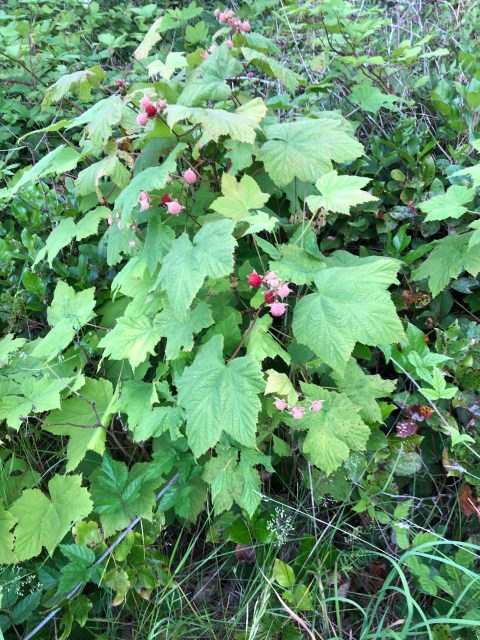
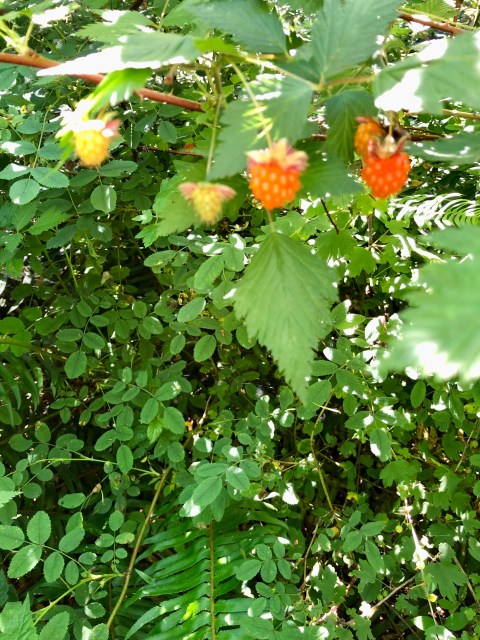
July is the time of wild berries here in the Pacific Northwest. The Rubus clan, best known for raspberry and blackberry also include many other members with edible fruits. Two woody shrubs that are fruiting now are Thimbleberry, Rubus parviflorus, and Salmonberry, R. spectabilis. These two edible berries were staples of native peoples. Around here, harvesting thimbleberries is a summertime pleasure. Children love to place the thimble-like fruit on their fingertips.

On the Quimper Peninsula I have only seen these two Rubus species growing on moist sites, but in some regions wild thimbleberry may occur on drier sites. In Jefferson County the water table is close to the surface in low-lying areas creating wetlands. These plants are also commonly found along stream sides, and can withstand being flooded for short periods of time, thus making these shrubs useful in the rain garden. They can also be part of restoration landscapes. The deer browse the buds and stunt newly planted shrubs. Fencing, caging or spraying deer repellent for a few years is necessary for them to get established. The local deer population has suffered from loss of habitat and loss of predators.

Salmonberry, Rubus spectabilis

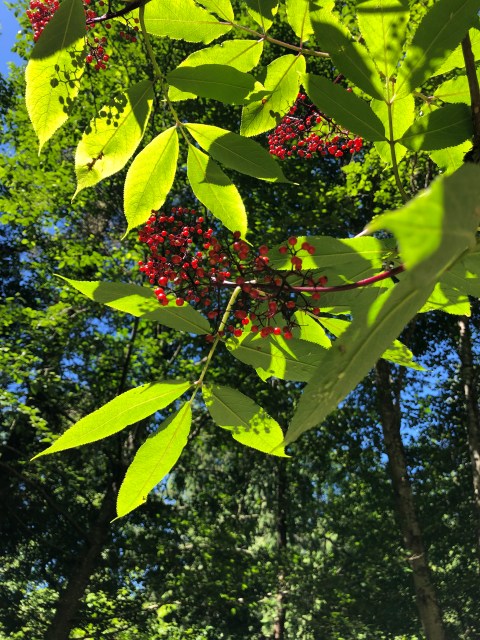
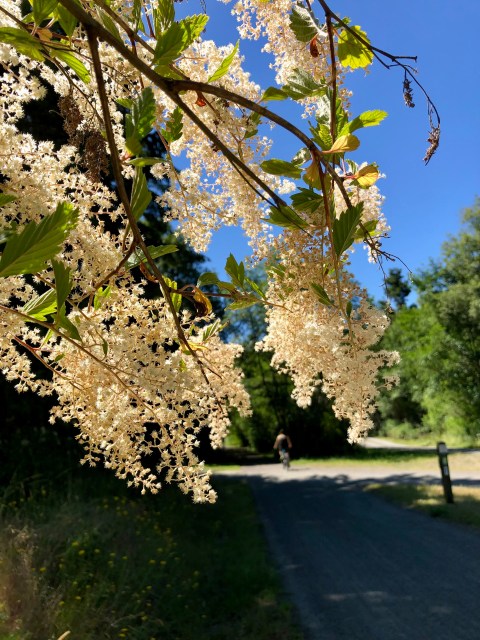
Another coastal native that’s fruiting now is red elderberry, Sambucus racemosa. The white flower cluster of has a pyramidal shape This berry can be edible if cooked, but I have never tasted it. Raw berries can cause nausea. All other parts of the plant are toxic. This plant grows easily in all soils and sun or shade.

Red Elderberry, Sambucus racemosa

(Blue elderberry, Sambucus nigra caerulea has white flower clusters that are flat. It is an edible, medicinal and ornamental plant.)

Other iconic berries will fruit soon including salal and huckleberry, stay tuned!

July in the Garden

Oceanspray, Holodiscus discolor has cascading clusters of tiny cream-colored flowers.

Summertime has arrived on the Olympic Peninsula’s rainshadow! Native shrubs like Oceanspray, Holodiscus discolor and Hardhack, Spirea douglasii are blooming. Others are fruiting: salmonberry, thimbleberry, and red elderberry The garden is filling out with lush greens, and warm-season crops are starting to develop and mature. Just yesterday I saw a garter snake with a big black slug in its mouth.

Edible Garden

Winter garden: Select beds that have finished producing and replenish with compost. Rotating crops prevents diseases from building in the soil.

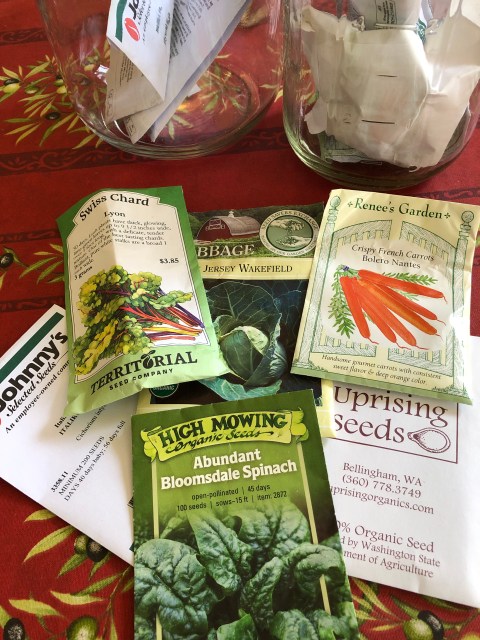
Time to direct sow brassicas and greens, beets and carrots. Varieties: Purple sprouting broccoli, Lacinato and Red Russian Kale, Early Jersey Wakefield cabbage, Winter Density lettuce, Abundant Bloomsdale spinach, Bolero carrots.

Make sure to leave room for your garlic crop that can be planted in November.

Tomatoes: Remove suckers and continue staking.

Weeding: Make a quick pass once a week to eliminate weeds. Some weeds can be companion plants, however they also compete for nutrients, water and light.

Curing garlic: Harvest garlic bulbs when 4-5 leaves are still green, taking care not to damage them. Over-watering or leaving them in the ground too long causes the bulbs to split or become prone to disease. Fresh garlic is fragile. Clean the garlic by gently pulling down the top leaf and removing it from the bulb. ( If the leaf has signs of rust, be sure to throw away the skins instead of composting to prevent spreading the spores.) Brush soil from roots.Drying in a well-ventilated place takes a couple of weeks. Check the stems and when no green remains inside, they are safe and should store well.

Strawberries: Renovate June-bearing varieties (not the everbearing, day-neutral ones). Cut to 2-3 inches. Mowing can accomplish this. Cut out and remove weak and crowded plants. Fertilize with a balanced natural blend like Down To Earth.

Flowers: Save seed from annuals and biennials including: nasturtium, bachelor buttons, foxglove, calendula and bread-seed poppies, cosmos. Dry them in a cool dark place and label the envelope with plant, and date.

Landscape

Time to review the garden. If some plants didn’t make it after the last couple of years of climate ups and downs, maybe replacing part of the landscape with natives could be on your horizon. If you have lots of space maybe it’s time to consider planting a hedgerow that will help slow the wind or screen the road.

Bulbs: Order bulbs  in the next few weeks to plant in the fall. This is especially true if you want to plant some more unusual bulbs. When they arrive check the bulbs to ensure there is no disease or damaged bulbs. Store them in a cool dark place until you are ready to plant. I often order from Johnny Scheepers. Another company, that is good and local is RoozenGaarde.

Irrigation: Determine which plants need extra care and keep their roots growing. Many established shrubs won’t need any water until August, but in the first couple of years a plant will develop nicely and be healthier if it is watered regularly. If plants look weak or diseased, give them a boast with compost and liquid seaweed fertilizer.

Lawns: Port Townsend homeowners have long had an unspoken agreement that green lawns are not a requirement for a beautiful landscape. A well-kept yard is often mowed until mid-July and then the grass goes dormant and the hawkweed or dandelions provide food for pollinators. When the autumn rains return, our lawns green-up again. At that time, spread dolomite lime. This provides calcium and magnesium as well as making the soil less acidic and more inviting for grass. In fact, many people prefer not to have lawns. But if grass is already there, allow it to go dormant.