Late-Autumn Garden Chores

Late autumn usually brings the most precipitation to Port Townsend and the eastern part of the Olympic Peninsula. Atmospheric rivers dump rain. Strong winds blow and fallen leaves swirl. The sun is low in the sky.

The winter vegetable garden is producing, but most growth happened before the fall equinox. Garden beds covered with hoops and floating row covers will be protected from frosts. Fresh salad greens, kale, Swiss chard, and leeks  can be harvested throughout the winter. Monitor vegetables for slugs and cut worms. The wet weather favors slugs and snails. Get them now and there will be less generations come spring. Also cut worms are a problem and can be found during routine weeding.

Fruit Trees

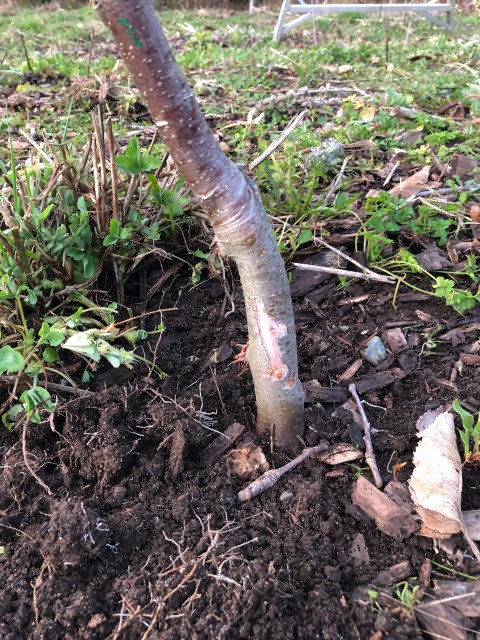
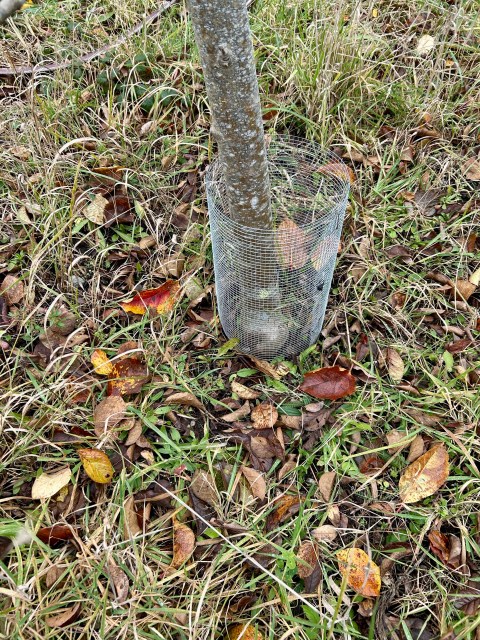
Keep the base of young trees free of tall grass. Better yet, place mulch around the trunks. Winter is the time when voles chew bark and roots. If you have a serious vole problem wrap the trunks with hardware cloth to prevent the rodents from gnawing the bark. Some gardeners even use pea gravel as a mulch to discourage voles.

Late winter is a better time for pruning apple and pear trees, ornamentals and raspberries. The reason not to prune now is because we could have a warm, sunny spell in January that could encourage plants to grow—only to be blasted by a deep cold in early February. Better to wait until mid- February for most pruning. Because wet weather promotes bacterial and other diseases, many gardeners prune plums and cherries after flowering during a sunny spell.

This is a good time for large garden projects that warm the body. Pushing wheelbarrows of manure, woodchips, and  making large compost piles. Building planter boxes and retaining walls. Cutting down dead trees or cutting up branches for firewood or hauling them to the yard-waste facility. If you live in the woods, think about a larger tree-free area around the home as future fire-prevention.

Going within

And then there are times to slow down, take walks and notice the birds. Different birds are here for the season. Watch for Pacific wren, red-breasted nut hatch, northern flicker, pine siskin, golden-crown kinglet and spotted towhee.

Winter is a good time to dream about the garden. A garden mentor once said that the garden is forgiving—we can always try again next year. It’s a time to think about rearranging perennial beds and planting more drought tolerant flowers. Or perhaps it is time to think about  simplifying a high maintenance garden. For some gardeners seed catalogs arrive in January and planning the edible gardens begin. Now you can think about how you can extend the season or create a garden sanctuary.

October Garden Chores

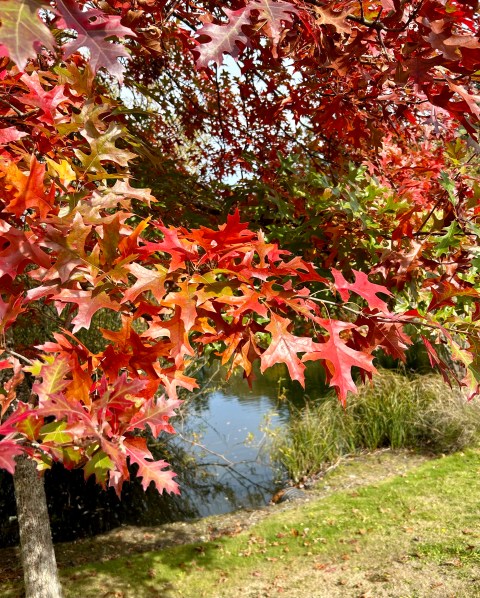
We know it’s autumn when the leaves start turning color. Here a Pin Oak brightens the landscape. It’s time to harvest winter squash and pumpkins, but if your squash isn’t quite ready, perhaps it will have time to continue ripening.

In Port Townsend, our typical first killing frost arrives by the end of November. If autumn temperatures drop slowly over time, plants get acclimated. The high concentration of sugars acts as ‘antifreeze’ in the protoplasm and this is what gives kale and other crops a sweeter flavor after the first frost. But if warm weather prevails until a sudden hard frost hits, then plants are not prepared. Sometimes in November the temperature can suddenly drop twenty degrees! Next month pay attention to the weather forecast and be ready to use floating row covers on crops and newly planted broad-leaf evergreen ornamentals. Forecasts for the next three to six months seem to be leaning toward La Niña but one forecaster described it as “a weak event”. NOAA posted this

Garden Chores

  • Leaves: Rake and compost, or save for mulch.
  • Lawns: Over-seed existing ones with white clover, yarrow, English daisy and other flowering plants for pollinators.
  • Mulch: shrubs and garden beds for winter protection and weed suppression. The increased organic matter will eventually feed the soil ecosystem. (This repeat from last month reinforces how important it is!)
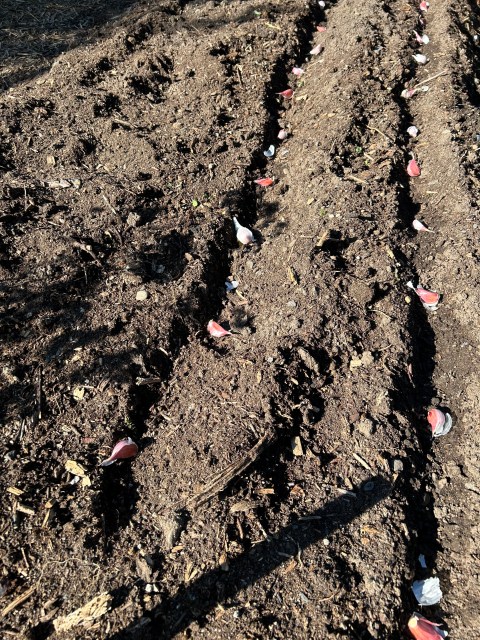
  • Plant garlic: 2” deep in well-drained soil. Space cloves 5 inches apart with the tip up. Mulch with straw. Prevent disease by rotating crop every 3-5 years. Certified disease free garlic or saving your own is best.
  • Fruit Trees: Rake and remove any diseased dried leaves, rotten- and mummy-fruits to prevent disease.
  • Apple tree pests: Examine fruits for coddling moth larvae damage. The Hortsense link offers preventative measures for next year.
Tinker and apprentice Brianna at Abundant Life Seed Foundation in 2001. Upper Salmon River squash

Winter squash can be slow to fully mature. One way to encourage this is to remove all small and new squash in September. This allows all the energy to go to the larger, more mature squash. The signs that a squash is mature include a bright yellow spot where the squash touched the ground, the stem becomes brown and corky-textured. Also, as the squash skin toughens up, it becoming duller, and even a bit waxy. It may difficult to make an indentation with your fingernail. These contribute to a good storage crop.

Tinker loved growing the Lower Salmon River winter squash. This variety of Cucurbita maxima is one of the few heritage crops from the PNW, and is known from the Salmon River area of Idaho. It has a distinctive flavor and texture. Seeds are available from Adaptive Seeds.

If you want to taste Lower Salmon River, Midori Farm grows it and the Food Co-op has some now. It takes about 90 days to mature. It can withstand a couple of light frosts although the first one will probably kill the foliage. For Cucurbita maxima aficionados, check out this Johnny’s Seeds critique of flavor and yield for varieties.

After the fall equinox, plant growth slows. We have not had frost yet in early October 20224, so crops are still growing well. Plants are able to sense cold temperatures and respond by producing carbohydrates. In vegetable crops, the high concentration of sugars acts as ‘antifreeze’ in the protoplasm and this is what gives kale and other brassicas a sweeter flavor after the first frost. For more on winter gardens see the OSU Extension Publication

Pacific Wax Myrtle: resilient native evergreen

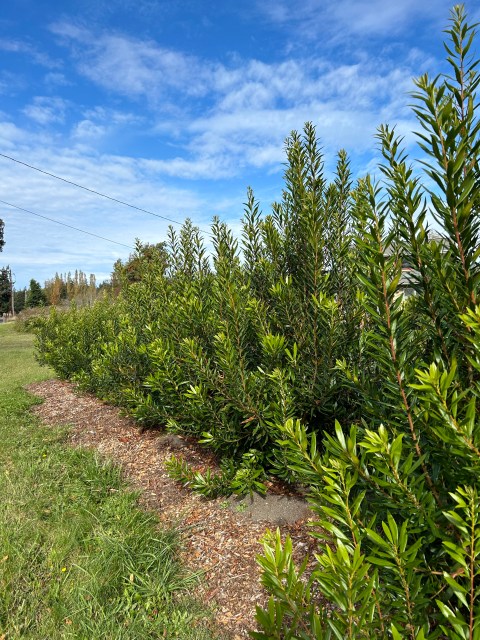
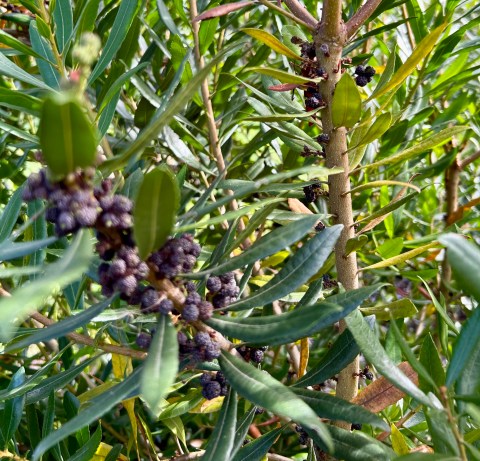
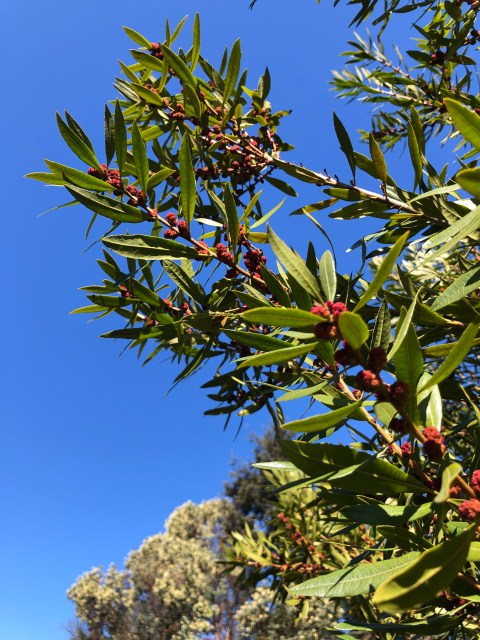
Pacific wax myrtle, Morella californica, is native to the coastal areas of Washington state and south to California. It is considered on of the best evergreen native shrubs for our gardens. Although the flowers are inconspicuous, the waxy black fruits are popular with birds. Knock-on-wood it is still deer resistant.

This hardy native is adaptable to many conditions from full sun to shade. Although it prefers moist, well-drained soil, it can grow in a variety of soils. The root nodules have nitrogen-fixing microorganisms that allow the plant to grow in poor soil.

Once established it is completely drought tolerant. It will grow to 30 feet tall and 15 feet wide in thirty years. For the average size garden, pruning will keep it within bounds. Late winter is best for heavy pruning, then general shaping can be made with heading-back cuts through out the season. This remarkable shrub can be pruned as a formal hedge, a loose screen or even a small tree. As a screening hedge, Pacific Wax Myrtle provides habitat for a multitude of birds including Spotted towhee, several sparrows, northern flicker, robin, goldfinch and cedar wax-wing. The latter are especially delightful in winter when small flocks gather on the shrubs. The waxy berries provide vegan fat in the winter.

Morella californica blooming in May

Pacific wax myrtle is slow to grow at first and once established, it grows steadily. Here the tiny flowers are blooming. Within these red catkins are separate male and female flowers. To see a close up and more photos go to the OSU landscape plant descriptions. This website provides excellent plant descriptions. I have not found anything like it in Washington.

For the longest time I didn’t think any disease bothered this shrub, but I noticed some foliage die back and even some stems turning brown. The Pacific Northwest Pest Management Handbook describes a type of leaf blight caused by a phytopthera that only bothers this species. This fungal-like organism was first identified as a pest in 2009 on the Oregon coast. I have been growing several shrubs at my place for thirty years and have only noticed it recently. Some ways to prevent spreading the disease:

  • Avoid overhead watering.
  • Mulch with arborist chips
  • Increase air circulation at the base of the plant by removing weeds or other vegetation.
  • Remove any diseased plant material and throw it in the garbage, don’t compost it,
  • Don’t over-fertilize and don’t fertilize late in the season.
  • Sanitize tools with isopropyl alcohol, or prepare a mix of 1 part bleach to 9 parts water. Dip tool or wipe with moistened rag.
  • Water to get the shrub established and then only monthly during summers to grow a hedge or screen.

The leaves make a pleasant tasting tea that is medicinal. The active medicinal substances include an astringent resin. The root and bark can be tinctured and used for inflamed gums according to Michael Moore’s Medicinal Plants of the Pacific West. The plant’s botanical name was changed in 2006. Previously it was known as Myrica californica.

A native plant adaptable to sun or shade and varying soil conditions, one that can synthesize it’s own nitrogen is bound to be more resilient!

September Garden Chores

The fall equinox is approaching quickly. The weather is changing. Autumn offers opportunities to plant and transplant; the soil retains warmth longer than the air can—a perfect combination for encouraging root growth. With cooler temperatures and short day length, plant growth slows. The roots have a chance to get established without the additional stress of transpiration or pumping water through plant and out the leaf surfaces.

Autumn is a great time to make compost piles with debris from the vegetable garden, perennial plants and deciduous leaves. Some people prefer to leave the dead foliage and seed heads for spring removal allowing insects and birds food and habitat overwinter. Try it, but note that adding garden clean-up to normal spring chores might overwhelm some gardeners.

Edibles

Fruit trees: Most tree fruits are ripe when they come off easily by lifting and twisting the fruit. Take care not to break off the short branch with buds known as a fruit spur. Cut open an apple —ripe seeds are brown. Pears are picked when they are still hard, before they are fully ripe. They soften from the inside out. Asparagus: Let the fronds remain and turn yellow. Cut them back to the ground after a hard frost. If you have an excess of produce, try making sauerkraut or kraut-chi.

Soil Fertility

Soil Samples: Every couple of years it is worthwhile to take a soil sample and get it tested. Although Jefferson Conservation District no longer handles soil testing, they do lend a tool for extracting clean samples and lab suggestions including A&L. I’ve had good luck with Peaceful Valley Farm Supply.

Compost: Build compost piles in bins or free-standing rectangles. All the autumn decaying foliage from the veggie garden, perennials, and deciduous leaves. Add a source of Nitrogen: manure; powdered fish or bloodmeal; or urine.

Mulch shrubs and garden beds for winter protection and weed suppression. The increased organic matter that will eventually feed the soil ecosystem.

Cover-cropping: After removing spent vegetables, rake the soil, add seeds of clover,  field peas, oats, rye, vetch, or fava beans. More information from WSU All seed available at Chimacum Corner.

Pests

Yellow jackets

Recognize yellow jackets and their underground nests. In the autumn listen for buzzing if there are more than two yellow jackets in a location, step back and search the ground for more. Yellow jackets can sting repeatedly. By contrast, bees avoid stinging because it is lethal, it rips out their stinger. Learn to distinguish them.

Spring Bulbs

Plant bulbs and corms now for spring bloom. The earliest bloomers are the small bulbs: snowdrops, crocus, chionodoxa, Siberian squill and winter aconite. Select bulbs that are firm with no signs of injury or mold. If one bulb is lightweight compared to  others, discard it. Plant with root side down and pointy end up. Plant at depth three time the length. Small bulbs often are earliest. See Royal Horticulture Society for more information.

Grain Amaranth

Abundant Life Seed Foundation Gardens 1999

Tinker was involved with Abundant Life Seed Garden from its inception in the 1980’s until 2001. She and John Gilardi were garden managers in the latter years. In the above photo, Tinker and an apprentice named Nicole are stripping the flower heads of dried amaranth to remove the seeds. Next steps include winnowing and screening. Later amaranth was one of the crops Tinker experimented with in the dryland farm project.

 Amaranth’s importance is twofold—its super nutritious and easy to grow.

Unlike grains, the seeds of amaranth contain all the necessary amino acids. The protein content is 16 percent, more than rice or wheat. Like quinoa, this offers complete protein for vegans. Amaranth is considered a pseudograin (only plants in the grass or Poaceae family are considered true grains)

Grain Amaranth comes from one of three species. All are white-seeded whereas the leafy greens amaranth tend to have black seeds and may become weedy.

A. cruentus, Purple Amaranth: Day-length neutral and most widely adapted. Typically white-seeded from Mexico, this is made into “Alegria”, the popped seeds mixed with molasses pressed into a small cake or bar.

A. hypochondriacus, Prince’s-feather is day-length sensitive. I know little about this species.

A. caudatus , Love Lies Bleeding is native Peru. Sometimes called Inca wheat, it is an important staple in the Andes.

While young foliage can be confused with weedy amaranth, (A.hybridus, A. viridis, A. retroflexus. A. spinosus.) grain amaranth has apical panicles, or seed heads forming only at the top. Grain amaranth can withstand drought conditions because their roots can grow several feet deep.

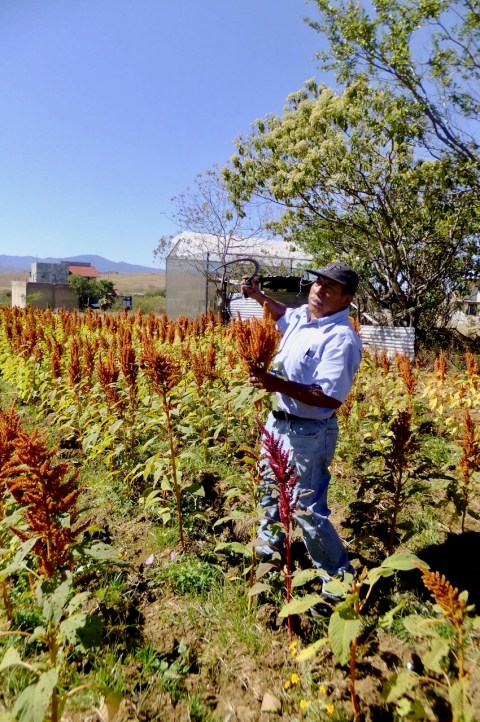
Early strains of A. cruentus were cultivated as far back as the time of the first maize in Oaxaca. The Jardin Etnobotanico de Oaxaca includes a section of early cultivated food crops. I was lucky to volunteer in the garden during the winter of 2019 and had the privilege to work with Roberto Chavez Rendon. Here he is with an early strain of Amaranthus cruentus.

Open-pollinated grain amaranth species can be variable. Many selected strains have full heads laden with seeds. Seed breeders are selecting for shorter plants that don’t shatter. University breeders are developing F-1 hybrids for food production.

Although claims vary, Amaranthus cruentus and A. hypochondriacus were cultivated before 1,000 BC in Mexico. Grain amaranth was an important food source from the Aztecs until European missionaries put a stop to eating or using amaranth in ritual. It is again popular and is best known as “Algeria” , the popped seeds mixed with molasses and pressed into a small cake or bar. An NGO in the Etla Valley of Oaxaca, Puente a la Salud promotes food sovereignty with a focus on grain amaranth not only for cakes but to add as an ingredient in many dishes ground into flour; boiled and used as a thickener in soups; toasted and popped as a cereal. They encourage farmers to grow the crop and teach communities how to make appropriate tech ovens and poppers for cottage industries with amaranth.

Amaranthus cruenthus. Farmer demonstrating harvesting with sickle.

Amaranth has the potential to be an important crop as we move into greater climate change. It is drought-, heat- and pest-tolerant. The nutty flavor can add more nutrients to oatmeal or ground into gluten-fee flour. Try growing this beautiful plant in the edible landscape, or in rows for production. Available from Adaptive Seeds, Bountiful Gardens and Johnny’s selected Seeds.

August in the Garden

By August the garden is often humming along on autopilot, although sometimes the garden (or more likely the gardener) feels tired by late summer. This year, July only got a bit of rain on the last day. The current forecast for the remainder of August is cooler than normal— great for the cool-season vegetable starts, but not so encouraging for the warm season crops that have just started to pump out vegetables like zucchini, beans and tomatoes.

This is a time to reflect on garden priorities. What thrives in your garden? Do you have an intention or a vision for it? Are you in a phase of expansion or contraction? This changes with how the garden matures and ages along with our own interests and energy levels. Walk around and make notes. Beth Benjamin, one of my favorite garden teachers from when I was an apprentice at Camp Joy, in the Santa Cruz Mountains, always said, “The garden is forgiving. Next year we can try again or change how we garden.”

Garden Chores

Shrubs and Trees: Don’t add any more fertilizer that is high in nitrogen to shrubs and trees. Plants need to harden off before the winter cold settles in. All-purpose natural fertilizer with fertilizer ratios in single digits are okay. Apply the last fertilizer to roses by mid-August. Aged compost is also okay.

Perennials: Continue deadheading, ease up on watering and fertilizing. Consider which large perennials could be divided and moved around to fill in gaps in the garden. Determine which plants are aligned with your watering regime. Plan to move or divide perennials in September or October.

Rockrose: They typical rock rose, Cistus hybridus tops out at 3 ft. But, here in Jefferson County can grow to 5 ft. and sprawl. Older shrubs can be completely renovated. Remove dead branches and then prune with a combination of thinning and heading cuts. Sometimes these plants can be pruned into artistic sculptural forms. Remove splayed and sprawling branches.

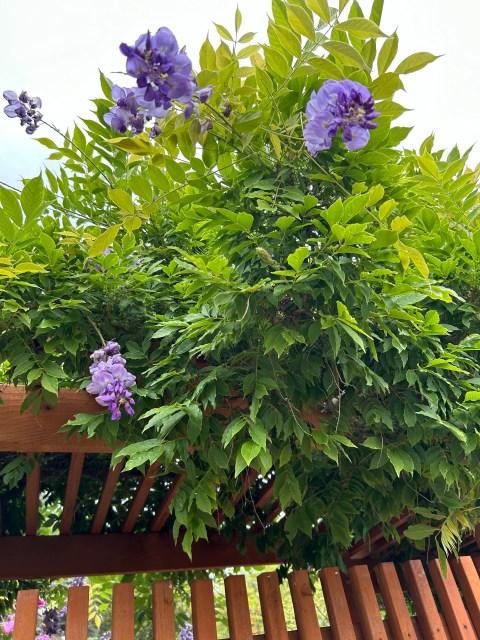
Wisteria: flowers better if pruned regularly. Prune the vine now after flowering and also when the vines are dormant in January/February. Now cut back new growth, leaving five or six leaves on a branch. This will encourage flower buds. In the winter cut back to three buds. These become spurs that will flower next year.

Wisteria was cut back about 2 weeks ago after prolific flowering earlier. Pruning encourages vines to grow flowering spurs

Raspberries: Summer bearing canes (floricanes) that have finished fruiting on the previous seasons wood. Cut these canes to the ground and remove. Any new growth thinner than a pencil should be prune to the ground. Then look at the canes that started this year—primocanes. Select 6-8 canes per plant spaced about  3-4 inches apart. When the plants go dormant in winter cut these canes back to just above top wire. These will produce lateral flowering and fruiting branches next summer.

Fruit Tree late summer pruning: Plum and cherry. Did your trees grow vigorously this summer? If so, prune back branches that pumped out two feet or more new growth. This can reduce next year’s vegetative vigor and encourage fruit buds. But if the tree grew moderately, then wait until winter or even after next year’s flowering before pruning. Poorly executed summer pruning can stunt a tree.

Apples: Sometimes apples get in a cycle of over-producing fruit one year and then the next one the tree is recuperating and has no fruit. Biennial fruit-bearing can happen for numerous reasons. If too many fruit form one year and are not thinned out then the tree doesn’t have the energy to form many flowers the next year. Some  apple varieties  like Honeycrisp and heirloom Brambley Seedling are naturally biennial fruiting. Other trees fall into this pattern through lack of nutrients, irregular watering, or one winter frost destroys the blooms. RHS always has good information. Thinning flowers (once you confirm they are pollinated) is more effective than thinning young fruit. Advanced gardeners can look at the Royal Horticulture Society’s post on summer pruning of apples and pears.

Weeds and our perspective

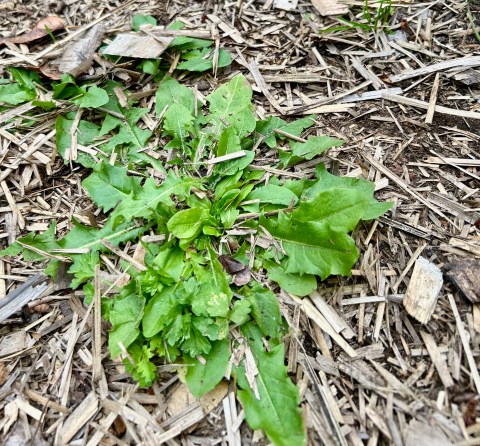
When I would help Tinker in her garden, often she dug up dandelion plants as if they were precious. The roasted roots made a delicious tea that she savored. Imagine if the plants we detested somehow changed in our mind to become useful resources. So much in life is how we frame something. If we look at a weed and notice a couple insect pollinators insects sipping the nectar, maybe the ‘weed’ isn’t so bad. That doesn’t mean we have to keep the plant. I have had weeds that I once hated and then learned to accept them, even as I removed them.

Dandelion, Taraxacum officinale

Gardeners who take the time to identify the plant can be more effective. Knowing a plant lets you determine the best way to control it. Sometimes a weed can be an indicator of environmental conditions: the soil is wet or heavy, or it is very acidic. Some tough weeds will die out if the roots don’t get nutrients from foliage. This requires diligence—regular weed-eating. Small, less-hardy weeds will die from deep mulch that smothers small plants and suppresses weed seeds. Proper ID is key to control.

Weed Identification

Botanical identification begins with a plant’s flower. We can’t rely on the foliage because weeds are by their nature adaptable and have a lot of variety. Vegetative characteristics are malleable. Here’s a short digression: years ago I managed the UCSC agroecology program greenhouse and was responsible for transplanting seedlings. In wood flats full of vegetables or flowers that required pricking out, there would be a number of weed seedlings from the compost. The young weeds could look almost identical to the some of the crops—so much so, that a number of the apprentices I supervised would pot up the weed seedlings! So identify your weed when it is flowering and then start to recognize the plant in all its stages, from young seedling to flowerings going to seed.

I’m old-school and like books. My favorite book for weed identification is Weeds of the West, University of Wyoming Press. Our cooperative Extension had it for sale decades ago. Now it can be downloaded for free from the website or used books can be found online. 900 color photos include the weed at young stages.

Online resources include Hortsense from Washington State University, with 90 fact sheets listed by alphabetical order. University of California, Davis has a useful online weed identification key

Weed Ecology

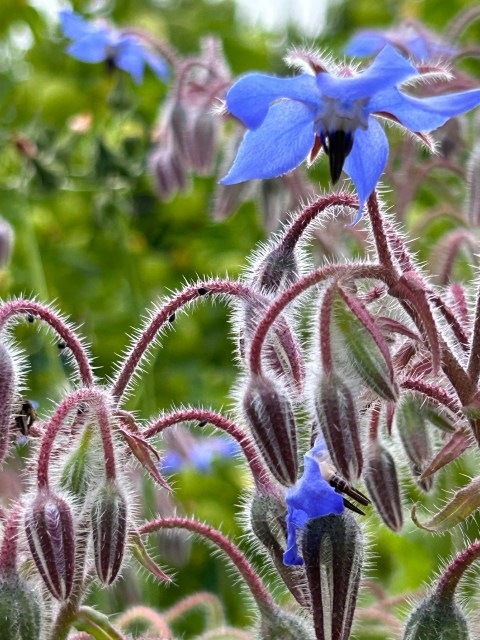
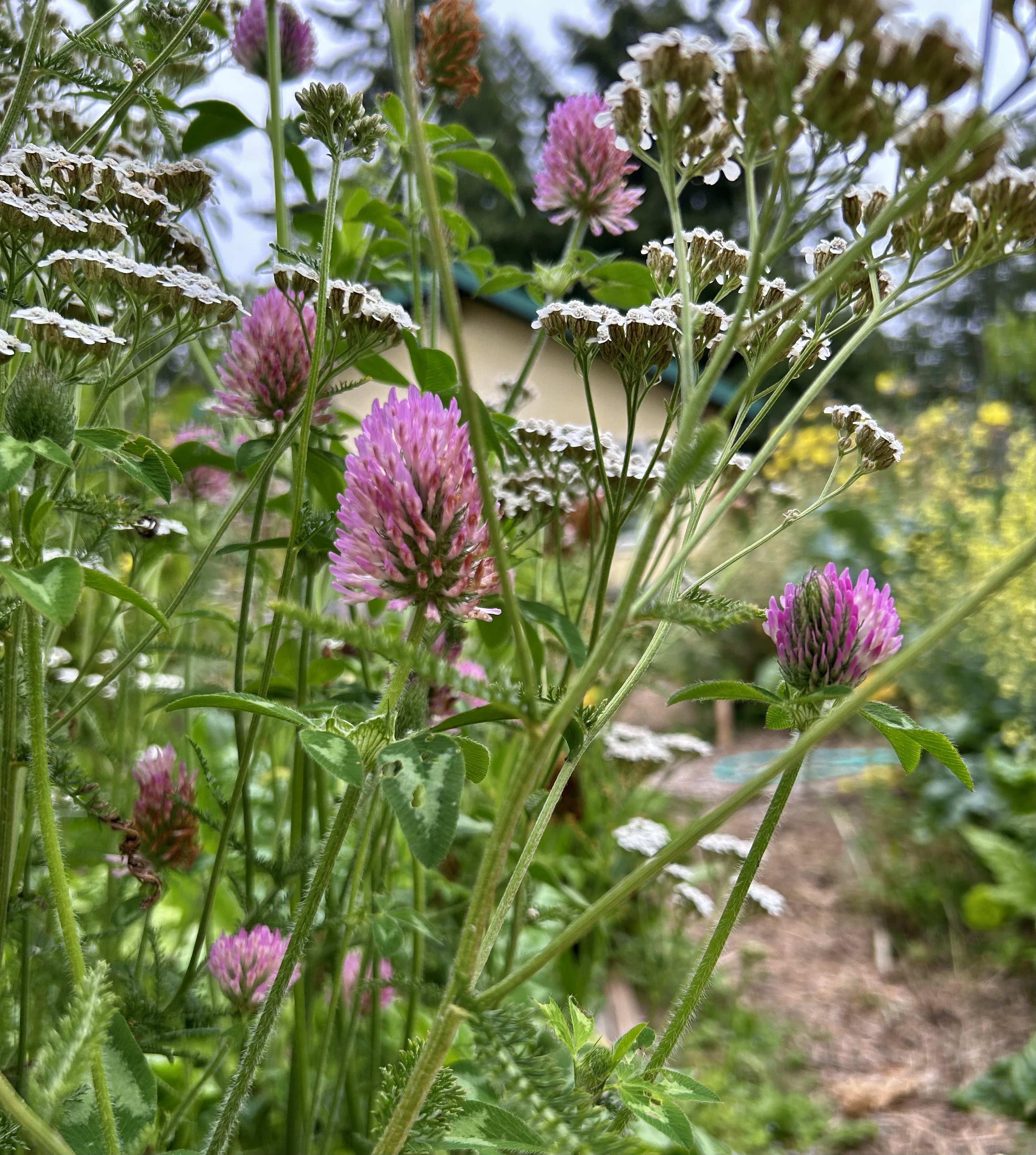
Many weeds are species that have adapted to colonize disturbed sites, such as landslides; after a wildfire has burned off vegetation; along roadsides; or at building sites where excavators have exposed mineral soil. Alan Chadwick, the famous gardener who developed the French-Intensive-Biodynamic method, always said nature abhors a vacuum. That’s why in my garden I sprinkle around borage, red clover, phacelia, or calendula. By regularly weeding out unwanted plants, I have mostly replaced the disturbed areas with annual flowers that are easy to pull and have many benefits. There’s not much room for weeds.

Borage, Borago officinalis

Weeding Techniques

Start weeding early spring, when the ground is still moist and the plants are young. Weed annual gardens regularly. Use lots of mulch around perennials and woody plants. Since weed seeds can remain dormant for decades, it’s important not to let weeds good to seed.

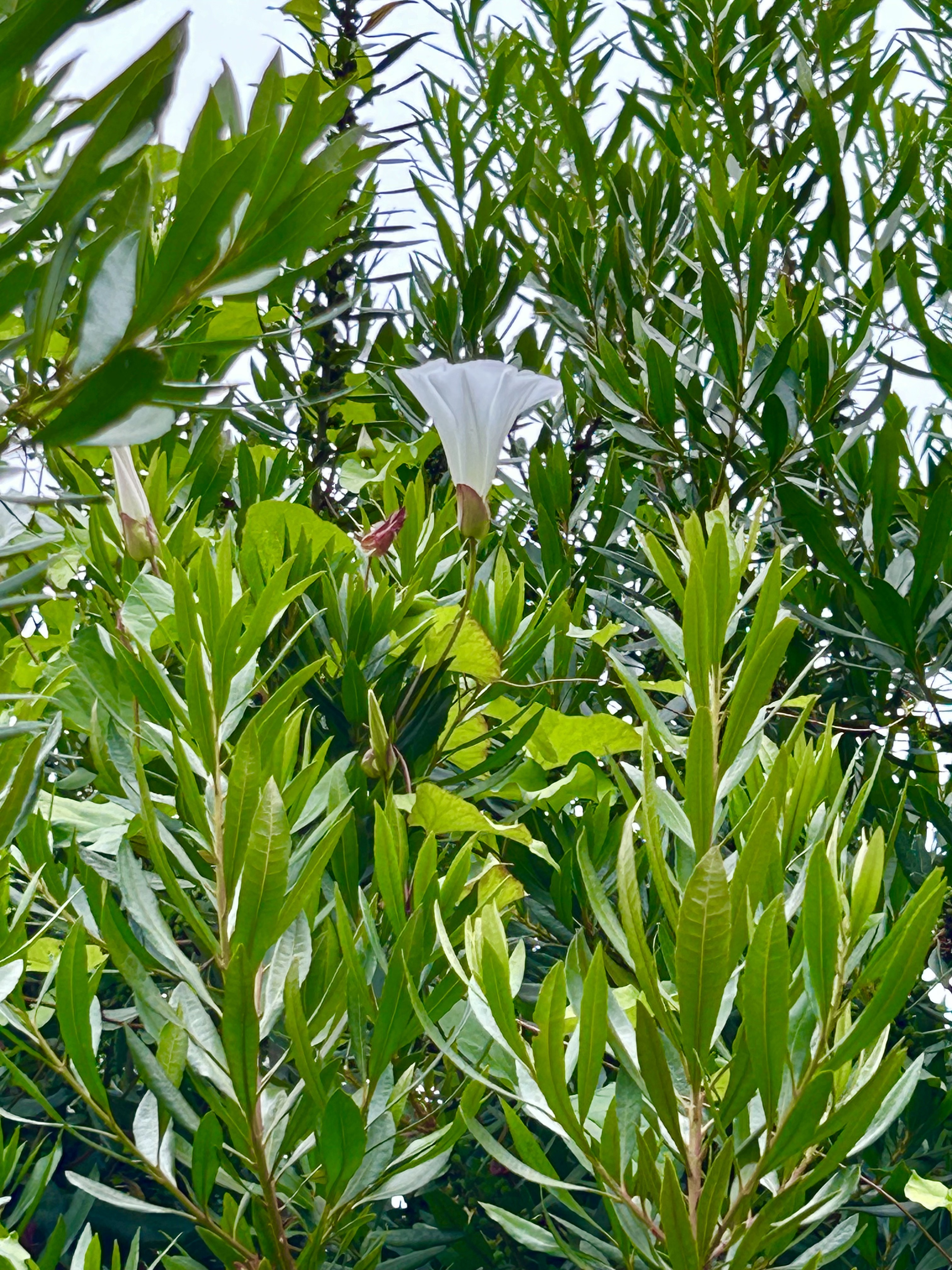
Certain perennial weeds can become one’s nemesis, for example horsetail, bindweed, Canada thistle . If you do nothing else, make sure to cut flower heads before they go to seed, bag them and send to the dump. The county noxious weed board doesn’t want what the state includes as noxious plants in our yard waste. If you cut the flower or seed heads and bag them, then the rest of the material is yard waste and can go to the compost facility. Thick mulch prevents seeds from sprouting. Everyday weeds can go into yard-waste. I have a big pile of plant debris that I will not use as compost, but will let it rot in place. In it I include weeds that have gone to seed but are not listed as noxious.

At one time I added woody plant material to this pile, but now wild roses, native blackberries and branches from hedges and ornamental shrubs go to yard waste. I don’t want excess fuel for potential wild fires.

If you are still using herbicide on weeds in pavement cracks or gravel, please consider a vinegar solution. Horticultural vinegar—at 35% strength is a lot stronger than kitchen vinegar—5% sold at grocery stores, so take more precautions! Wear gloves, glasses and long clothing. Although flame torches are used in agriculture to control weeds ( by boiling the sap, not turning foliage black), when I called our fire dept about using them for weeds in cracks I was informed that we had two wildfires in the county start that way!

For woody plants or deep-rooted perennials, such as Scotch broom, Himalayan blackberry, and poison hemlock, a weed wrench can be used to yank out the entire plant. The county weed board has wrenches they loan out.

A lot of weeds are my friends. I make flower bouquets, or add them to salads. Others are a haven for pollinators. Some are good sources of carbon for my compost piles.

Native Berry Plants in the Landscape

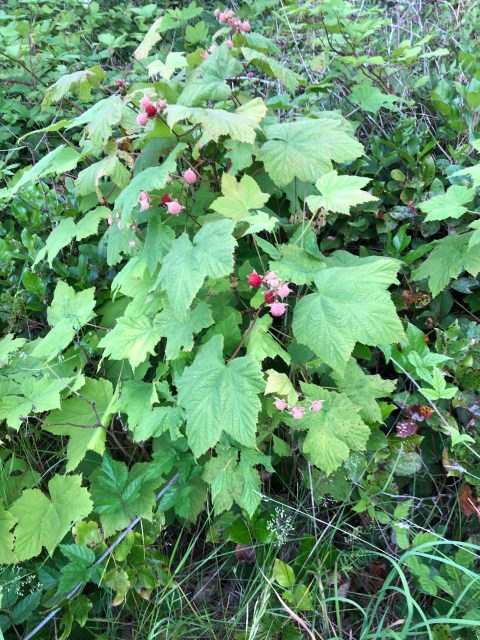
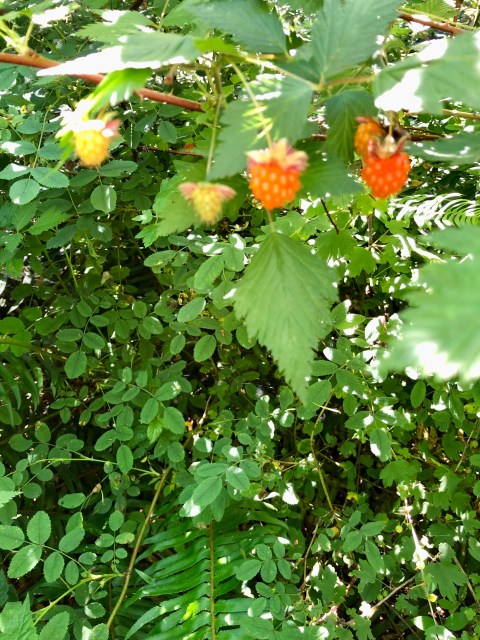
July is the time of wild berries here in the Pacific Northwest. The Rubus clan, best known for raspberry and blackberry also include many other members with edible fruits. Two woody shrubs that are fruiting now are Thimbleberry, Rubus parviflorus, and Salmonberry, R. spectabilis. These two edible berries were staples of native peoples. Around here, harvesting thimbleberries is a summertime pleasure. Children love to place the thimble-like fruit on their fingertips.

On the Quimper Peninsula I have only seen these two Rubus species growing on moist sites, but in some regions wild thimbleberry may occur on drier sites. In Jefferson County the water table is close to the surface in low-lying areas creating wetlands. These plants are also commonly found along stream sides, and can withstand being flooded for short periods of time, thus making these shrubs useful in the rain garden. They can also be part of restoration landscapes. The deer browse the buds and stunt newly planted shrubs. Fencing, caging or spraying deer repellent for a few years is necessary for them to get established. The local deer population has suffered from loss of habitat and loss of predators.

Salmonberry, Rubus spectabilis

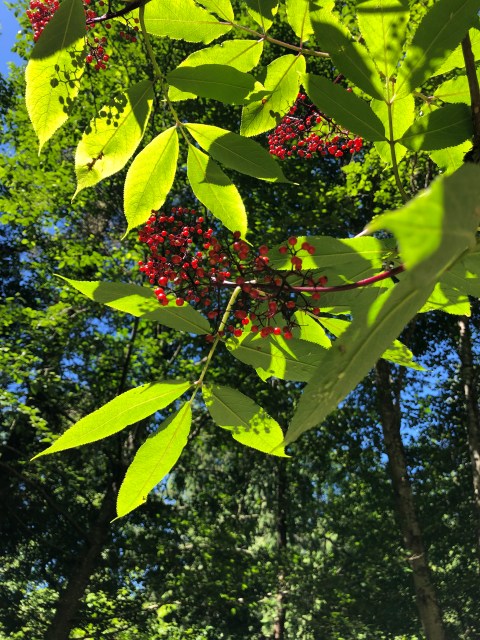
Another coastal native that’s fruiting now is red elderberry, Sambucus racemosa. The white flower cluster of has a pyramidal shape This berry can be edible if cooked, but I have never tasted it. Raw berries can cause nausea. All other parts of the plant are toxic. This plant grows easily in all soils and sun or shade.

Red Elderberry, Sambucus racemosa

(Blue elderberry, Sambucus nigra caerulea has white flower clusters that are flat. It is an edible, medicinal and ornamental plant.)

Other iconic berries will fruit soon including salal and huckleberry, stay tuned!

June 2024 Garden Chores

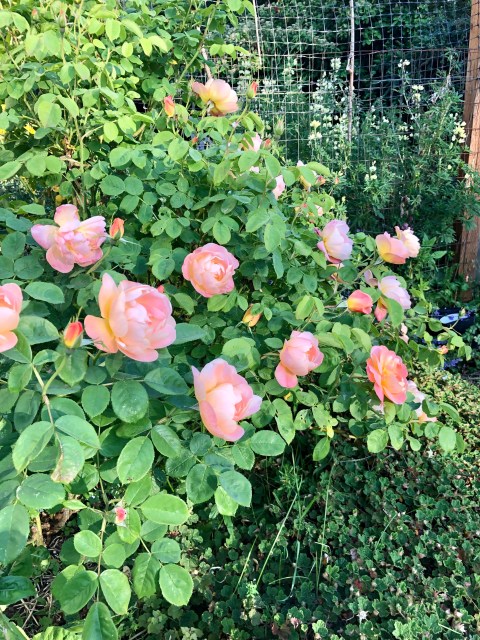
The garden is a riot of blooms bursting with color. Let’s take a look at English garden roses, one of my favorite. Goumi, the earliest fruit in my garden has a sweet-tart flavor that I love to nibble. The garden is alive with bird songs! Robins in the garden are fun to watch as adults seek out worms and their fledglings beg for food.

By now in the vegetable garden, the cool season crops are producing and warm season crops are in the ground. Before the month is out we will be preparing for the winter garden.

Edibles

Tomatoes: Begin training indeterminate tomatoes. Train a couple of main stems. When new shoots form between the main stems and a leaf, pinch out these suckers. There will be less fruit but they will ripen sooner. Remove some foliage if it is excessive but leave some to protect the fruits from sun-scald.

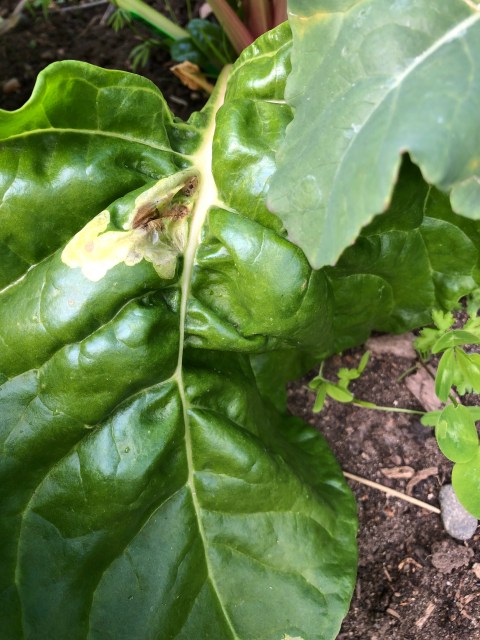
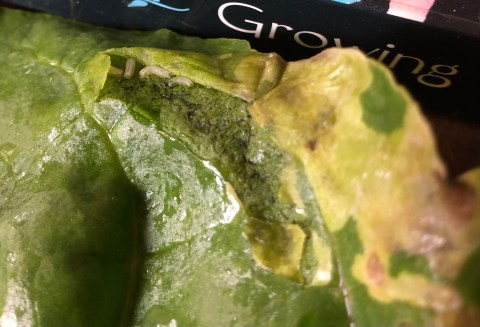
Vegetable Pests: Watch for signs of leaf miners on spinach, beets and Swiss chard. The larvae form tunnels between the layers of leaves that look like yellow trails and pockets. As the fly larvae metabolize the plant they deposit black frass. Hand pick the leaves and trash them. Don’t place them in compost!

Swiss chard leaf with yellow spot indicating leaf borer within.
Leaf miner maggots visible on top left. The top layer of leaf was peeled back to reveal these fly larvae.

Garlic: Harvest scapes ( curvy shoots with flowering head) Stop watering when leaves start to turn yellow. Harvest when only 4 leaves are still green, or the bottom 1/3 of foliage is yellow. For longer storage, cure (dry) garlic with the tops and roots for several weeks, allowing nutrients into the bulb. Cut tops and roots leaving as much skins to protect garlic bulbs.Prevent the spread of garlic rust fungus by starting with certified disease-free bulbs, rotate crops and use a mulch of arborist chips to prevent rust from establishing in soil.

Asparagus:  Mature fronds can get top heavy and fall, sometimes snapping at the base. For attractive plants in an edible landscape stake individual plants or prop up with bamboo. For asparagus in rows place a metal t post at each end and run jute twine between the posts. To keep the plants together weave the string between plants. In the fall when the shoots die to the ground, the jute can go into the compost along with the dead asparagus.

Fruit Trees: Thin fruit, and watch for signs of fungal disease that spreads by splashing water. Use neem oil spray or sulfur powder. Look for and destroy tent caterpillars. Patrol for slugs and snails.

Winter vegetable garden It can be confusing to newbie gardeners that just as the summer solstice arrives, we begin sowing seeds for winter harvest! Sow brassicas  including winter cabbage, kale, and purple sprouting broccoli. from mid- to late June. If you miss this window, buy vegetable starts at the coop next month. Purple sprouting broccoli is the most successful winter broccoli with its small and numerous shoots. Early July is time to sow the following: carrots, beets, Swiss chard, kohlrabi and radicchio. (Crops for late fall harvest grows through the autumn equinox and then growth slows almost to a standstill.)

Ornamental Plants

Deadhead Rhododendron. By gently snapping off the flower cluster, seeds won’t form, instead we allow the shrub’s energy to be directed into growing foliage and starting next year’s flower buds.

Perennial Flowers: Some late summer and fall- blooming perennials, pinch back now for sturdier and shorter stems. Remove the top 1/3 of the following plant Asters, mums, beebalm (Monarda),  and Joe-Pye weed.

Fungal diseases are exacerbated by rain. Powdery mildew is not one disease but a symptom.Caused by different fungal diseases, the symptom is white circular patterns with a powdery texture, becomes gray or brown over time. The disease is more than cosmetic; it inhibits photosynthesis. It can overwinter in buds and also on dropped infected foliage on the ground. Humid weather and crowded conditions that cause stagnant air encourages fungal growth. Neem oil or sulfur can be effective when used  at first signs. Safer brand Fungicide is another option.

Winter Injury: By now many plants have recovered from the winter. Evergreen shrubs that dropped foliage are now leafing out. Old stands of red-hot-poker that completely died to the ground with many rhizomes turning to mush are now leafing out. All these plants require monitoring, removing dead wood and watering during dry spells.

Asparagus

Asparagus shoots are emerging–here is a crop to test our commitment to delayed gratification!  Some clients have told me they tried growing asparagus but gave up. This perennial vegetable requires a dedicated bed and will produce for decades if well-tended. Growing asparagus well is time-consuming; let’s look at what it takes. One trick is to prepare the planting site well in advance.

 Preparing the bed: Diligently remove all perennial weeds and prevent them from getting established. Add lots of organic matter and water deeply until the plants are  established. If the soil is heavy clay,  prepare a raised bed. Wait a couple of years before harvesting to allow the plants to get established.

Harvesting: Begins for a couple of weeks in the third year. Snap or cut the shoots at the base. After about five years, harvest for almost 8 weeks or as long as the shoots are vigorous and finger-wide. Stop harvesting before emerging shoots are spindly. By allowing the fronds to grow and nourish the plant, we  prevent the plant from losing vigor.

The plants are either male or female. They are sold in nurseries as 1-year old crowns. All-male varieties have the advantage of bigger shoots. Growing them from seed means you will also have slender female plants that put more energy into producing red fruits and seed. Be sure to remove volunteer seedlings so they don’t crowd out the initial crowns. In the autumn after the plants turn yellow, cut them to the ground.

Staking: Do you lean more to the aesthetic or very efficient gardening mode? An asparagus crop is a prime candidate for edible landscaping with its ferny leaves. Stake individual plants or use a horizontal trellis (used for growing long-stemmed flowers) to allow the ferny fronds to sway a bit.

 If you have a no-nonsense, efficient approach to the garden then plant them in a row and place wood or metal posts at both ends. Once the plants are tall and start to bend, string a line from post to post and pin the plants in as the plants mature. A month later twine another string about a foot or two above the first to hold them in place. In any event, asparagus is a delicious addition to the garden.