Permaculture Shrub Goumi


A friend of mine has moved to a beautiful old craftsman style-cottage in Port Townsend with a landscape full of edible plants. The other day a fragrant scent greeted me as I opened the gate. I turned down the side brick path before knocking on the door.

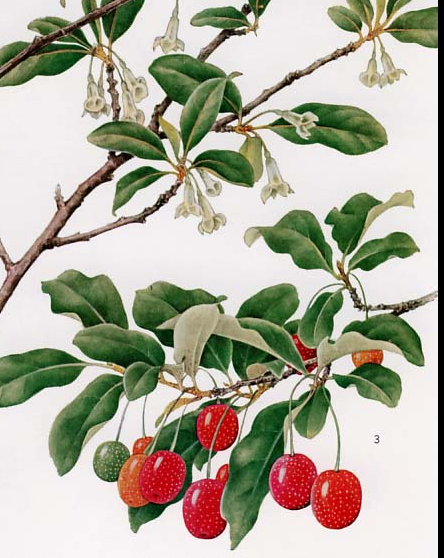
Was it coming from the flowering shrub with an abundance of pale-yellow tubular flowers? The shrub was humming with bees and other pollinators. What was it? The bronze colored scale on the tender stems made me think of Elaeagnus, the genus including Autumn Olive and Silverberry. But so many flowers! Compare the photo to the botanical illustration of the species below.
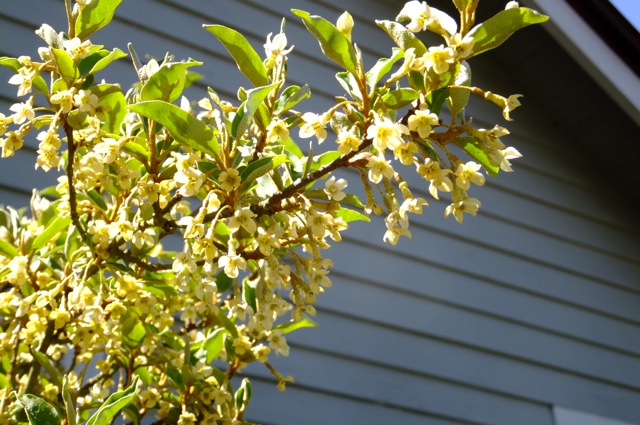
Late April 2014
Late April 2014

Elaeagnus multiflora

Knowing this was an edible landscape, my mind flashed to an unusual deciduous shrub I knew from a garden I once tended in the late 1990’s. What was the name-goji? No, but something like that. The scarlet berries dangled from stems tantalizing me. In late summer I popped them in my mouth to savor the astringent sweet-tart flavors. The longer they were left unpicked the sweeter they became, that is if the birds didn’t get them first.

But the shrub I remembered was never wreathed in blossoms. The flowers were sparse. The shrub was growing on the edge of the garden next to blueberries, rhubarb, and Abronia. The client had gotten the plants from One Green World Nursery. I remember reading their catalog that promoted Mountain Ash, Sea Buckhorn, and other ornamentals that plant breeders in Russia and and Ukraine had been selecting for larger, more delicious fruits. The Oregon nursery owners had gone on plant expeditions to bring back edible crops.

QUICK FACTS

  • Soil: flexible, variable pH
  • Water needs: drought tolerant once established
  • Pest: disease and pest resistant. Protect trunks from girdling by rodent
  • Height: 6 to 9 feet
  • Foliage: deciduous silvery green
  • USDA hardiness: Zones 5-9
  • Medicinal: Lycopenes help prevent heart disease.
  • Propagation: Species by seed from ripe seed. Varieties by softwood cuttings with a heel in July/ August or hardwood cuttings from current year’s growth or and layering.
  • Cultivars: Sweet Scarlet™, Ukranian variety self-fertile but best when cross-pollinated with Red Gem™. Note trademark means plants are patented and cannot be propagated for commercial production!

Elaeagnus multiflora, an Asian native has been cultivated in the US for many years. LH Bailey, one of my horticultural heroes discusses it in The Standard Cyclopedia of Horticulture in 1927. It is native to Japan where it is known as natsugumi. There it grows into a small tree. Other edible Japanese natives in the genus include Aki-gumi, E. umbellate, known here as Autumn Olive. The fruits of this shrub are high in lycopene, so goumi may be too. Unlike Autumn Olive goumi is not invasive.

Nawashiro-gumi, E. pungens.

But this shrub was not a random seedling, but a named variety, grown from cuttings, I’m sure of it. Plant breeders have bred it to produce more flowers. Compare the photo of my friend’s plant with this botanical illustration:

Landscape and Permaculture Use

This drought tolerant, deer-proof and pest-free shrub offers a special bonus; nitrogen fixing. Elaeagnus form symbiotic relationships with bacteria called actinomycetes that form nodules on the shrub roots and fix nitrogen from the air. This characteristic is found in some plants that are the first to colonize disturbed sites. These pioneer plants can grow in poor soils and enrich the soil.

Taking a cue from nature, the permaculture design approach uses Elaeagnus as an early succession plant. Consider planting it in a windbreak of tough plants in poor soil and five years later remove some replacing them with plants that require more fertile soil.

Potential Crop Production

Researchers at the University of Wisconsin are exploring the potential for a commercial market for goumi. Planted in organic systems it can be grown like other hedgerow fruit crops like gooseberry, elderberry, serviceberry, and cornelian cherry. Plant them 4 feet apart and prune into multi trunk shrubs that are allowed to branch about two feet high and maintain at five or to six feet, so it can be mechanically harvested.
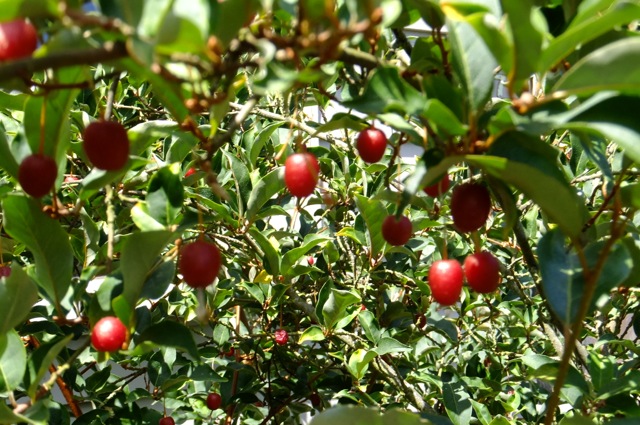
Goumi berries

Oregon Grape—Pacific Northwest Native

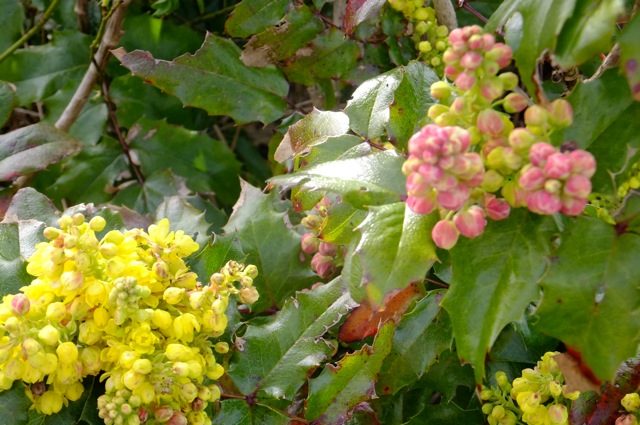
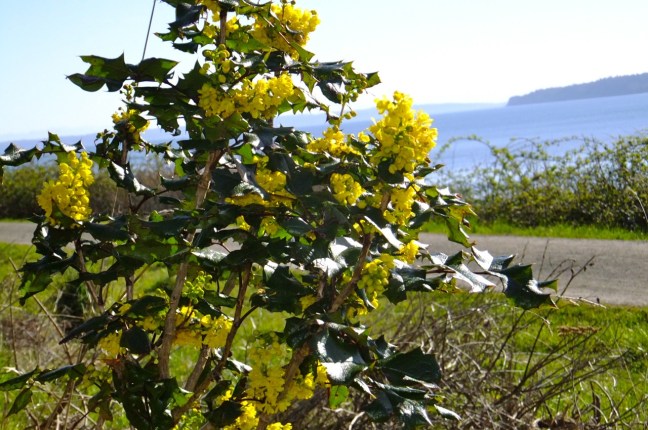
Yellow flowers brighten the hedgerows of Port Townsend. Oregon grape is in bloom! In a couple of months the flowers will mature into berries. Keep an eye out for when they do.

The clusters of ripe berries are tempting. With a name like Oregon grape you would think they would be sweet—but only pop them in your mouth if you want an adventure in flavors. I do so I do. Taste is an interesting subject, if you need everything super sweet you miss out on life’s bitter and pungent flavors. Our culture seems to thrive on sweet, fatty, or salty flavors. Cultivate a healthy palate for the more obscure and you immediately eat healthier foods. I relish bitter and pungent herbs. Tinker Cavallero has made jam with the pectin-rich berries and says it is delicious with a little sweetner.

One of my favorite things about Oregon grape is the bright yellow root hidden beneath the root bark. This berberine-rich root is used medicinally and as a dye plant.  When I used to be a landscape gardener I would come across the roots as I was weeding or adding compost to the soil. It spreads by suckers—not as fast as raspberries, but enough to form thickets over time. When I found the roots spreading into other plants, I pulled them out and clipped off a section about four inches long to chew on—like chewing on licorice roots. I enjoy the bitter and earthy flavor.

The roots have medicinal qualities that are best preserved in alcohol-based tinctures. Berberine is an alkaloid similar to the alkaloid hydrastine found in Golden Seal. Both chemicals provide antibiotic and antifungal properties. Oregon grape is also good for the liver, and is anti-inflammatory.

Permaculture gardeners can use this plant for creating wild habitat and hedgerows at the outer edge of their property. It is a great choice for bank stabilization. Purchasing the plant at a nursery can be expensive, especially if you buy varieties like Mahonia  ‘compacta’ (The nursery trade has not caught up with the name change, but native plant societies refer to it by its new name Berberis aquifolium,) It grows so easily from seed that you can find the plant from mail order nurseries that specialize in bare root bundles of conservation plants. Order them in late winter.

Choose this plant for bank stabilization
Flower close-up
Flower close-up

Nopal: edible cactus

A friend of mine wrote to let me know of a nopal recipe contest in Hostotipaquillo. Most people who have been to the Southwest know this is the fleshy pad or leaf of the prickly pear, Opuntia cactus. It is a common vegetable in Mexico. I’ve mostly eaten it in salads or with scrambled eggs called nopalitos. The taste reminds me of string beans with a little bit of lemon juice. People can be very creative with it and prepare it boiled, grilled, fried, or mixed into sauces.

What makes nopal so special from a nutrition perspective is that by eating it we can prevent diabetes.

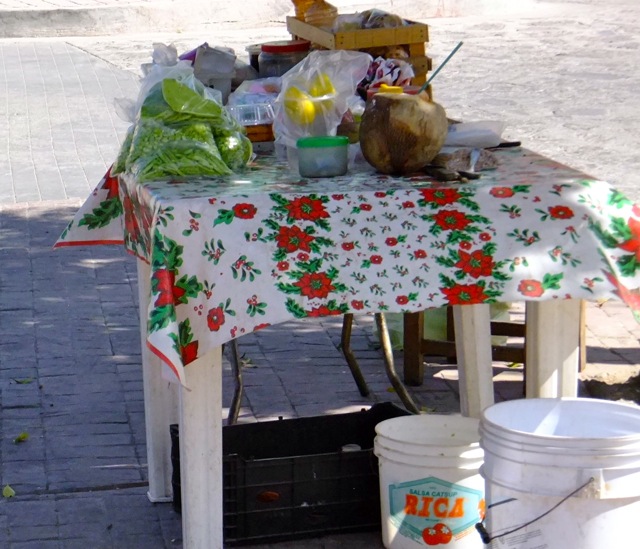
Vendors stand in the plaza. Note the bag of cut nopal at the front edge
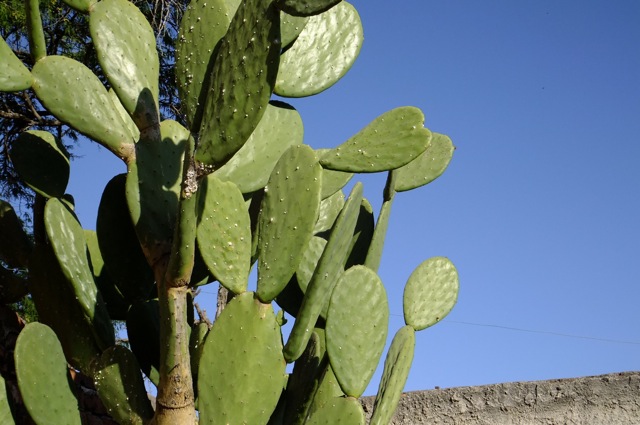
Mature nopal is an attractive landscape plant.
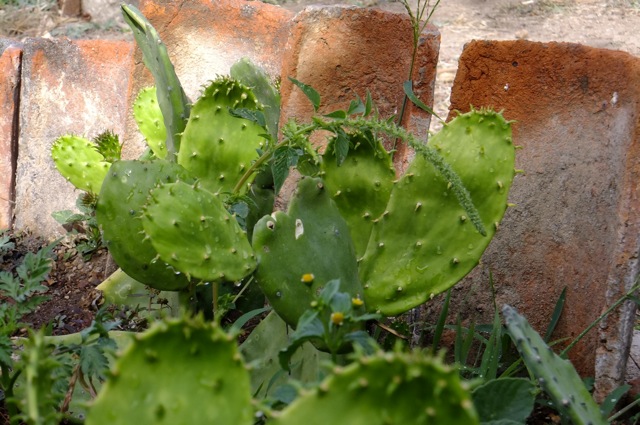
Immature leaf pads are more tender and flavorful. Wear gloves! I got fingers full of spiny hairs!

Scientists have figured out some really cool insights to how this works. The prickly pear cactus plant adapts to its dry environment by slowing down water loss with its slimy extracellular mucilage. According to Gary Paul Nabhan, author of Why Some Like it Hot, “the gooey globs of soluble fiber holds water longer and stronger than the moisture held within photosynthesizing cells.” He goes on to explain the mechanism of how this works. He then talks about how nopal works in the human digestive tract.

“ The very mucilage and pectin that slow down the digestion and absorption of sugars in our guts are produced by prickly pears to slow water loss during times of drought. And prickly pear, it turns out, has been among the most effective slow-release foods in helping diabetes-prone native people slow the rise in their blood glucose levels after a sugar-rich meal.”

You can see how to prepare and cook nopal by watching Dr. Tierona Low Dog, director of fellowship at Arizona Center for Integrative Medicine, on Dr. Weil’s site

http://www.drweil.com/drw/u/VDR00128/Preparing-Prickly-Pear-Cactus-Dr-Low-Dog.html

I’ll keep you posted about the winning recipe from Hosto!

Quinoa Continued

The folks at Golden Rule Garden, a project of Ecology Action contributed two gallons of recently grown and dried quinoa to the Ecology Action 40th Anniversary Celebration, last weekend. Ellen Bartholomew, garden manager, warned me that I needed to repeatedly wash the quinoa seeds (technically a pseudograin because it is not from the grass family, rather it is related to spinach, Swiss chard and the edible weed, lambsquaters). Well, I didn’t listen.

These were her instructions:

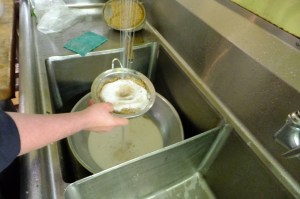
Place 1 to 2 cups quinoa in a blender. Fill with water almost to the top. Blend at low speed for a minute or two. Drain the sudsy water, add fresh water rinse twice and repeat. Repeat again. Do this however long it takes for the water to come out clear, not sudsy.

Now the problem is, as you probably know, quinoa is high in saponins, a chemical constituent that is not essential for basic metabolism, but worth it to the plant to produce for some reason. Saponins taste bitter. I love bitter food and I spit out quinoa that was not properly rinsed. The birds in the field don’t eat quinoa, so the saponins are protection against predation. Good strategy.

There is not a blender in this otherwise complete catering kitchen. So I used the high-pressure dish washing faucet to rinse and rinse. Well, after an hour and a half of trying to wash about 10 cups on the day of the event, I got frustrated.  This is not something you can do in advance because in less than 24 hours the moistened quinoa will sprout. Finally, when Fenanda and Luke, interns at Golden Rule, showed up at the Frey’s kitchen, I understood. Luke calmly placed some of the quinoa in a large mixing bowl and added water almost to the top.Voila! The colorful calyx of each tiny seed floated to the surface and Luke poured them off. I had not been adding enough water. Quinoa also has a hard shiny coat surrounding each seed. Fenanda and Luke washed away the bitter principle and we all ate the most delicious, nutritious home-grown quinoa!

Harvesting and Threshing Quinoa

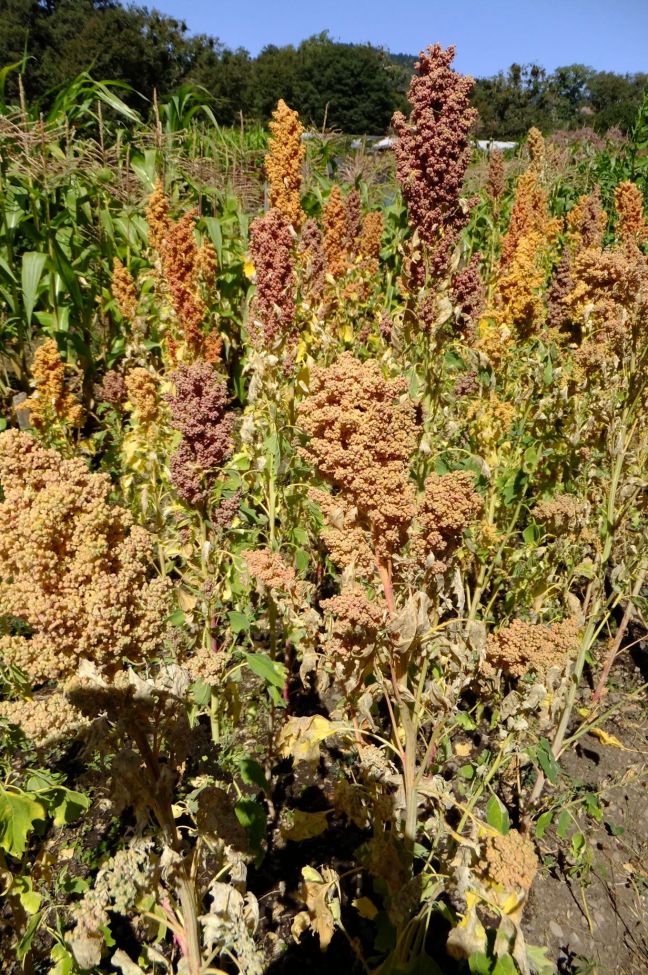
I read the email this morning.  Fernanda said they had harvested quinoa and would start threshing it today. An intern from Ecuador, Fernanda had told me about growing up in Riobamba, in the Andes, where her mother has a restaurant that serves traditional food, including quinoa. Last week I took a picture of her standing beside the quinoa, a variety from the USDA seed bank, a multi-hued one. Fernanda led me to the drying loft of the barn, where bundles of rye, teff, and garlic were hung to dry. I arrived at the garden at lunchtime so, she got me started and went to take a break. I was excited to get started. The last time I cleaned quinoa was when I worked at the Abundant Life Seed Foundation fifteen years ago.

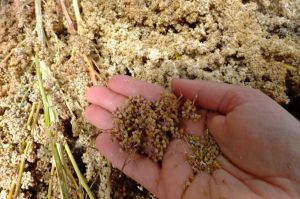
Another Ecology Action intern, Luke, showed me how they first weigh the whole plant to calculate the dry biomass, an important step in collecting data for their research in determining yields. Then the seeds are gently stripped off the stem to avoid gathering unnecessary bits of stem and debris.  One batch I worked on was not completely dry. The colored stems were so heavily ribbed that they reminded me of rainbow chard when it has bolted. Much of the seed stayed wrapped in the dried chaff, yet the grain (pseudograin see archives) looked completely mature. The other batch was much faster to process because the stems were brittle.  I rubbed the dried flower heads between my hands and let the seed fall into a bowl. I worked alone for a few minutes and then two volunteers returned to work on amaranth.

Later, Ellen Bartholomew, the garden manager at this site, one of Ecology Action’s research gardens, joined me. She showed me a faster way to process grains.  After stripping the dried seed heads, we pushed the quinoa through seed screens.  The best arrangement was  #5 on top and the fine mesh on bottom. The most mature quinoa fell through by shaking the screen, whereas we needed to rub the remainder through the screen. The stems and coarse material remained on top. The finest chaff sifted through the fine mesh screen, leaving very little debris to remove in the last step.

Winnowing is a skill that reminds me of a chef tossing an omelet.  I remember working as a cook in an Italian restaurant and told to practice with a skillet of dry beans. By flipping the wrist I learned how to turn a pan of sautèd veggies without a spatula. Holding a bowl lightly with two hands and standing in front of an electric fan on low, I tossed the quinoa; the chaff sailed through the air, onto the floor. Quinoa is a good one for beginners to learn with because the chaff is so much lighter than the seed, thus it separates easily. To make sure the seed is evenly dry, the quinoa will be kept at the temperature it will later be stored at before being placed in a sealed container. If they are not damp, and don’t stick to each other, unlikely in this dry air, then they will be ready to go into storage containers. Ecology Action does lots of quinoa trials; this mountain valley provides the ideal growing conditions, hot days and cool nights.

In Praise of Grains

Grain growing is one of the frontiers of home gardening; people start with vegetables and move to fruits; strawberries, cane fruits and home orchards. Perennial vegetables like asparagus and artichokes or culinary herbs often follow. We tend to shy away from growing grains.  Grain growing takes so much space; grains are so cheap to buy.  But, now more and more gardeners are taking up the challenge to grow their own grains.

I got my wake-up call from an article in the Washington Post on March 13, 2011 by the founder of the World Watch Institute, and Earth Policy Institute, Lester Brown:

The United States has been the world’s breadbasket for more than half a century. Our country has never known food shortages or spiraling food prices. But, like it or not, we will probably have to share our harvest with the Chinese, no matter how much that raises our prices.

A small patch of grain can be broadcast by hand.  When I do this, I feel connected with ancient people; there is something almost biblical about this practice.  Broadcasting is a meditative dance; the continual moving forward while sweeping the arm to and fro while evenly scattering the seed.  If you prefer a more accurate form of seed dispersal, one low-tech option is to use a grass seed broadcaster.  Think of sowing a lawn, but one that will grow tall and go to seed.  If you have a big sunny backyard, a 30 ft. by 30 ft. patch of winter wheat sown in the fall will produce 50 lbs. of dry wheat berries the following early summer.

The other end of the spectrum is transplanting seedlings of grain.  Before you throw up your hands in disbelief, consider this. It is possible to produce the same 50 pounds on a mere 300 sq.ft. area. That is enough wheat to make a one-pound loaf of bread every week of the year. If your space is limited, try this Grow Biointensive technique.  Mind you, it is part of an entire process described in How to Grow More Vegetables: THAN YOU EVER THOUGHT POSSIBLE, ON LESS LAND THAN YOU CAN IMAGINE. John Jeavons and the Ecology Action staff have quantified the yields of grain grown by transplanting seedlings.  So, I’ll leave you with these seeds of inspiration and in the fall instead of planting cover crops for the winter; consider sowing some amber waves of grain.

Keep an eye out for more about grains–easy choices for the novice; harvesting with an Austrian Scythe; how flailing can be graceful, and more surprises.

Quinoa

Ecology Action Garden at Golden Rule siteI wrote this for the Abundant Life Seed Foundation Newsletter back in 1999 when I worked there.

Quinoa (pronounced keen-wa) known to the Incas of the Andes as “Mother Grain” is an attractive plant, nutritious crop, and a delicious food.  If you have ever cooked this psuedograin you have seen the funny little squiggle or partial spiral of the seed’s germ.  Let’s take a look at this interesting crop.

The plant grows high in the mountains of South America, in an area known as the altiplano, where it withstands extremes of climate– not only freezing temperatures and poor soil but also high intensity of sunlight.  The Queche Indians, heirs to the Inca legacy, have grown the “mother grain” for 3,000 to 5,000 years and developed many varieties adapted to various conditions.

It is not a true grain from the grass or cereal family, but a member of the Goosefoot family.  Quinoa is related to spinach, orach, and beets, but most closely linked to the weedy edible lamb’s quarters and epazote the pungent, culinary herb from Mexico.  Like them, Quinoa has leaves with toothed margins and a powdery texture. The plants grown at the Abundant Life trials garden grow 3 to 5 feet tall.  As the autumn air turns crisp, the foliage turns a stunning array of yellows and purples. The flowers have no petals–they look like tiny green balls with dense, pyramid shaped clusters of seeds, that mature into an attractive golden color.

The individual millet-sized seeds are flat on two sides.  You may recall washing the “grain” before preparing it.  That’s because the seed coat has saponins, a bitter property that protects it from the intense sunlight and repels insects and birds.

Most quinoa exported from South America has been mechanically buffed to remove the saponins in the outermost edge of the kernel, (thus is nonviable as seed stock) in a process known as pearling.  Some seeds bypass the machines, so it is still advisable to rinse it before cooking.

The embryo of quinoa takes up a greater portion of the seed than normal cereal grains, so the protein content is higher.  The National Academy of Sciences calls it “one of the best sources of vegetable protein in the vegetable kingdom”.  It is also high in calcium and iron.

Quinoa is prepared by simply boiling but traditionally it was used as flour or dry roasted.  Try this recipe next time instead of plain rice:  Place 4 cups of water in a pot with 1/4 c wild rice and a piece of dried kombu or other sea vegetable (for flavor and nutritious trace elements).  Bring to a boil and after 10 minutes add 1c short grain brown rice.  Lower heat and cook another 25 minutes Add 3/4 c of rinsed quinoa.  Let it simmer  15-20 minutes  Enjoy the nutty, nutritious flavor of quinoa as a regular part of your diet.

Dryland Farming Project

This is an exciting project that I wrote about two years ago for the PT Co-op Newsletter.  You can see it on their website.

The early morning sunlight illuminates the heads of grain: golden barley, blue-green triticale, and vibrant green wheat.  Walk along the public trail near Collinwood Farm and you will see a hand painted sign announcing the Dryland Farming Project, a trial plot for staple crops. This is an exciting experiment, not only in growing crops, but also in community involvement.

For many years the idea has been a handful of seeds in the mind of Tinker Cavallero. She has an uncanny knack for being right ahead of the curve in sustainable living. Now she’s exploring the limits of what staples can be grown locally with little inputs, especially without irrigation. “We need to research ways that we can locally and sustainably grow staple crops such as grains, legumes, and seed crops,” she said. Tinker is proposing selecting strains of wheat, beans, and other staples through the old-fashioned technique of seed saving.

The Quimper Peninsula receives very little rain, about seventeen inches on average. We are also learning that the Chimacum aquifer is at risk of being overdrawn. And of course, more development means more wells, and there’s a limit to the water held in the aquifer. Additionally, sandy soils low in organic matter are common in our region.

The seeds of an idea were just waiting for a time and place to germinate. Ian Keith, owner of five acres of land lacking the infrastructure for water, wanted to see the land farmed. The land is located above Collinwood Farm and has been fallow for many years. Community organizer and member of Local 2020’s Food Self-Sufficiency group, Judy Alexander, believed in the idea and wanted to be part of the project; she encouraged people to invest in a cooperative to share the initial expense and the harvest. Tinker contributes her five years of experience at Abundant Life Seed Foundation as garden co-manager, her three years experience running a CSA at Collinwood Farm, and her experience co-managing a seed farm in New Zealand for a year. She was also co-manager at Frog Hill Farm where she experimented in spinach seed trails in conjunction with the Organic Seed Alliance.

Tinker has the experience to carry the project forward and the support of several experts. Kevin Murphy, PhD (remember his CSA at Collinwood Farm 10 years ago?) and Steve Jones from the WSU Extension in Mount Vernon will help with different wheat varieties. Several farmers are on board to consult about dried beans and corn.

The project has presented an opportunity for a real exploration in the dynamics of leadership. There is no hierarchy. Participants have self-selected for different responsibilities by communicating through an online Google group, from locating seed sources, to directing work parties, to bringing snacks and organizing potlucks. Tinker’s daughter, Kia Ochun, got so involved in the project she ended up researching the different grains and staples for her high school senior thesis. You can read her crop descriptions posted on signs at the field.

Every Friday and Saturday from five to ten people have shown up to participate in preparing the ground, sowing seed, and weeding the quack grass. The atmosphere on Friday morning is vibrant with people working together. Bob Aoili, a farmer who managed the market garden at Corona Farm, says, “I love the organic-ness of the group, that we can do something without too much structure. And also that each person has a different insight about farming that inspires them.” Another member added, “Here is a group of people who didn’t know each other before we came together and we vary in age from under 10- years-old to over 60. And we have so much fun together!”

“It is my hope,” Tinker said, “that through our trials we can start to create crops that will produce reasonably well and in the process learn methods and varieties best suited for our conditions.” She continued, “I can imagine trials of flax, rape seed, soup peas, fava beans, spelt, barley, buckwheat, oats, quinoa, millet, as well as naked seeded pumpkin seeds and sunflower seeds.” At this point an acre of staple crops are vigorously growing.  The first crop to harvest will be the barley.  Come by and see the first stages of a dream for dryland farm crops.

Other farmers are involved in similar projects. Finn River Farm is currently doing wheat trials and their winter wheat is growing strong. Stay posted for further developments of the Dryland Farming Project in the Port Townsend area.