Some types of agave reproduce asexally, making cultivation easier and more uniform. Either small hijuelos (sons) form vegetatively at the base of a mature plant, or bulbils form instead of flowers and seeds. (This latter formation also occurs in many garden plants including garlic and chives.)
Other species are used in traditional mezcal production, but are difficult to grow. Traditionally they have been collected from the wild, but as the demand for mezcal keeps increasing, wild populations are shrinking, and growers are attempting to cultivate other species.
TobaláAgave potatorum, is one I particularly enjoy. The flavor is full-bodied, a complex of notes hinting at floral and spicy. The Tobalá plant is much smaller than Espadín:, requiring up to to eight piñas to equal one of the latter. Combine that with the fact that Tobala rarely produces bublils or pups, so it must be grown from seed. Luis Mendez in Solga Vega Oaxaca is now cultivating the plants to preserve the wild population from over-harvest. A nursery in Santa Catarina Minas is also selling seedlings.
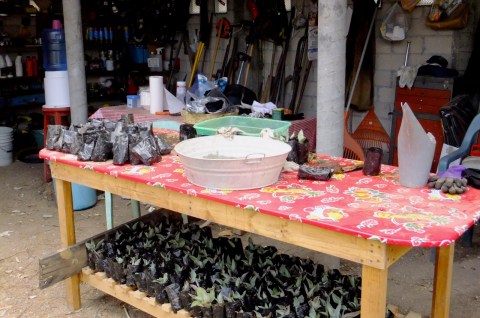
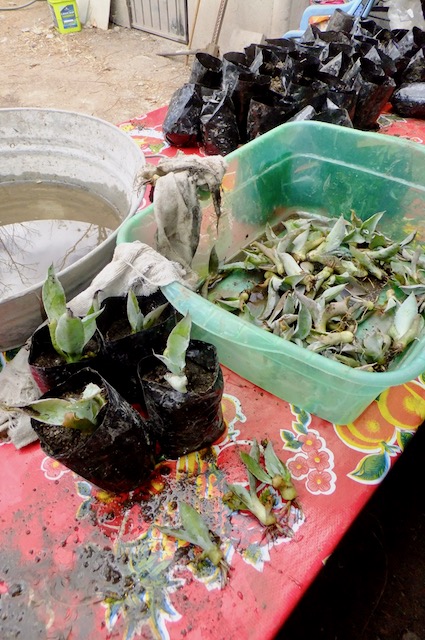
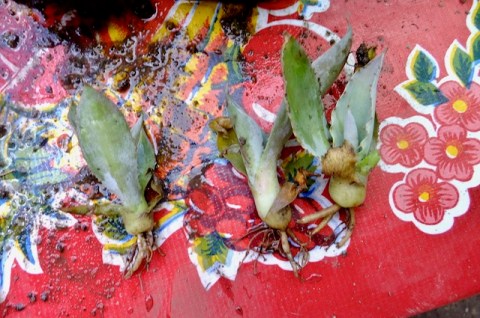
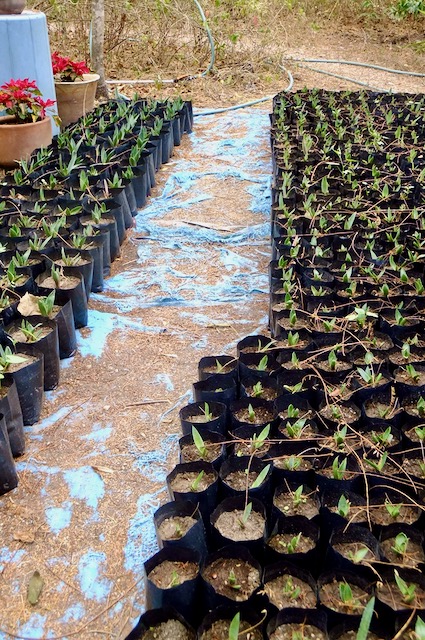
In January 2020 I helped pot up Tobalá plants for Tony Raab at Casa Raab, San Pablo Etla, Oaxaca.
One of Tony’s workers, Rodregio.
Tobala seedlings
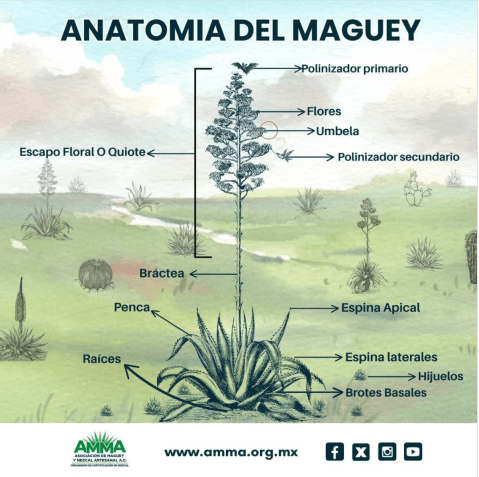
AMMA published this diagram of agave anatomy.
In my search for information on sustainable maguey preservation and cultivation, I came across this post Mescalistas: Can wild agave be successfully grown? In the future I hope to visit more maguey plantations.
Tinker was involved with Abundant Life Seed Garden from its inception in the 1980’s until 2001. She and John Gilardi were garden managers in the latter years. In the above photo, Tinker and an apprentice named Nicole are stripping the flower heads of dried amaranth to remove the seeds. Next steps include winnowing and screening. Later amaranth was one of the crops Tinker experimented with in the dryland farm project.
Amaranth’s importance is twofold—its super nutritious and easy to grow.
Unlike grains, the seeds of amaranth contain all the necessary amino acids. The protein content is 16 percent, more than rice or wheat. Like quinoa, this offers complete protein for vegans. Amaranth is considered a pseudograin (only plants in the grass or Poaceae family are considered true grains)
Grain Amaranth comes from one of three species. All are white-seeded whereas the leafy greens amaranth tend to have black seeds and may become weedy.
A. cruentus, Purple Amaranth: Day-length neutral and most widely adapted. Typically white-seeded from Mexico, this is made into “Alegria”, the popped seeds mixed with molasses pressed into a small cake or bar.
A. hypochondriacus, Prince’s-feather is day-length sensitive. I know little about this species.
A. caudatus , Love Lies Bleeding is native Peru. Sometimes called Inca wheat, it is an important staple in the Andes.
While young foliage can be confused with weedy amaranth, (A.hybridus, A. viridis, A. retroflexus. A. spinosus.) grain amaranth has apical panicles, or seed heads forming only at the top. Grain amaranth can withstand drought conditions because their roots can grow several feet deep.
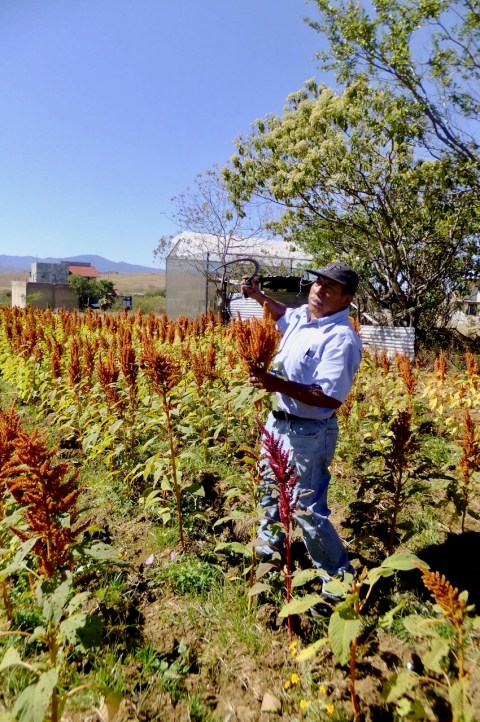
Early strains of A. cruentus were cultivated as far back as the time of the first maize in Oaxaca. The Jardin Etnobotanico de Oaxaca includes a section of early cultivated food crops. I was lucky to volunteer in the garden during the winter of 2019 and had the privilege to work with Roberto Chavez Rendon. Here he is with an early strain of Amaranthus cruentus.
Open-pollinated grain amaranth species can be variable. Many selected strains have full heads laden with seeds. Seed breeders are selecting for shorter plants that don’t shatter. University breeders are developing F-1 hybrids for food production.
Although claims vary, Amaranthus cruentus and A. hypochondriacus were cultivated before 1,000 BC in Mexico. Grain amaranth was an important food source from the Aztecs until European missionaries put a stop to eating or using amaranth in ritual. It is again popular and is best known as “Algeria” , the popped seeds mixed with molasses and pressed into a small cake or bar. An NGO in the Etla Valley of Oaxaca, Puente a la Salud promotes food sovereignty with a focus on grain amaranth not only for cakes but to add as an ingredient in many dishes ground into flour; boiled and used as a thickener in soups; toasted and popped as a cereal. They encourage farmers to grow the crop and teach communities how to make appropriate tech ovens and poppers for cottage industries with amaranth.
Amaranthus cruenthus. Farmer demonstrating harvesting with sickle.
Amaranth has the potential to be an important crop as we move into greater climate change. It is drought-, heat- and pest-tolerant. The nutty flavor can add more nutrients to oatmeal or ground into gluten-fee flour. Try growing this beautiful plant in the edible landscape, or in rows for production. Available from Adaptive Seeds, Bountiful Gardens and Johnny’s selected Seeds.
My earliest memories of Joe-Pye-Weed are from the coastal town in MA where I grew up. In late summer the purple flowers towered over other plants growing wild in what we then called swamps. I would bicycle down the country lane and cut stems of the flowers to make dried flower arrangements. Joe-Pye-Weed was likely named for Joseph Shauquethqueat, a Mohican medicine man who cured settlers.
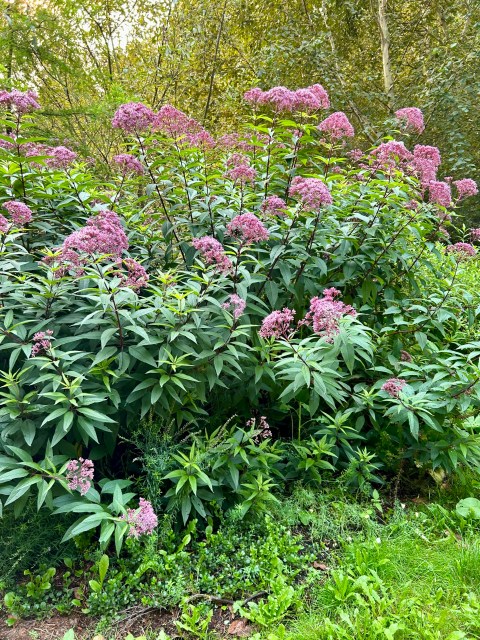
Although the plants are found throughout the East Coast on moist sites, they can tolerate drought conditions. For this reason, they make a good addition to our landscapes. A myriad of hybrids is available for this popular genus. Formally known as part of the genus Eupatorium, botanists have recently reclassified this group into a distinct genus, Eutrochium.
One hybrid has been bred to grow only 3 feet tall. They can grow in part shade and look more robust with regular watering. If the intention is to encourage them to be drought-tolerant, plant them in lots of compost. After three years divide the plants. They will ocassionally reseed, mostly they spread slowly from the crown.
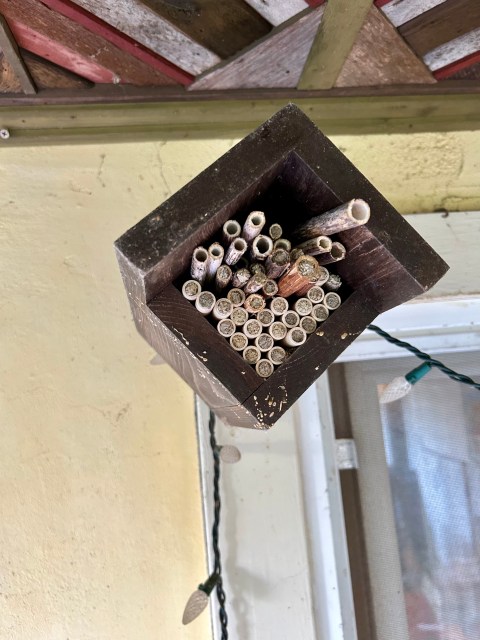
The 6 ft tall hybrid plants I have were divided from a friend’s clump. The hollow stems are a deep purple and after the perennial is finished for the season, these stems make excellent disposable tubes for Mason bee homes!
Landscape uses:
Consider this for outside the deer fence. Eupatorium works well with Miscanthus, perennial sunflower and cardoon for a dramatic late summer perennial display. After growing vigorously in spring and summer, they come into their own in August and September. Rain gardens need plants that can withstand inudated soils.
Other Uses
If you raise mason bees, see my earlier post, then the dried stems of this plant make great disposable nesting tubes for the mothers to lay their brood.The right photo shows the Joe-Pye stems on left and the purchased tubes on right.
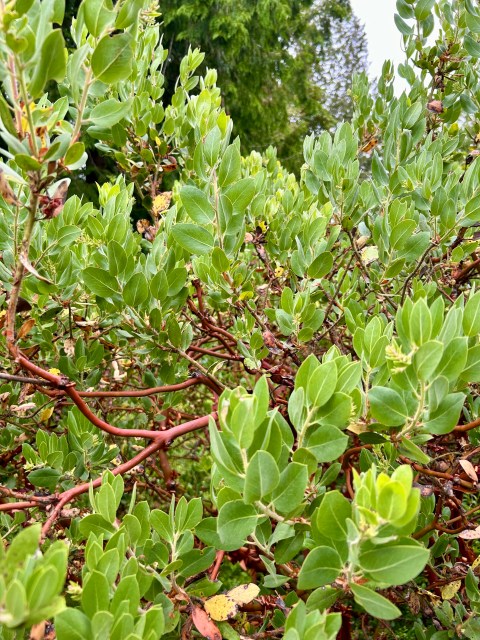
This native manzanita is uncommon on the Quimper Peninsula , but I have seen it growing wild on Cape George Road and close to Kala Point. The above photos are of a shrub that Willy Smothers grew at his place on Marrowstone Island. Recently Janet Welch pruned it to highlight the beautiful peeling bark.
The tiny ‘apple-like’ fruits are eaten by birds, small mammals and patient gardeners. It grows in the coastal scrub community and its range is from Sonoma County, California to Vancouver Island. Along with shore pines, manzanita can grow on and stabilize sand dunes. Native specimens can also be found in the understory of open coniferous forests in the Cascades. The critical factor is gravelly soil. The peeling bark is an attractive feature that it shares with its cousin Madrone. However, it is more closely related to our native groundcover kinnikinnick, Arctostaphylos uva-ursi. In fact a hybrid called Arctostaphylos x media is cross between the two.
Care for Manzanita
Manzanita rewards the patient gardener. Select a site with full sun and excellent drainage. It is best to start with plants in one-gallon containers. Water weekly until new growth appears and then taper off. One way to avoid crown rot is to plant it a little bit higher than the existing grade and mulch with woodchips. Don’t mulch with compost. Use drip irrigation because overhead water will encourage fungal disease. Keep it on the lean-side and avoid adding soil amendments. Once established it is completely drought tolerant.
Here is another manzanita, a hybrid, (probably Arctostaphylos x media) used in the landscape of Kathleen Turaski and Peter Hornsby This drought-tolerant garden includes Ceanothus and red hot poker, Kniphofia. They hope to remove the deer fencing once the plants are mature. But realistically, they may need to keep the fence in place—even if deer don’t browse a plant to death, they often step on and break branches of nearby plants.
Oregon State University, Horticulture Dept has many more photos, including pictures of the flowers and fruits. A great new native plant nursery opened in Kingston. Salish Trees Nursery carries hairy manzanita. Their knowledgeable staff will be a great help. Far Reaches Nursery has a superb variety of Arctostaphylos densiflora—Howard Mc Minn.
This hybrid Manzanita is an excellent drought tolerant choice
This beautiful grey-grey foliage plant with fragrant large white poppies does best where it has room to spread. It is both drought tolerant and—knock on wood—deer resistant.
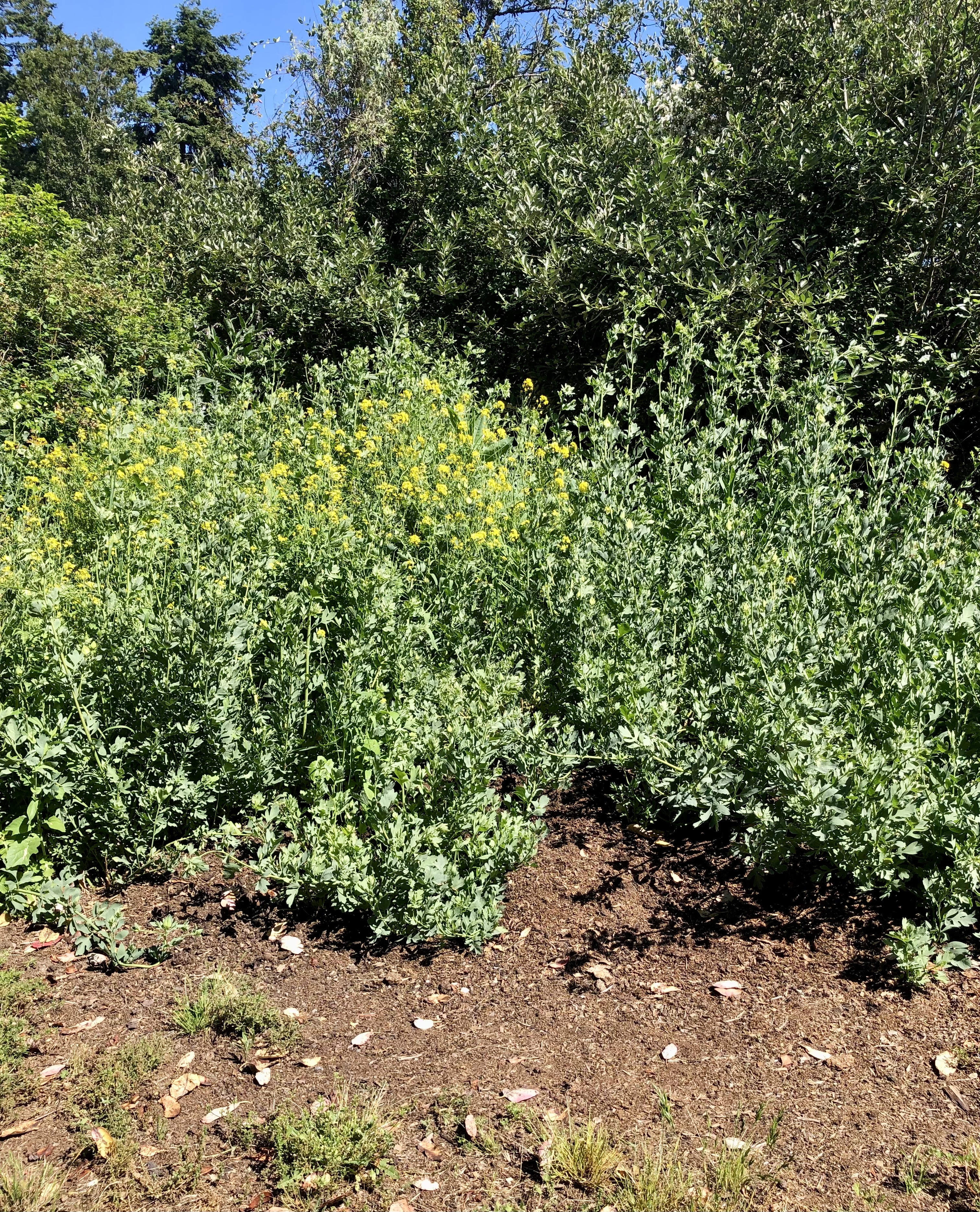
Matilija grows well on the loose soil of landslides. I planted some on a mound about 20 years ago and rarely weed it. After a time, the Nootka rose spread across the mound pushing out the poppy. Not much can hold its own against Nootka rose. (That’s why I only suggest it for creating wildlife hedges where it will be kept in check by mowing or weedeating lawns and fields.) Matilija poppy migrated over to a pile of soil and rotting sod. Last year I had a dump truck load of horse manure delivered near the Matilija planting. Some of the plants were buried in the manure. Instead of suffering, the plant spread throughout what was left of the manure after I moved most of it.
Description
Perennial flower growing 3 to 6 feet tall
Gray-green foliage
4”-8” fragrant flowers. Described as fried-egg flower
Growing requirements and care:
Full sun
Drought-tolerant once established
Soil: flexible, needs good drainage
Cut back to the ground in late fall
Matilija Poppy spread to adjacent aged-manure pile. Wild mustard’s yellow blossoms in the middle of plants.
The Chumash, an indigenous tribe of central -southern coastal California, values the antimicrobial properties. In fact the name Matilija comes from a Chumash tribal leader. The plant’s alkaloids and other secondary substances make it useful for sensitive gums and preventing plaque. Herbalist Micheal Moore describes Matilija as a good first aid plant: the foliage makes a good external wash for sunburn, and inflammation from allergic reactions. At one time this plant was seriously considered as the state flower of California.
In the landscape, plant this majestic plant with other tall drought-tolerant ornamentals like Miscanthus and cardoon. In the foreground use Russian sage, and red hot poker. Once established these are all deer-resistant.
One of my favorite permaculture shrubs is Goumi, Elaeagnus multiflora. This multifunctional plant is easy to grow! The fragrant tiny yellow flowers bloom in April, followed by astringent and sweet fruit by the end of June. In 2018 I ordered plants from One Green World and they recommend planting two varieties, so I planted two Sweet Scarlet and two Red Gem. The former is more robust with dense foliage that hides the fruit from the birds whereas Red Gem has a more open framework, with less foliage and is more productive. If you have limited space and prefer to cook the fruit with a sweetener, then Red Gem is a winner. I mostly eat the fruit raw and share the crop with birds. For the sweetest flavor wait until the fruit is a deeper red.
The genus Elaeagnus is recognized for having a symbiotic bacteria, Frankia that grows in the soil and fixes nitrogen from the air, making it available to the plant. I prune Sweet Scarlet several times a season and use the leafing branches as compost.
Goumi, an Asian native has been cultivated here for at least one hundred years. In Japan it is known as natsugumi. The fruits of this shrub are high in lycopene I wrote a more thorough account here
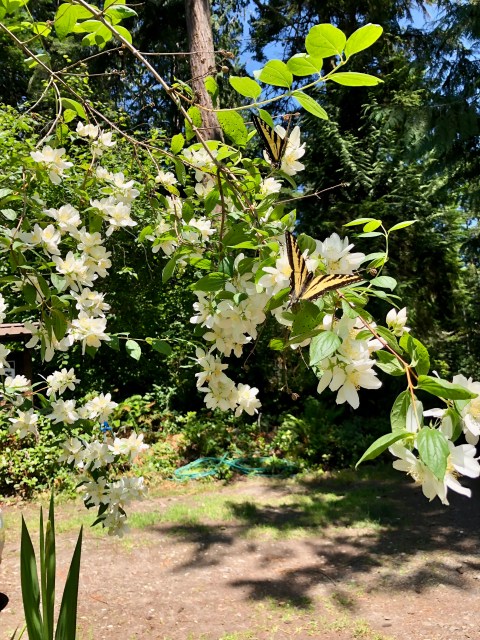
A delightful native shrub for early summer is Lewis’s mock orange, Philadelphus lewisii. This deciduous shrub has a fountain like shape and fragrant white flowers that grow in clusters.
It is equally at home in a cultivated landscape or a natural thicket. My introduction to this native came in a conservation bundle thirty years ago. When the shrubs matured and started to flower, I wondered if a mistake had been made. The flowers looked so much like the Philadelphus coronarius, a European introduction commonly seen on old farms in New England. Our native west coast mock orange is just as beautiful and better adapted!
This multi-stemmed shrub with long arching branches may grow 3-10 ft tall or more. I planted one by a shed where the rain spills off the roof and after thirty years, it is close to 15 ft tall. Since it was part of a native plant thicket planted along the roadside, I never pruned it.
Lewis’ mock orange is equally effective as an ornamental as it is in restoration plantings. It can be used in borders or grouped together for screens. In autumn the foliage turns lemon yellow.
Growing Conditions
Lewis’s Mock Orange is flexible about soil requirements. It prefers soil rich in organic matter but will grow in gravelly soil if provided moisture. Full sun will encourage more blossoms but the plant will be healthy in partial sun. This native will be drought tolerant once established.
Native Habitat
Mock orange can be found throughout the west from British Columbia to California. I am sad to say I have never seen it growing on the Olympic Peninsula but, in Nelsa Buckingham’s book Flora of the Olympic Peninsula, she says it occurs in open habitat here on the peninsula lowlands from north to east. also at mid-elevations from northeast to east.
Benefits
Pollinators love this nectar-rich plant. Birds that eat the seeds in autumn include junco, chickadee, thrush, flicker and finch.
Asparagus shoots are emerging–here is a crop to test our commitment to delayed gratification! Some clients have told me they tried growing asparagus but gave up. This perennial vegetable requires a dedicated bed and will produce for decades if well-tended. Growing asparagus well is time-consuming; let’s look at what it takes. One trick is to prepare the planting site well in advance.
Preparing the bed: Diligently remove all perennial weeds and prevent them from getting established. Add lots of organic matter and water deeply until the plants are established. If the soil is heavy clay, prepare a raised bed. Wait a couple of years before harvesting to allow the plants to get established.
Harvesting: Begins for a couple of weeks in the third year. Snap or cut the shoots at the base. After about five years, harvest for almost 8 weeks or as long as the shoots are vigorous and finger-wide. Stop harvesting before emerging shoots are spindly. By allowing the fronds to grow and nourish the plant, we prevent the plant from losing vigor.
The plants are either male or female. They are sold in nurseries as 1-year old crowns. All-male varieties have the advantage of bigger shoots. Growing them from seed means you will also have slender female plants that put more energy into producing red fruits and seed. Be sure to remove volunteer seedlings so they don’t crowd out the initial crowns. In the autumn after the plants turn yellow, cut them to the ground.
Staking: Do you lean more to the aesthetic or very efficient gardening mode? An asparagus crop is a prime candidate for edible landscaping with its ferny leaves. Stake individual plants or use a horizontal trellis (used for growing long-stemmed flowers) to allow the ferny fronds to sway a bit.
If you have a no-nonsense, efficient approach to the garden then plant them in a row and place wood or metal posts at both ends. Once the plants are tall and start to bend, string a line from post to post and pin the plants in as the plants mature. A month later twine another string about a foot or two above the first to hold them in place. In any event, asparagus is a delicious addition to the garden.
Serviceberry, Amelanchier alnifolia, is a multi-trunk small native tree reaching about 15 feet high and about 10 feet wide. It is an attractive addition to the garden—in spring it is covered with white blossoms and the foliage turns a butter yellow in autumn. Edible fruits are a favorite with many birds, including the cedar waxwing. There is nothing like a small flock of these delicate birds in ones tree to stop the mind!
Serviceberry does best in a sunny spot but will tolerate partial shade. To encourage growth water it regularly until it is established, then only water during the driest months. Since its native range is from Alaska to California, it should be hardy even in the toughest winters.
Botanical name: Amelanchier alnifolia
(ame-e-LANG-kee-er al-ni-FO-le-ah)
Working around the tree in summer I might nibble on the delicious tiny fruits, but mostly I leave them for the birds. Around here that include waxwings, goldfinches, thrushes and towhees, among others. The tree provides nectar for hummingbirds. Washington Native Plant Society offers much more information on using them for restoration.
About 25 years ago, I started a nursery bed for young bare-root trees from the conservation district. I planted them in rows that were easy to water and weed; after a couple of years, I transplanted them around my property. A minimum amount of pruning to shape them has really helped their form. Since they are in the rose family and a relative to our common fruit trees, understanding their growth patterns was straightforward. A row of four trees on the property line is a cheerful herald of spring. These photos were taken in 2015. Since then I forgot to water them during some of our summer ‘heat-domes’ and they have struggled. I plan to water deeply once or twice a month in August and September as needed.
Although I have only grown serviceberry seedlings, there are named varieties that have been bred for fruit and landscape appeal. ‘Regent’ serviceberry is a desirable edible landscape plant that was developed in North Dakota. It grows about 8 feet tall and has delicious berries.
As I munched a couple of fresh black currants, I could not imagine them shrinking down to the sweet little dried currants I buy from the bulk bins at the co-op. Turns out dried currants are really tiny grapes originally from the region of Corinth, Greece. Maybe you knew that, but I didn’t! Now that I’m no longer confused, I can appreciate fresh black currants on their own merits! The big shiny berries are juicy and aromatic with tiny seeds. Sweet is not an adjective I would use for the ones I have tasted, but aromatic, spicy, and juicy are.
A good reason to include black currants in the landscape or food forest would be for their nutritional value. They have more phosphorus and potassium than any fruit; more iron and protein than any fruit save elderberry; and are highest in ascorbic acid (Vit C).
Where currants really shine are in preserves and beverages. Consider canning the fruit with cherries to make a preserve. It could be an interesting treat during the winter holidays served on crackers with goat cheese.
Mature size is about 3-5 ft high and wide. Space accordingly. Because they can tolerate more shade than many berries they grow well with trees, it’s just they produce less. Since they have shallow roots, currants work well with drip irrigation. Mulch helps them from drying out.
New branches come up from the crown and produce fruit the following year. Prune out wood older than 4 years old so most of the wood is one to three-years old growth.













 Sustainable Garden Design