Late autumn usually brings the most precipitation to Port Townsend and the eastern part of the Olympic Peninsula. Atmospheric rivers dump rain. Strong winds blow and fallen leaves swirl. The sun is low in the sky.
The winter vegetable garden is producing, but most growth happened before the fall equinox. Garden beds covered with hoops and floating row covers will be protected from frosts. Fresh salad greens, kale, Swiss chard, and leeks can be harvested throughout the winter. Monitor vegetables for slugs and cut worms. The wet weather favors slugs and snails. Get them now and there will be less generations come spring. Also cut worms are a problem and can be found during routine weeding.
Fruit Trees
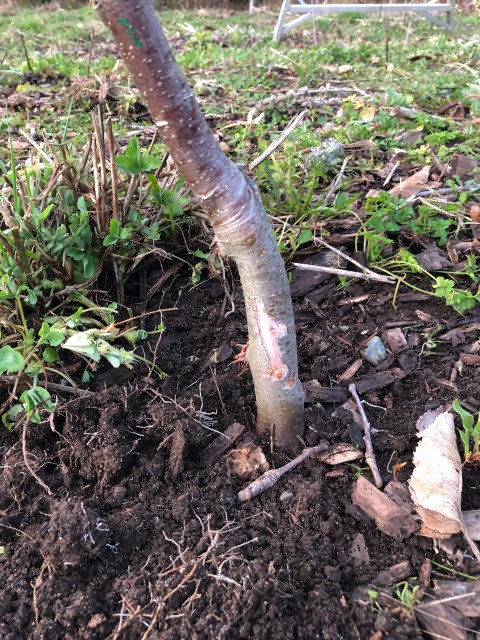
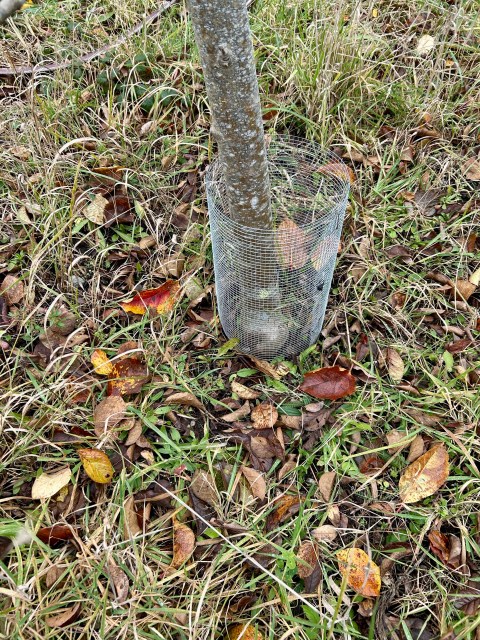
Keep the base of young trees free of tall grass. Better yet, place mulch around the trunks. Winter is the time when voles chew bark and roots. If you have a serious vole problem wrap the trunks with hardware cloth to prevent the rodents from gnawing the bark. Some gardeners even use pea gravel as a mulch to discourage voles.
Late winter is a better time for pruning apple and pear trees, ornamentals and raspberries. The reason not to prune now is because we could have a warm, sunny spell in January that could encourage plants to grow—only to be blasted by a deep cold in early February. Better to wait until mid- February for most pruning. Because wet weather promotes bacterial and other diseases, many gardeners prune plums and cherries after flowering during a sunny spell.
This is a good time for large garden projects that warm the body. Pushing wheelbarrows of manure, woodchips, and making large compost piles. Building planter boxes and retaining walls. Cutting down dead trees or cutting up branches for firewood or hauling them to the yard-waste facility. If you live in the woods, think about a larger tree-free area around the home as future fire-prevention.
Going within
And then there are times to slow down, take walks and notice the birds. Different birds are here for the season. Watch for Pacific wren, red-breasted nut hatch, northern flicker, pine siskin, golden-crown kinglet and spotted towhee.
Winter is a good time to dream about the garden. A garden mentor once said that the garden is forgiving—we can always try again next year. It’s a time to think about rearranging perennial beds and planting more drought tolerant flowers. Or perhaps it is time to think about simplifying a high maintenance garden. For some gardeners seed catalogs arrive in January and planning the edible gardens begin. Now you can think about how you can extend the season or create a garden sanctuary.
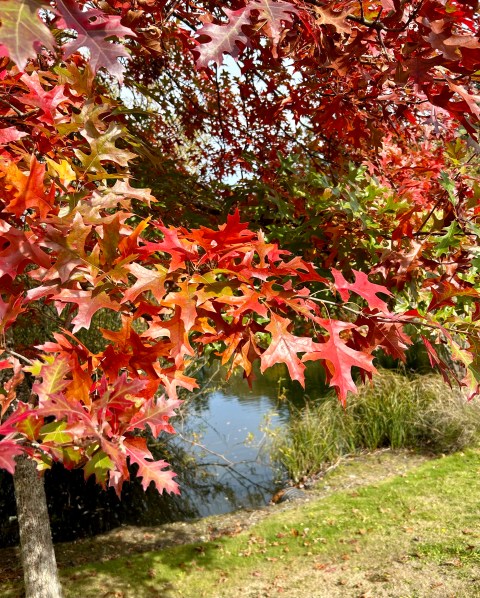
We know it’s autumn when the leaves start turning color. Here a Pin Oak brightens the landscape. It’s time to harvest winter squash and pumpkins, but if your squash isn’t quite ready, perhaps it will have time to continue ripening.
In Port Townsend, our typical first killing frost arrives by the end of November. If autumn temperatures drop slowly over time, plants get acclimated. The high concentration of sugars acts as ‘antifreeze’ in the protoplasm and this is what gives kale and other crops a sweeter flavor after the first frost. But if warm weather prevails until a sudden hard frost hits, then plants are not prepared. Sometimes in November the temperature can suddenly drop twenty degrees! Next month pay attention to the weather forecast and be ready to use floating row covers on crops and newly planted broad-leaf evergreen ornamentals. Forecasts for the next three to six months seem to be leaning toward La Niña but one forecaster described it as “a weak event”. NOAA posted this
Garden Chores
Leaves: Rake and compost, or save for mulch.
Lawns: Over-seed existing ones with white clover, yarrow, English daisy and other flowering plants for pollinators.
Mulch: shrubs and garden beds for winter protection and weed suppression. The increased organic matter will eventually feed the soil ecosystem. (This repeat from last month reinforces how important it is!)
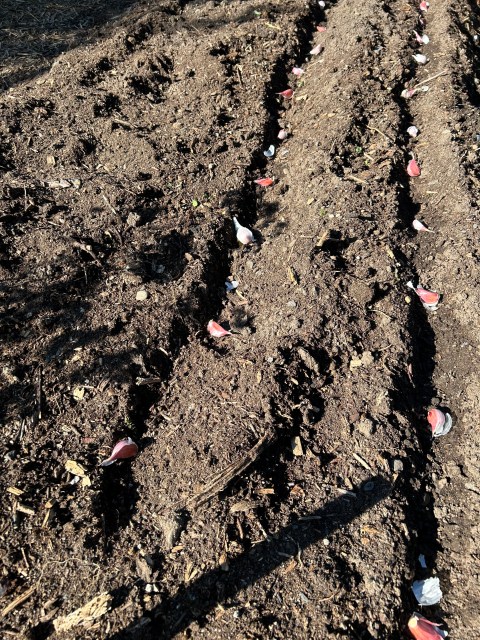
Plant garlic: 2” deep in well-drained soil. Space cloves 5 inches apart with the tip up. Mulch with straw. Prevent disease by rotating crop every 3-5 years. Certified disease free garlic or saving your own is best.
Fruit Trees: Rake and remove any diseased dried leaves, rotten- and mummy-fruits to prevent disease.
Apple tree pests: Examine fruits for coddling moth larvae damage. The Hortsense link offers preventative measures for next year.
Winter squash can be slow to fully mature. One way to encourage this is to remove all small and new squash in September. This allows all the energy to go to the larger, more mature squash. The signs that a squash is mature include a bright yellow spot where the squash touched the ground, the stem becomes brown and corky-textured. Also, as the squash skin toughens up, it becoming duller, and even a bit waxy. It may difficult to make an indentation with your fingernail. These contribute to a good storage crop.
Tinker loved growing the Lower Salmon River winter squash. This variety of Cucurbita maxima is one of the few heritage crops from the PNW, and is known from the Salmon River area of Idaho. It has a distinctive flavor and texture. Seeds are available from Adaptive Seeds.
If you want to taste Lower Salmon River, Midori Farm grows it and the Food Co-op has some now. It takes about 90 days to mature. It can withstand a couple of light frosts although the first one will probably kill the foliage. For Cucurbita maxima aficionados, check out this Johnny’s Seeds critique of flavor and yield for varieties.
After the fall equinox, plant growth slows. We have not had frost yet in early October 20224, so crops are still growing well. Plants are able to sense cold temperatures and respond by producing carbohydrates. In vegetable crops, the high concentration of sugars acts as ‘antifreeze’ in the protoplasm and this is what gives kale and other brassicas a sweeter flavor after the first frost. For more on winter gardens see the OSU Extension Publication
The fall equinox is approaching quickly. The weather is changing. Autumn offers opportunities to plant and transplant; the soil retains warmth longer than the air can—a perfect combination for encouraging root growth. With cooler temperatures and short day length, plant growth slows. The roots have a chance to get established without the additional stress of transpiration or pumping water through plant and out the leaf surfaces.
Autumn is a great time to make compost piles with debris from the vegetable garden, perennial plants and deciduous leaves. Some people prefer to leave the dead foliage and seed heads for spring removal allowing insects and birds food and habitat overwinter. Try it, but note that adding garden clean-up to normal spring chores might overwhelm some gardeners.
Edibles
Fruit trees: Most tree fruits are ripe when they come off easily by lifting and twisting the fruit. Take care not to break off the short branch with buds known as a fruit spur. Cut open an apple —ripe seeds are brown. Pears are picked when they are still hard, before they are fully ripe. They soften from the inside out. Asparagus: Let the fronds remain and turn yellow. Cut them back to the ground after a hard frost. If you have an excess of produce, try making sauerkraut or kraut-chi.
Soil Fertility
Soil Samples: Every couple of years it is worthwhile to take a soil sample and get it tested. Although Jefferson Conservation District no longer handles soil testing, they do lend a tool for extracting clean samples and lab suggestions including A&L. I’ve had good luck with Peaceful Valley Farm Supply.
Compost: Build compost piles in bins or free-standing rectangles. All the autumn decaying foliage from the veggie garden, perennials, and deciduous leaves. Add a source of Nitrogen: manure; powdered fish or bloodmeal; or urine.
Mulch shrubs and garden beds for winter protection and weed suppression. The increased organic matter that will eventually feed the soil ecosystem.
Cover-cropping: After removing spent vegetables, rake the soil, add seeds of clover, field peas, oats, rye, vetch, or fava beans. More information from WSU All seed available at Chimacum Corner.
Pests
Yellow jackets
Recognize yellow jackets and their underground nests. In the autumn listen for buzzing if there are more than two yellow jackets in a location, step back and search the ground for more. Yellow jackets can sting repeatedly. By contrast, bees avoid stinging because it is lethal, it rips out their stinger. Learn to distinguish them.
Spring Bulbs
Plant bulbs and corms now for spring bloom. The earliest bloomers are the small bulbs: snowdrops, crocus, chionodoxa, Siberian squill and winter aconite. Select bulbs that are firm with no signs of injury or mold. If one bulb is lightweight compared to others, discard it. Plant with root side down and pointy end up. Plant at depth three time the length. Small bulbs often are earliest. See Royal Horticulture Society for more information.
By August the garden is often humming along on autopilot, although sometimes the garden (or more likely the gardener) feels tired by late summer. This year, July only got a bit of rain on the last day. The current forecast for the remainder of August is cooler than normal— great for the cool-season vegetable starts, but not so encouraging for the warm season crops that have just started to pump out vegetables like zucchini, beans and tomatoes.
This is a time to reflect on garden priorities. What thrives in your garden? Do you have an intention or a vision for it? Are you in a phase of expansion or contraction? This changes with how the garden matures and ages along with our own interests and energy levels. Walk around and make notes. Beth Benjamin, one of my favorite garden teachers from when I was an apprentice at Camp Joy, in the Santa Cruz Mountains, always said, “The garden is forgiving. Next year we can try again or change how we garden.”
Garden Chores
Shrubs and Trees: Don’t add any more fertilizer that is high in nitrogen to shrubs and trees. Plants need to harden off before the winter cold settles in. All-purpose natural fertilizer with fertilizer ratios in single digits are okay. Apply the last fertilizer to roses by mid-August. Aged compost is also okay.
Perennials: Continue deadheading, ease up on watering and fertilizing. Consider which large perennials could be divided and moved around to fill in gaps in the garden. Determine which plants are aligned with your watering regime. Plan to move or divide perennials in September or October.
Rockrose: They typical rock rose, Cistus hybridus tops out at 3 ft. But, here in Jefferson County can grow to 5 ft. and sprawl. Older shrubs can be completely renovated. Remove dead branches and then prune with a combination of thinning and heading cuts. Sometimes these plants can be pruned into artistic sculptural forms. Remove splayed and sprawling branches.
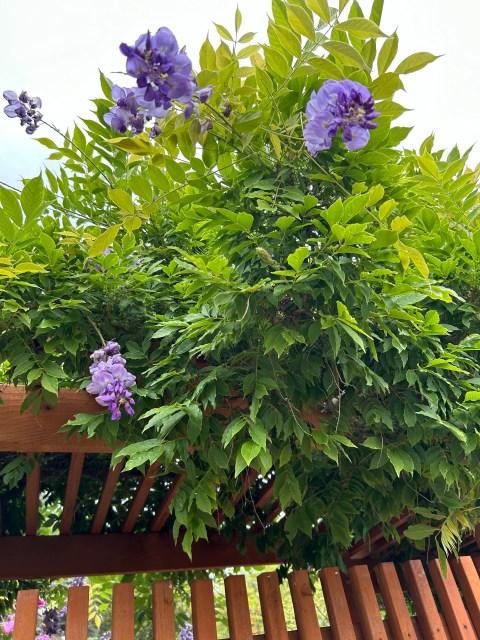
Wisteria: flowers better if pruned regularly. Prune the vine now after flowering and also when the vines are dormant in January/February. Now cut back new growth, leaving five or six leaves on a branch. This will encourage flower buds. In the winter cut back to three buds. These become spurs that will flower next year.
Wisteria was cut back about 2 weeks ago after prolific flowering earlier. Pruning encourages vines to grow flowering spurs
Raspberries: Summer bearing canes (floricanes) that have finished fruiting on the previous seasons wood. Cut these canes to the ground and remove. Any new growth thinner than a pencil should be prune to the ground. Then look at the canes that started this year—primocanes. Select 6-8 canes per plant spaced about 3-4 inches apart. When the plants go dormant in winter cut these canes back to just above top wire. These will produce lateral flowering and fruiting branches next summer.
Fruit Tree late summer pruning: Plum and cherry. Did your trees grow vigorously this summer? If so, prune back branches that pumped out two feet or more new growth. This can reduce next year’s vegetative vigor and encourage fruit buds. But if the tree grew moderately, then wait until winter or even after next year’s flowering before pruning. Poorly executed summer pruning can stunt a tree.
Apples: Sometimes apples get in a cycle of over-producing fruit one year and then the next one the tree is recuperating and has no fruit. Biennial fruit-bearing can happen for numerous reasons. If too many fruit form one year and are not thinned out then the tree doesn’t have the energy to form many flowers the next year. Some apple varieties like Honeycrisp and heirloom Brambley Seedling are naturally biennial fruiting. Other trees fall into this pattern through lack of nutrients, irregular watering, or one winter frost destroys the blooms. RHS always has good information. Thinning flowers (once you confirm they are pollinated) is more effective than thinning young fruit. Advanced gardeners can look at the Royal Horticulture Society’s post on summer pruning of apples and pears.
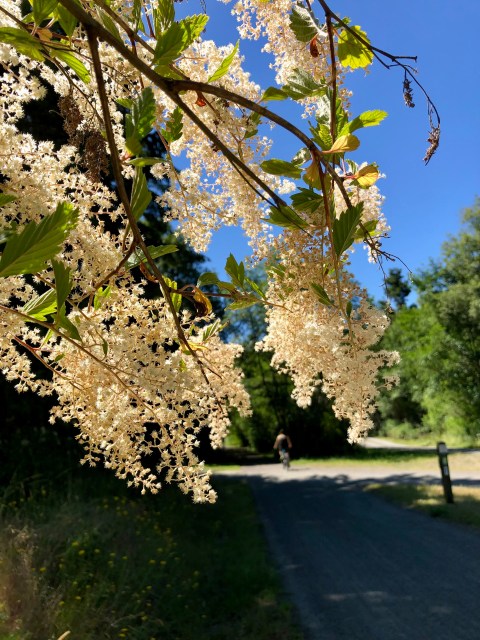
Oceanspray, Holodiscus discolor has cascading clusters of tiny cream-colored flowers.
Summertime has arrived on the Olympic Peninsula’s rainshadow! Native shrubs like Oceanspray, Holodiscus discolor and Hardhack, Spirea douglasii are blooming. Others are fruiting: salmonberry, thimbleberry, and red elderberry The garden is filling out with lush greens, and warm-season crops are starting to develop and mature. Just yesterday I saw a garter snake with a big black slug in its mouth.
Edible Garden
Winter garden: Select beds that have finished producing and replenish with compost. Rotating crops prevents diseases from building in the soil.
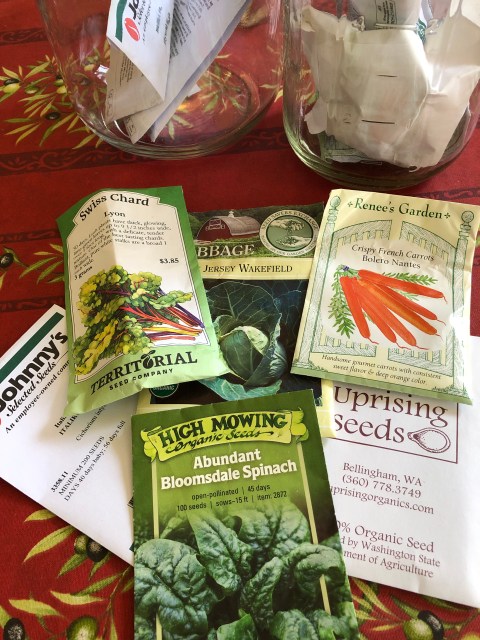
Time to direct sow brassicas and greens, beets and carrots. Varieties: Purple sprouting broccoli, Lacinato and Red Russian Kale, Early Jersey Wakefield cabbage, Winter Density lettuce, Abundant Bloomsdale spinach, Bolero carrots.
Make sure to leave room for your garlic crop that can be planted in November.
Tomatoes: Remove suckers and continue staking.
Weeding: Make a quick pass once a week to eliminate weeds. Some weeds can be companion plants, however they also compete for nutrients, water and light.
Curing garlic: Harvest garlic bulbs when 4-5 leaves are still green, taking care not to damage them. Over-watering or leaving them in the ground too long causes the bulbs to split or become prone to disease. Fresh garlic is fragile. Clean the garlic by gently pulling down the top leaf and removing it from the bulb. ( If the leaf has signs of rust, be sure to throw away the skins instead of composting to prevent spreading the spores.) Brush soil from roots.Drying in a well-ventilated place takes a couple of weeks. Check the stems and when no green remains inside, they are safe and should store well.
Strawberries: Renovate June-bearing varieties (not the everbearing, day-neutral ones). Cut to 2-3 inches. Mowing can accomplish this. Cut out and remove weak and crowded plants. Fertilize with a balanced natural blend like Down To Earth.
Flowers: Save seed from annuals and biennials including: nasturtium, bachelor buttons, foxglove, calendula and bread-seed poppies, cosmos. Dry them in a cool dark place and label the envelope with plant, and date.
Landscape
Time to review the garden. If some plants didn’t make it after the last couple of years of climate ups and downs, maybe replacing part of the landscape with natives could be on your horizon. If you have lots of space maybe it’s time to consider planting a hedgerow that will help slow the wind or screen the road.
Bulbs: Order bulbs in the next few weeks to plant in the fall. This is especially true if you want to plant some more unusual bulbs. When they arrive check the bulbs to ensure there is no disease or damaged bulbs. Store them in a cool dark place until you are ready to plant. I often order from Johnny Scheepers. Another company, that is good and local is RoozenGaarde.
Irrigation: Determine which plants need extra care and keep their roots growing. Many established shrubs won’t need any water until August, but in the first couple of years a plant will develop nicely and be healthier if it is watered regularly. If plants look weak or diseased, give them a boast with compost and liquid seaweed fertilizer.
Lawns: Port Townsend homeowners have long had an unspoken agreement that green lawns are not a requirement for a beautiful landscape. A well-kept yard is often mowed until mid-July and then the grass goes dormant and the hawkweed or dandelions provide food for pollinators. When the autumn rains return, our lawns green-up again. At that time, spread dolomite lime. This provides calcium and magnesium as well as making the soil less acidic and more inviting for grass. In fact, many people prefer not to have lawns. But if grass is already there, allow it to go dormant.
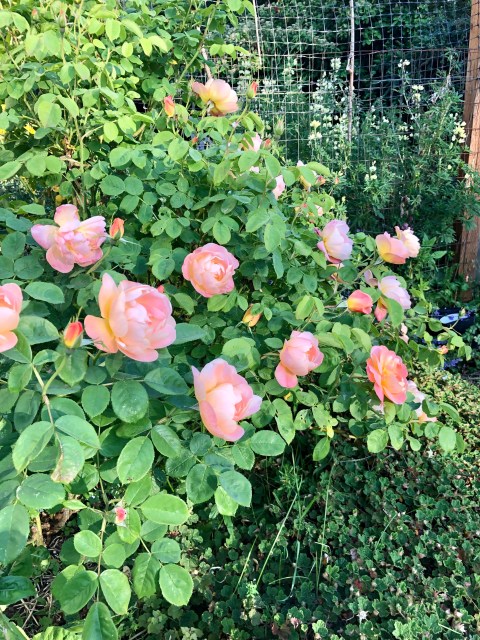
The garden is a riot of blooms bursting with color. Let’s take a look at English garden roses, one of my favorite. Goumi, the earliest fruit in my garden has a sweet-tart flavor that I love to nibble. The garden is alive with bird songs! Robins in the garden are fun to watch as adults seek out worms and their fledglings beg for food.
By now in the vegetable garden, the cool season crops are producing and warm season crops are in the ground. Before the month is out we will be preparing for the winter garden.
Edibles
Tomatoes: Begin training indeterminate tomatoes. Train a couple of main stems. When new shoots form between the main stems and a leaf, pinch out these suckers. There will be less fruit but they will ripen sooner. Remove some foliage if it is excessive but leave some to protect the fruits from sun-scald.
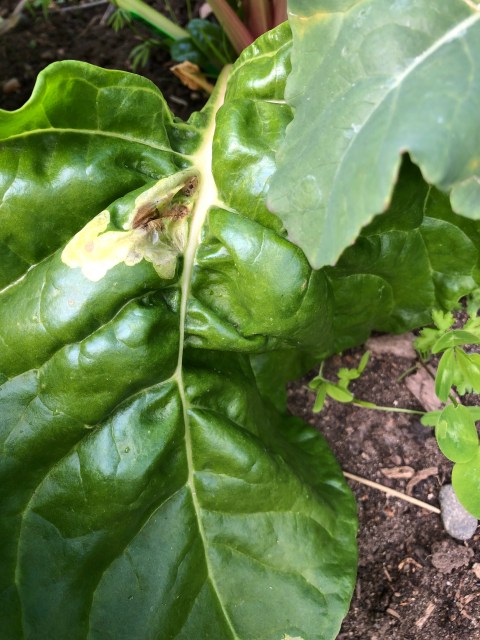
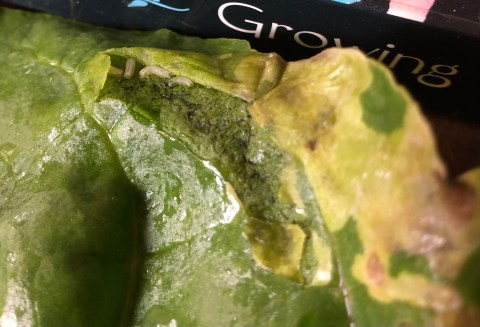
Vegetable Pests: Watch for signs of leaf miners on spinach, beets and Swiss chard. The larvae form tunnels between the layers of leaves that look like yellow trails and pockets. As the fly larvae metabolize the plant they deposit black frass. Hand pick the leaves and trash them. Don’t place them in compost!
Swiss chard leaf with yellow spot indicating leaf borer within. Leaf miner maggots visible on top left. The top layer of leaf was peeled back to reveal these fly larvae.
Garlic: Harvest scapes ( curvy shoots with flowering head) Stop watering when leaves start to turn yellow. Harvest when only 4 leaves are still green, or the bottom 1/3 of foliage is yellow. For longer storage, cure (dry) garlic with the tops and roots for several weeks, allowing nutrients into the bulb. Cut tops and roots leaving as much skins to protect garlic bulbs.Prevent the spread of garlic rust fungus by starting with certified disease-free bulbs, rotate crops and use a mulch of arborist chips to prevent rust from establishing in soil.
Asparagus: Mature fronds can get top heavy and fall, sometimes snapping at the base. For attractive plants in an edible landscape stake individual plants or prop up with bamboo. For asparagus in rows place a metal t post at each end and run jute twine between the posts. To keep the plants together weave the string between plants. In the fall when the shoots die to the ground, the jute can go into the compost along with the dead asparagus.
Fruit Trees: Thin fruit, and watch for signs of fungal disease that spreads by splashing water. Use neem oil spray or sulfur powder. Look for and destroy tent caterpillars. Patrol for slugs and snails.
Winter vegetable garden It can be confusing to newbie gardeners that just as the summer solstice arrives, we begin sowing seeds for winter harvest! Sow brassicas including winter cabbage, kale, and purple sprouting broccoli. from mid- to late June. If you miss this window, buy vegetable starts at the coop next month. Purple sprouting broccoli is the most successful winter broccoli with its small and numerous shoots. Early July is time to sow the following: carrots, beets, Swiss chard, kohlrabi and radicchio. (Crops for late fall harvest grows through the autumn equinox and then growth slows almost to a standstill.)
Ornamental Plants
Deadhead Rhododendron. By gently snapping off the flower cluster, seeds won’t form, instead we allow the shrub’s energy to be directed into growing foliage and starting next year’s flower buds.
Perennial Flowers: Some late summer and fall- blooming perennials, pinch back now for sturdier and shorter stems. Remove the top 1/3 of the following plant Asters, mums, beebalm (Monarda), and Joe-Pye weed.
Fungal diseases are exacerbated by rain. Powdery mildew is not one disease but a symptom.Caused by different fungal diseases, the symptom is white circular patterns with a powdery texture, becomes gray or brown over time. The disease is more than cosmetic; it inhibits photosynthesis. It can overwinter in buds and also on dropped infected foliage on the ground. Humid weather and crowded conditions that cause stagnant air encourages fungal growth. Neem oil or sulfur can be effective when used at first signs. Safer brand Fungicide is another option.
Winter Injury: By now many plants have recovered from the winter. Evergreen shrubs that dropped foliage are now leafing out. Old stands of red-hot-poker that completely died to the ground with many rhizomes turning to mush are now leafing out. All these plants require monitoring, removing dead wood and watering during dry spells.
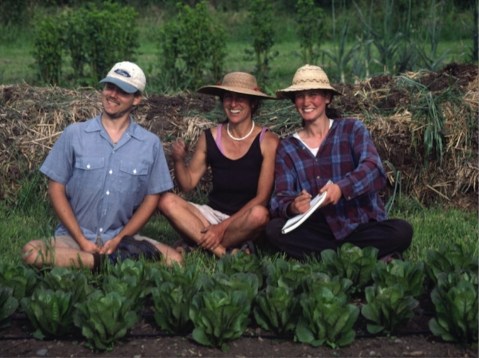
Tinker with apprentices at Abundant Life Garden 1990’s
Tinker was an advocate of living lightly on the Earth by conserving resources and living a joyful life of volunteer simplicity. This post is for local farmers who may not know her legacy and want to continue this important work.
Along with Judy Alexander, Tinker spearheaded the Dryland Farming Project, exploring the limits of what staples can be grown locally with little inputs, especially without irrigation. “We need to research ways that we can locally and sustainably grow staple crops such as grains, legumes, and seed crops.”
Today we have a vibrant farming community and many people share Tinker’s passion. Organic Seed Alliance develops seeds that grow organically with less inputs. Finn River is growing wheat and many others are working together toward a sustainable farming future.
Garden soil acts as a bank account, holding available water.” Tinker Cavallaro gave a presentation based on the Dryland Farming Project ten years ago at the Quimper Grange. Tinker discussed her presentation with me beforehand and I wrote up the handouts. These are some of the notes:
Understanding our climate and the site’s soil properties is the foundation for making smart choices in garden irrigation.Rainfall quantities vary across the Quimper Peninsula. Close to the mountains, Quilcene gets much more rain. Port Townsend is located in the rainshadow of the Olympics, a unique area with less rainfall than most of Puget Sound. The rainshadow of the North Olympics extends from Sequim to the San Juan Islands.
“As crops grow they make heavy withdrawals from the garden soil bank account.” We will investigate more about soil properties but here are some basic tips:
Practices and techniques
Develop the habit of checking the soil for moisture
Use drip irrigation or low-volume sprinklers
Use water-filled containers with holes placed next to larger plants
Foliar spray or fertigation with liquid fertilizer known as ‘tea’ made of water and organic matter such as compost, manure, seaweed or nettle
Raised beds hold moisture better than rows do
Plant seeds and transplants deeper than normal in the soil
Crops that do well with no extra water
Early Spring Crops
Peas
Greens: mustard, arugula & early lettuce
Kale, cabbage, early broccoli & radish
Direct-sown early carrots & beets that are heavily thinned
Grains
Potatoes
Late Spring-Sown Crops
Field corn
Amaranth, quinoa
Winter squash
Dry beans including field peas, garbanzos, lentils & fava beans
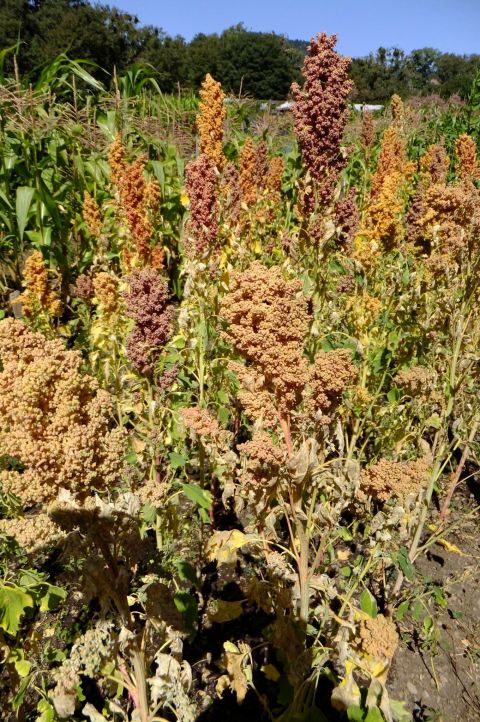
Quinoa trials at Ecology Action in Willits, CA
Crops that require summer irrigation
Celery & celeriac
Napa cabbage and summer brassicas
Summer lettuce & spinach
Onions if you expect sizable bulbs
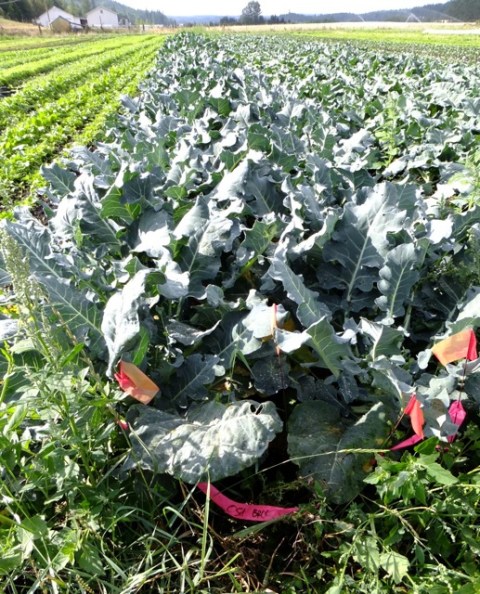
NOVIC Broccoli Field Trials at Red Dog Farm, Chimacum Washington
Understanding the Soil’s Capacity
Our rainy season, extending from fall through winter, provides enough water to bring our soils to field capacity, or the ability for the soil to hold all the moisture possible. Summer rains, on the other hand, are usually insignificant. In our windy location the little rain that falls often evaporates.
As plants grow they make heavy ‘withdrawals’ from the garden soil bank account. Hot sun and wind cause plants to transpire moisture. The roots of plants pull soil moisture from the soil, up through the plant and out the surface of leaves. Foliage gives clues as to the plants ability to conserve water or use it freely. Drought-tolerant plants from dry climates tend to have small leaves or grey foliage. Magnification reveals tiny hairs that shade the leaf surface. The lush foliage of leafy green vegetables on the other hand can withdraw much water if not properly managed.
How plants utilize water
Plant roots, in a symbiotic relationship with soil microbes form a region known as the rhizosphere, the active site for water and nutrient uptake. Plant enzymes dissolve insoluble starches and oils that are required for plant energy and change them into water-soluble sugars. Roots draw moisture from the soil to their ultimate lateral spread and depth. The size of a plant’s roots indicates drought tolerance.
Healthy soil includes air and water. This water can move upward through the soil by a process known as capillary action. Water is drawn up in a wicking action through the gaps between soil particles. Soil texture determines the soil’s capacity to hold moisture. Sand holds one inch of water per foot of soil. Sandy loam (soil with a bit of silt and clay) can retain 2 inches of water per foot; clay soil retains 3 inches of water per foot. The point is that clayey soil holds three times as much water as sandy soil. If the capillary action is not strong enough then the gravitational pull will sink water deeper into the soil.
Cohesion describes when water is attracted to water and adhesion describes when water is attracted to other materials. When irrigation or rain moistens the ground, soil particles act almost as magnets and water adheres to them. Like a wet sponge, the ground is holding as much water as possible. Water is highly cohesive so gravity will pull water deeper into the soil. This happens when the water cannot adhere to the surface of the soil. If the soil structure has enough pores and humus that acts like glue, more water can be utilized. Root systems have to be able to penetrate the soil, become more extensive, and grow deeper to utilize the soil water.
Plants are much healthier if they can aggressively seek new water in soils unoccupied by roots and grow deeper and wider. Not only will vigorous plants be capable of withstanding drought and wind, they will also create more flavors and sugars.
( For more information on this important topic see Steve Solomon’s Growing Vegetables West of the Cascades, Ch 5)
Springtime can be overwhelming. Everywhere we look something is calling out in need of attention. One of my garden mentors, Beth Nelson from Camp Joy Gardens, always said, “The garden is forgiving. If we don’t get it right this year, we can try again next year. Be patient with yourself.” Enjoy the time in the garden. Here are suggestions for where to begin:
General garden maintenance
Liquid fertilizer like fish and seaweed solution benefits plants more quickly in cold soil than the dry fertilizer.
Control weeds before they flower.
In the edible garden
Time to pull back straw mulch to allow the soil to warm.
Plant bare-root strawberries and raspberries
Transplant vegetable starts
Cover pea bed with floating row covers
Direct sow root crops like radish, spinach, chard, lettuce, mustard greens
Top-dress beds of perennial crops and flowers with well-aged compost.
Landscape care
Read our post about pruning flowering shrubs
Replenish alder chips or arborist-chip mulch. Be careful with trunks of shrubs & trees—no mulch within six inches. (Mulch can keep the trunks moist and allow disease organisms to breed.)
Add lime to lawns.
Learn to appreciate the many benefits of weeds in the lawn—think polyculture!
Mow grass leaving it about 2 1/2 inches tall.
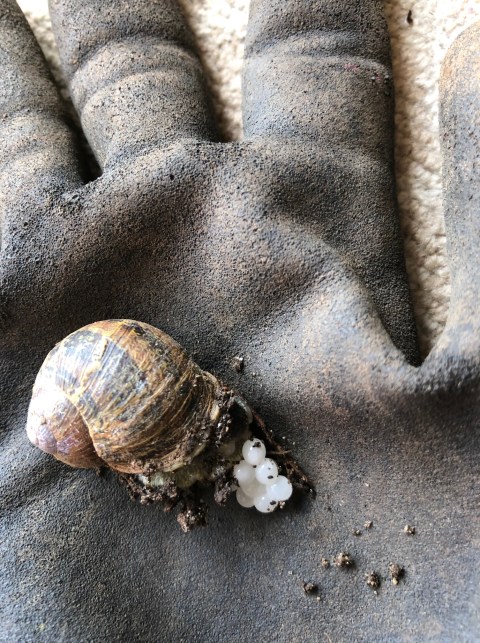
Hand pick & destroy slugs and snails. Learn to recognize snail eggs.
Sprinkle Sluggo or other nontoxic slug bait
Vegetable Starts
Start seeds indoors if you can grow healthy starts that are sturdy and dark green. Inadequate light causes the seedlings to grow spindly and fragile. Indoor lighting is dim compared with sunshine. Even a cloudy day offers more light than a typical florescent grow-light.
Once they have germinated, place the seedling trays outside on nice days. At first place them in a protected bright spot and then a day or two later, set them in full sunlight. And a light breeze will help then get sturdier. Also, by placing them outside, and bringing them in at night, the seedlings have begun the harden-off process. Otherwise, if they are greenhouse grown and then directly placed in the cold garden soil, the young plants can go into shock rather than grow.
The goal is to transplant them to the garden when they have two or three sets of true leaves. A grey, overcast day helps prevent transplant shock. If all this is too much effort, buy the vegetable starts. You can always sow your own seeds later in the season. We are so lucky here in Jefferson County to have excellent seedlings available from Midori Farm and Red Dog Farm. They are available now at the PT food Coop and Chimacum Corner Farmstand. They carry an array of vegetable varieties that thrive here.
Pruning
Shrubs that produce vigorous replacement shoots are good plants to learn pruning. These flower on one-year old wood. If you only shear them, they never flower well. Also there will be a lot of thicker woody stems. Remove any crossing branches and weak or dead stems.
Proper pruning is a combination of thinning out—removing the branch all the way back to a larger branch, and heading back—what hedge shears are good for. Most novices just do heading back cuts. The problem is the plant grows into a dense hedge with just an inch or two of vegetation on the surface. A healthy pruning jobs increases the depth of foliage by allowing light and air in to the shrub.
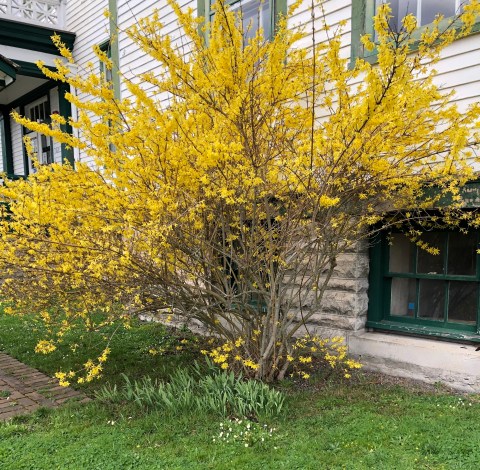
Examples are flowering currant, mock orange (or Philadelphus), forsythia, kerria and flowering quince. Wait until the flowers are faded before pruning.
Making Lists
Springtime can be overwhelming. Everywhere we look something is calling out in need of attention. One solution is making lists. Walk through the garden and write down anything that needs attention. Next set priorities. Sometimes fifteen minutes is enough time to tackle a crucial task. To borrow a term from construction industry, consider making a punch list. Keep a running list of projects that require additional help or some expertise. At the end of the day, it is satisfying to cross off items. Of course, sometimes I enjoy puttering in the garden, skipping around in a relaxed fashion. This can be a form of horticultural therapy where enjoying the clouds skittering across the sky, or watching insect behavior is just as satisfying as accomplishing something.
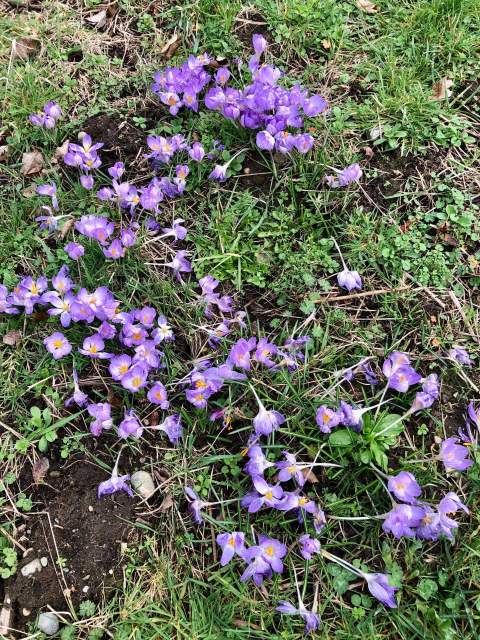
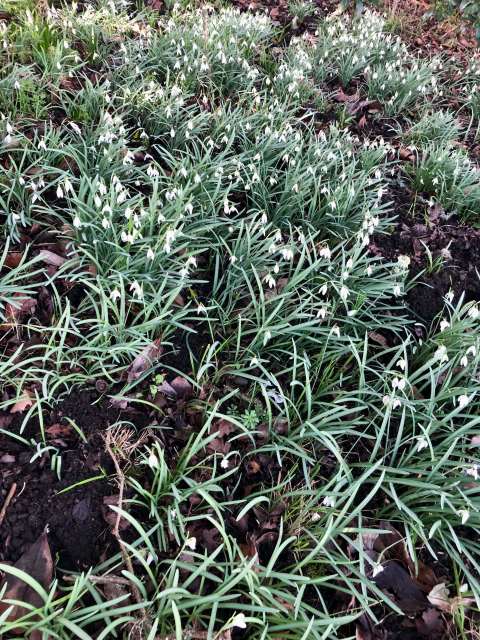
Species crocus, known as snow crocus can withstand a late snow and cheerfully rebound. This Tuscan Crocus, botanically known as Crocus etruscus Zwanenburg, once planted will naturalize. Here they are in the orchard. They bloom about the same time as Snowdrops. The trick to encouraging their growth is to hold back on mowing or weed-eating until the foliage has died down completely. I buy bulbs locally or from an old bulb house https://www.johnscheepers.com
Spring may seem distant after the snow on Feb. 27, but the sun is getting higher in the sky and birds are returning. I weeded the asparagus this morning and got to see up close just what is changing. This is a good time to remove any perennial weeds from the asparagus bed. Th trick is to move gently around the asparagus to avoid nicking the new spears forming underground.
The crowns of perennials are starting to show signs of foliage: angelica, lemon balm, even the California fuchsia (Zauschneria) Along with the cool season weeds of deadnettle (Lamium) and shotweed (Cardamine hirsuta) are seedlings of several delightful annual flowers including Love-in-a-Mist.
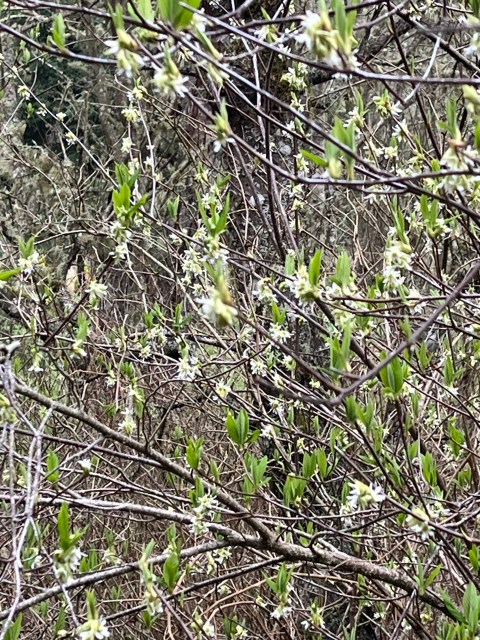
Around here spring starts blooming in the woods with Osoberry. I love the way tips of branches end in two leaves like palms held together in prayer or the anjali mudra.
Pruning Raspberries
An easy place to learn pruning is in the raspberry patch. Unlike fruit trees, there are not so many variables. The stems, known as canes are fairly simple and easy to cut with hand clippers. No saw or loppers are required. Raspberries tend to be vigorous so if you make a mistake and remove a lot it’s okay. Thin out canes to about 4 inches spacing Remove any spindly or diseased canes. Below are before and after photos.
Raspberry: There are two types of raspberry, summer-bearing fruits and autumn-bearing fruits.
The summer-bearing varieties (Cascade Delight and Tulameen) require two seasons to fully mature. The first-year leafy young canes shoot up from the roots; but not until the second season do these canes produce flowers and fruits. Some people cut these So, after the second-year canes fruit, cut them to the ground. Last year’s leafy canes are topped. These will produce flowers in early summer and abundant fruits in July for at least a month. For more on raspberries
Fruit Trees
Now is the time to prune apples, pears and other fruit tress, except plums and cherrys. In a future post I will demonstrate in a video how to prune. I love it and think of pruning as a form of sculpture. If you want to learn now, I suggest getting a lesson, watching a video or volunteering with our local gleaners. If you are not familiar with the gleaners, you must check out what they are doing. i have volunteered with them from time to time and it is so much fun!
One of the best spring chores in the orchard is foliar feeding. By spraying liquid fertilizer directly to the new foliage, and even the branches, nutrients are absorbed faster than when added to the soil. This is partly because the ground is still cold. Foliar feed in the spring when the buds are beginning to burst with about 1/4 inch of green showing. Then again when the flower buds are pink and later when the petals drop. Spray early in the day to avoid wetting pollinators. This recipe was created by orchard expert Michael Phillips. Besides the nutrients provided by the liquid seaweed and fish fertilizer, neem is an amazing tree from the tropics that can disrupt insect pest reproductive cycles. Mix the ingredients in a pump sprayer. A Backpack sprayer is most efficient if you have many fruit trees.
2 gal H2O
2T Neem
2T Kelp
5T Fish Emulsion
Growing Peas
Fresh peas off the vine are one of the delights of a home garden. We often rush to get the seeds sown, but the ground can be too cold. The seed languishes and is vulnerable to rot and disease. Cutworms and slugs can attack the emerging seedling. Mid- or late-March will be soon enough. If your soil is heavy clay you might want to wait another week.
Sprouting the seed indoors gives it a jumpstart. Either soak overnight and set on paper until the sprout is ½ inch long or grow the seeds in small pots and transplant when the first two sets of true leaves emerge. If the seedlings were grown indoors, be sure to set the pots outside and bring them back in at night for a couple of days or more to let them harden off. (If you are late getting your pea crop going, we are extremely fortunate to have a selection of vegetable starts from Midori Farm and Red Dog Farm.
Favorite Pea Varieties
Snap peas: Sugar Snap, Sugar Ann and Oregon Sugar Pod
Snow peas: Oregon Giant and Avalanche
Shelling peas: Arrow and Lincoln.
Winter Storm Damage
Frost damaged leaves can appear water-soaked or they might turn dark brown and black, then drop off.
After a relatively mild December, plants were not hardened off, but still growing. Many evergreen shrubs have leaves that are brown and dropping. Although some look awful, restrain the urge to cut back the shrubs. Patience. Experts advise waiting until May or June to determine if plants are dead or just weakened. Plants like hebe from New Zealand, hardy fuchsia and some Mediterranean subshrubs like rosemary can look bad but will probably recover.
Arctic Blast
Thirty-three years ago, I worked here as gardener when we were hit with a severe arctic blast. Plants that looked terrible did recover slowly. The recent storm in January was very hard on gardens. Although some evergreen shrubs look awful, restrain the urge to cut them back. Patience. Experts advise waiting until May or June to determine the level of damage. The plants are weakened and will require extra attention in the coming year. Consistent watering based on their need, compost and some fertilizer will help. See this post on foliar spray seaweed. Some less hardy plants including newer introductions from New Zealand and Australia may die all the way to the ground but the roots could still be alive.
WEATHER
Cliff Mass, a meteorologist at Univ of WA has a blog that can teach you about our local weather https://cliffmass.blogspot.com/
He is not always right and his politics are questionable, but I read him regularly because his weather forecasting is good and he provides clear explanations about weather and climate. In the future, the winter weather event we should be alert for is the Oscillating Polar Vortex. That’s when an arctic blast rushing down from the Fraser Valley can slam the Olympic Peninsula.
Watering plants (Or using a hand-pump sprayer to spray as a foliar feed) with seaweed fertilizer provides micronutrients that can help all plants be more resilient. Research shows that kelp fertilizer strengthens plants to withstand abiotic stresses including drought and cold. I have used seaweed liquid fertilizer (Maxicrop) for 40 years and it is an essential part of my gardening. Seaweeds are rich in plant hormones that trigger the plant’s own hormonal production. And finally, seaweed extract strengthens the plant through its impact on the microbiome in the soil around the roots.
Foliar Feeding with Liquid Seaweed
Foliar feeding is a way of getting nutrients to the plants through openings in the plants leaves. It is faster than applying the same product to the roots. Use a hand-pump sprayer or backpack sprayer and apply in mornings or when it is not windy. Seaweed fertilizer provides micronutrients that can help all plants be more resilient. Research shows that kelp fertilizer contributes to abiotic stresses including drought and cold. Seaweeds are rich in plant hormones that trigger the plant’s own hormonal production. And finally, seaweed extract strengthens the plant through its impact on the microbiome in the soil around the roots.






 Sustainable Garden Design