October Garden Chores

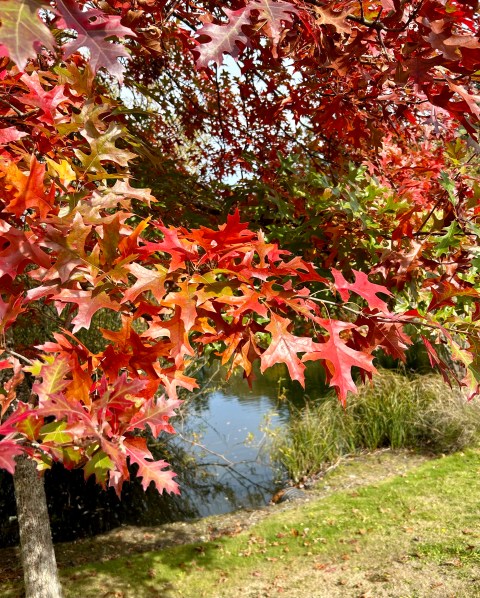
We know it’s autumn when the leaves start turning color. Here a Pin Oak brightens the landscape. It’s time to harvest winter squash and pumpkins, but if your squash isn’t quite ready, perhaps it will have time to continue ripening.

In Port Townsend, our typical first killing frost arrives by the end of November. If autumn temperatures drop slowly over time, plants get acclimated. The high concentration of sugars acts as ‘antifreeze’ in the protoplasm and this is what gives kale and other crops a sweeter flavor after the first frost. But if warm weather prevails until a sudden hard frost hits, then plants are not prepared. Sometimes in November the temperature can suddenly drop twenty degrees! Next month pay attention to the weather forecast and be ready to use floating row covers on crops and newly planted broad-leaf evergreen ornamentals. Forecasts for the next three to six months seem to be leaning toward La Niña but one forecaster described it as “a weak event”. NOAA posted this

Garden Chores

  • Leaves: Rake and compost, or save for mulch.
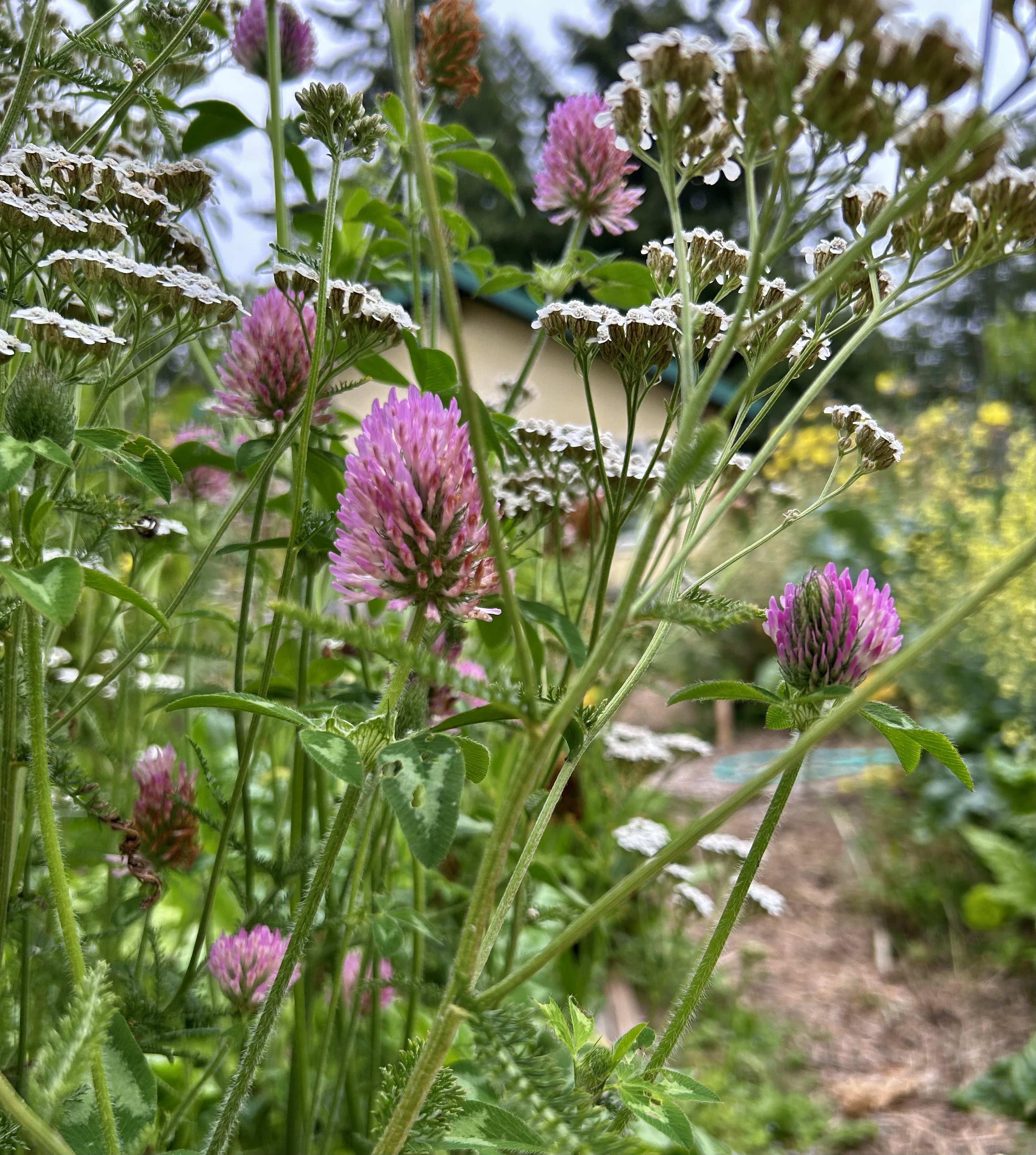
  • Lawns: Over-seed existing ones with white clover, yarrow, English daisy and other flowering plants for pollinators.
  • Mulch: shrubs and garden beds for winter protection and weed suppression. The increased organic matter will eventually feed the soil ecosystem. (This repeat from last month reinforces how important it is!)
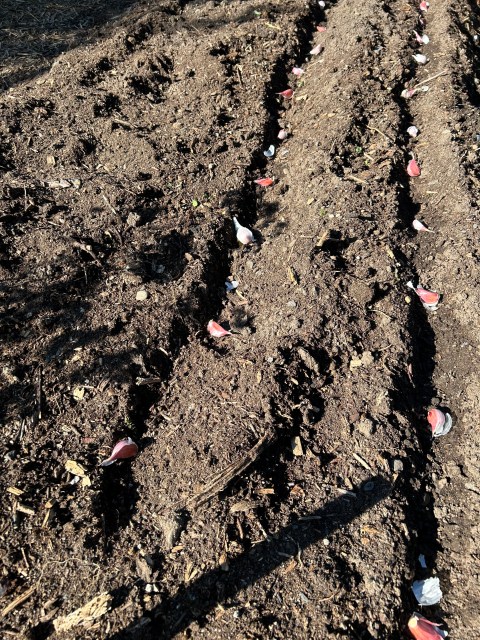
  • Plant garlic: 2” deep in well-drained soil. Space cloves 5 inches apart with the tip up. Mulch with straw. Prevent disease by rotating crop every 3-5 years. Certified disease free garlic or saving your own is best.
  • Fruit Trees: Rake and remove any diseased dried leaves, rotten- and mummy-fruits to prevent disease.
  • Apple tree pests: Examine fruits for coddling moth larvae damage. The Hortsense link offers preventative measures for next year.
Tinker and apprentice Brianna at Abundant Life Seed Foundation in 2001. Upper Salmon River squash

Winter squash can be slow to fully mature. One way to encourage this is to remove all small and new squash in September. This allows all the energy to go to the larger, more mature squash. The signs that a squash is mature include a bright yellow spot where the squash touched the ground, the stem becomes brown and corky-textured. Also, as the squash skin toughens up, it becoming duller, and even a bit waxy. It may difficult to make an indentation with your fingernail. These contribute to a good storage crop.

Tinker loved growing the Lower Salmon River winter squash. This variety of Cucurbita maxima is one of the few heritage crops from the PNW, and is known from the Salmon River area of Idaho. It has a distinctive flavor and texture. Seeds are available from Adaptive Seeds.

If you want to taste Lower Salmon River, Midori Farm grows it and the Food Co-op has some now. It takes about 90 days to mature. It can withstand a couple of light frosts although the first one will probably kill the foliage. For Cucurbita maxima aficionados, check out this Johnny’s Seeds critique of flavor and yield for varieties.

After the fall equinox, plant growth slows. We have not had frost yet in early October 20224, so crops are still growing well. Plants are able to sense cold temperatures and respond by producing carbohydrates. In vegetable crops, the high concentration of sugars acts as ‘antifreeze’ in the protoplasm and this is what gives kale and other brassicas a sweeter flavor after the first frost. For more on winter gardens see the OSU Extension Publication
Weeds and our perspective

When I would help Tinker in her garden, often she dug up dandelion plants as if they were precious. The roasted roots made a delicious tea that she savored. Imagine if the plants we detested somehow changed in our mind to become useful resources. So much in life is how we frame something. If we look at a weed and notice a couple insect pollinators insects sipping the nectar, maybe the ‘weed’ isn’t so bad. That doesn’t mean we have to keep the plant. I have had weeds that I once hated and then learned to accept them, even as I removed them.

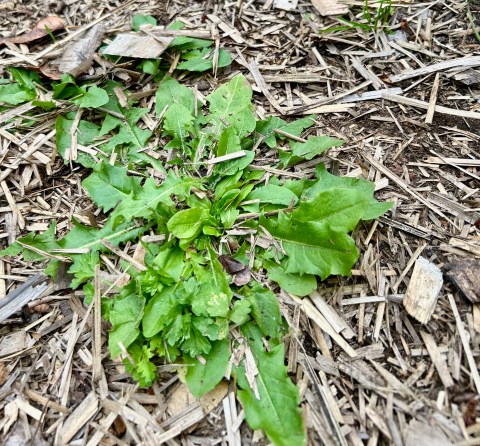
Dandelion, Taraxacum officinale

Gardeners who take the time to identify the plant can be more effective. Knowing a plant lets you determine the best way to control it. Sometimes a weed can be an indicator of environmental conditions: the soil is wet or heavy, or it is very acidic. Some tough weeds will die out if the roots don’t get nutrients from foliage. This requires diligence—regular weed-eating. Small, less-hardy weeds will die from deep mulch that smothers small plants and suppresses weed seeds. Proper ID is key to control.

Weed Identification

Botanical identification begins with a plant’s flower. We can’t rely on the foliage because weeds are by their nature adaptable and have a lot of variety. Vegetative characteristics are malleable. Here’s a short digression: years ago I managed the UCSC agroecology program greenhouse and was responsible for transplanting seedlings. In wood flats full of vegetables or flowers that required pricking out, there would be a number of weed seedlings from the compost. The young weeds could look almost identical to the some of the crops—so much so, that a number of the apprentices I supervised would pot up the weed seedlings! So identify your weed when it is flowering and then start to recognize the plant in all its stages, from young seedling to flowerings going to seed.

I’m old-school and like books. My favorite book for weed identification is Weeds of the West, University of Wyoming Press. Our cooperative Extension had it for sale decades ago. Now it can be downloaded for free from the website or used books can be found online. 900 color photos include the weed at young stages.

Online resources include Hortsense from Washington State University, with 90 fact sheets listed by alphabetical order. University of California, Davis has a useful online weed identification key

Weed Ecology

Many weeds are species that have adapted to colonize disturbed sites, such as landslides; after a wildfire has burned off vegetation; along roadsides; or at building sites where excavators have exposed mineral soil. Alan Chadwick, the famous gardener who developed the French-Intensive-Biodynamic method, always said nature abhors a vacuum. That’s why in my garden I sprinkle around borage, red clover, phacelia, or calendula. By regularly weeding out unwanted plants, I have mostly replaced the disturbed areas with annual flowers that are easy to pull and have many benefits. There’s not much room for weeds.

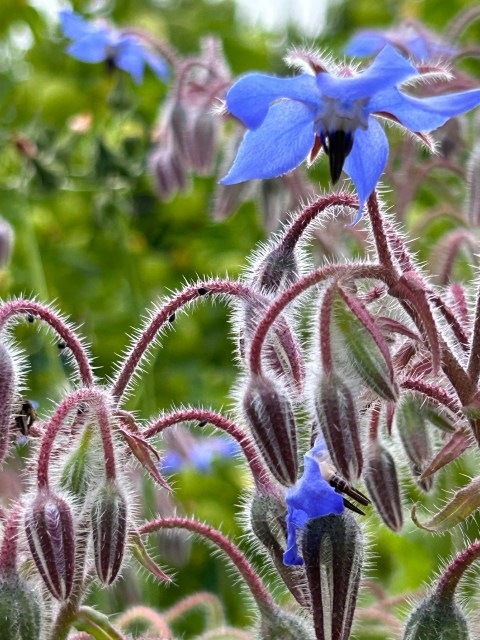
Borage, Borago officinalis

Weeding Techniques

Start weeding early spring, when the ground is still moist and the plants are young. Weed annual gardens regularly. Use lots of mulch around perennials and woody plants. Since weed seeds can remain dormant for decades, it’s important not to let weeds good to seed.

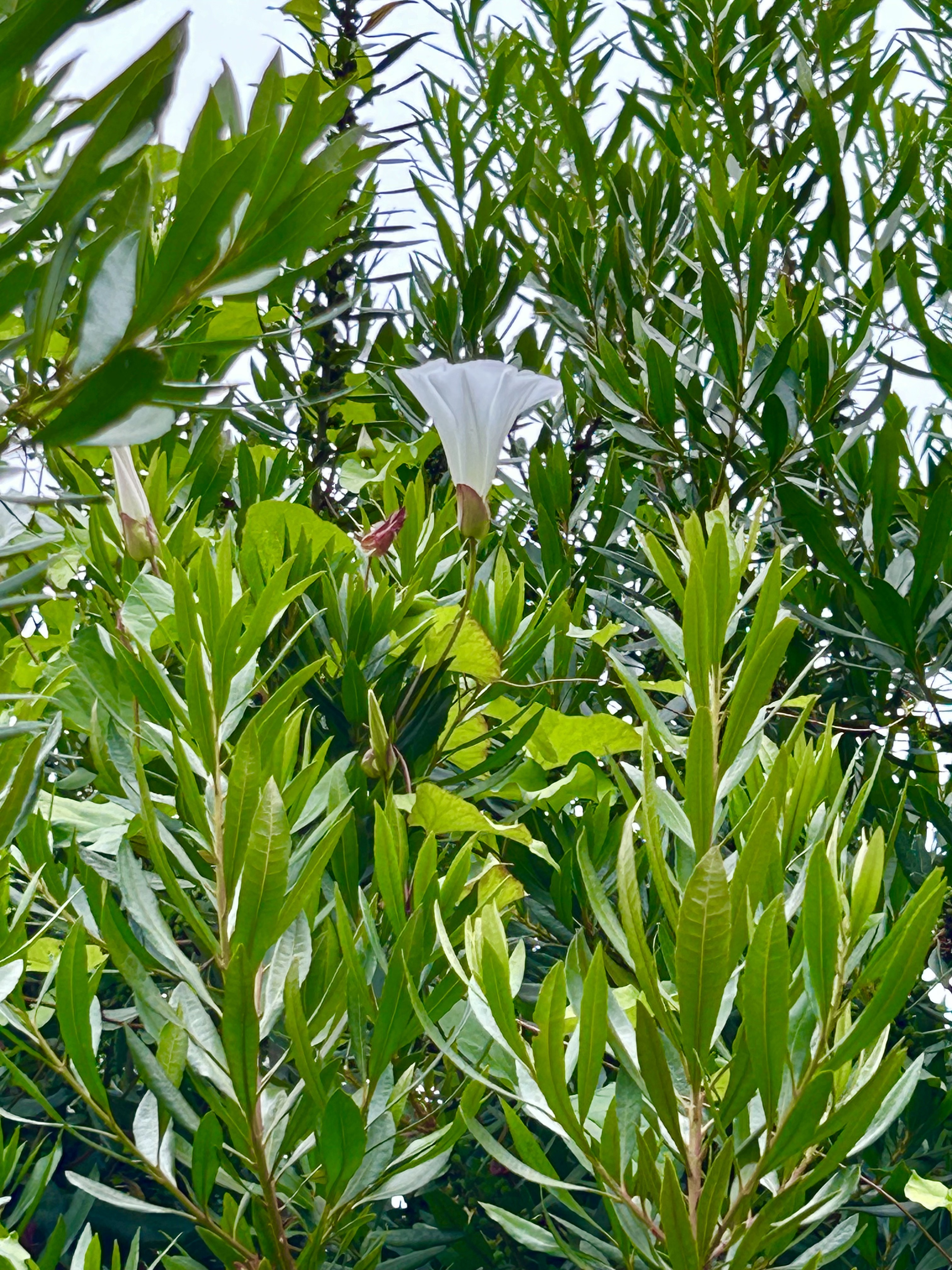
Certain perennial weeds can become one’s nemesis, for example horsetail, bindweed, Canada thistle . If you do nothing else, make sure to cut flower heads before they go to seed, bag them and send to the dump. The county noxious weed board doesn’t want what the state includes as noxious plants in our yard waste. If you cut the flower or seed heads and bag them, then the rest of the material is yard waste and can go to the compost facility. Thick mulch prevents seeds from sprouting. Everyday weeds can go into yard-waste. I have a big pile of plant debris that I will not use as compost, but will let it rot in place. In it I include weeds that have gone to seed but are not listed as noxious.

At one time I added woody plant material to this pile, but now wild roses, native blackberries and branches from hedges and ornamental shrubs go to yard waste. I don’t want excess fuel for potential wild fires.

If you are still using herbicide on weeds in pavement cracks or gravel, please consider a vinegar solution. Horticultural vinegar—at 35% strength is a lot stronger than kitchen vinegar—5% sold at grocery stores, so take more precautions! Wear gloves, glasses and long clothing. Although flame torches are used in agriculture to control weeds ( by boiling the sap, not turning foliage black), when I called our fire dept about using them for weeds in cracks I was informed that we had two wildfires in the county start that way!

For woody plants or deep-rooted perennials, such as Scotch broom, Himalayan blackberry, and poison hemlock, a weed wrench can be used to yank out the entire plant. The county weed board has wrenches they loan out.

A lot of weeds are my friends. I make flower bouquets, or add them to salads. Others are a haven for pollinators. Some are good sources of carbon for my compost piles.

Soil Ecosystems and Compost

Soil and Dirt

Outside, the ground is alive; it’s soil. When it gets on your hands and clothes and you bring it inside it becomes dirt—sand, silt, and clay. It dries out and the organisms die.

The organisms in the soil form an entire ecosystem or a soil food web—from microorganisms like bacteria to top predators like black ground beetles. Here is the invisible part of what we commonly think of as the food chain; the decomposers responsible for decay. Organic matter is an essential part of soil, the storehouse of nutrients and energy. Bacteria utilize the fresh plant material while fungus typically consumes fibrous plant matter, wood, and humus.

Humus defined

Humus results from many organisms using and transforming organic material to the point that the original material can no longer be identified.

Soil organisms consume the physical plant remains until the detritus is reduced to sugar, starch, proteins, and other organic compounds. The process occurs more slowly with the plant fibers of lignin and cellulose. Along the way soil microbes grow, reproduce, die, and decompose. When the original remains of matter are dark, spongy, and smell earthy, we call it humus, one of the building blocks of topsoil. Rather than burning up as CO2, this carbon can last in the soil for hundreds of years.

What is Compost?

Composting is a technique that produces an organic material that mimics the leaf litter of a forest floor by applying the principles of the soil food web. Compost is made by layering organic matter in combination with air; water; and soil or compost inoculant to provide a feast for decomposers. Compost made from materials grown on the land where it is applied is most similar to an ecological cycle, especially compost comprised of materials high in carbon that slowly decomposes. Ecology Action has pioneered the work on this.

What is soil carbon sequestration and how does it reduce greenhouse gases?

Understanding the potential of carbon sequestration allows us to stabilize and even reverse global warming, since one-quarter of the total excess of carbon in the atmosphere comes from agriculture.

Plants use the sun’s energy to draw carbon dioxide from the atmosphere in the process known as photosynthesis. Plants separate the carbon and oxygen to form sugars. These sugars are transformed into more stable forms of carbon compounds. Some carbon moves from the plants roots into the surrounding soil and can remain bound and sequestered. Sustainable practices that mimic this natural process include compost-making, green manures, and growing compost crops, food crops that are high in carbon.

Why is compost important?

  • Compost can reduce atmospheric carbon and other greenhouse gases by increasing the amount of carbon stored in the soil.
  •  Compost reintroduces soil microbes to soils that have been damaged by chemical fertilizer and pesticides.
  • Compost feeds the organisms in the soil web. Alan Chadwick, a great horticulturist always said, “Feed the soil and the soil feeds the plants.”
  • Compost feeds soil microbes that in turn release enzymes and hormones that promote healthy plant growth.
  •  Compost is a form of plant fertilizer; humus organic acids help dissolve soil minerals, making them available to plants.
  • Compost provides beneficial microorganisms that protect plants from pathogens.
  • Compost prevents soil erosion by improving soil structure.
  • Compost adds microorganisms that breakdown toxins in the soil.
  • Compost can buffer soil pH.

Dr. Elaine Ingham http://www.nrcs.usda.gov/wps/portal/nrcs/detailfull/soils/health/biology/?cid=nrcs142p2_053868

http://www.youtube.com/watch?v=GEtl09VZiSU

Compost-making Casa Colibri
Building a compost pile at Casa Colibri

Matt Drewno, Ecology Action Greenbelt Garden Manager with fava bean compost crop.


Ecology Action www.growbiointensive.org


Making Compost in Jalisco

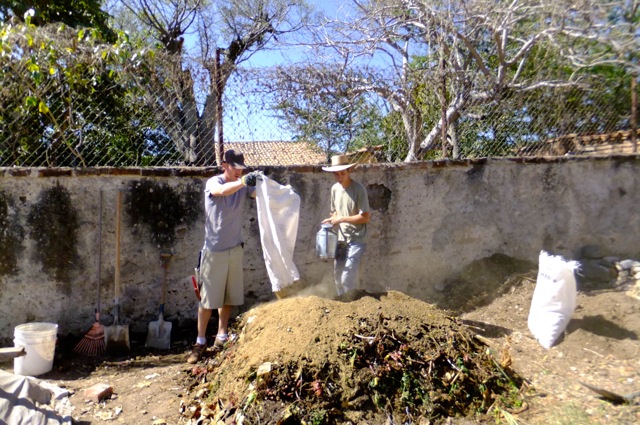
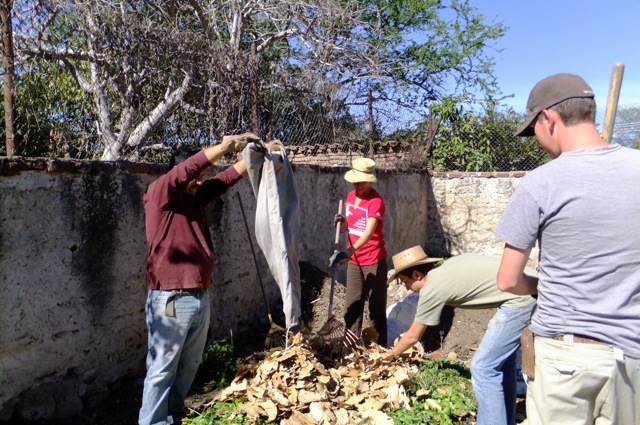
Compost making: Adding a layer of dried leaves

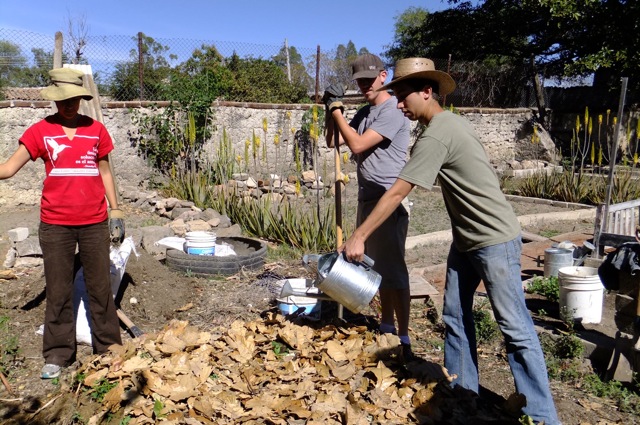
The city turns off the water during the day, so 55-gal barrels are filled for use during the day. Labor-intensive hand watering makes us appreciate when the water is flowing out of a hose.
The city turns off the water during the day, so 55-gal barrels are filled early each morning. Labor-intensive hand watering makes us appreciate when the water is flowing out of a hose.

Dried cow manure from a stockyard provides a layer of norogen
Dried cow manure from a stockyard provides a layer of nitrogen.

The day before this event several members borrowed a truck and went to the local stockyard to shovel manure into bags.

We built the pile one layer at a time, like a huge sandwich: Alternating dry material with green material, then a layer of soil. Another way to look at it is layering nitrogen-rich material with carbon-dense matter and then another layer of soil and or compost. We made the pile large enough to create an insular mass for the microbes to thrive. In the tropics 3 foot by 3 foot by 3 foot works. In temperate climates increase that to four-foot all around.

Basically, compost mimics nature's process of decomposition.
Basically, compost mimics nature’s process of decomposition.

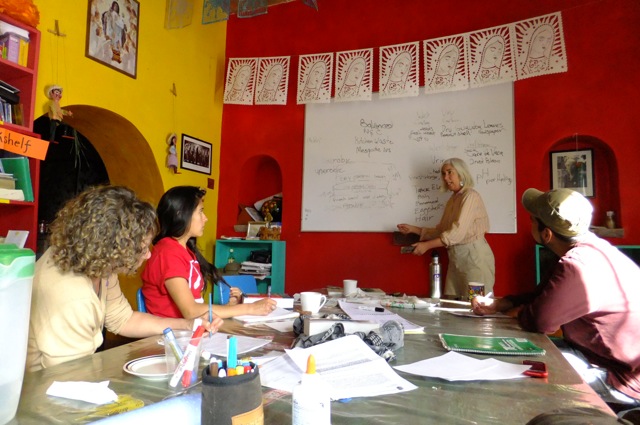
After lunch we came inside to review the soil food web and the basics of making compost.

If you explore a forest floor below the leaf litter, you find humus, the result of an entire soil food web. Compost is a way to speed up the process by providing the decomposers—soil bacteria, fungi and invertebrates with all the nutrients they need. We work with microbes when we make bread, yogurt, or sauerkraut. Compost is messier and larger but is similar in that we are creating an environment for microbes to thrive and directing their behavior to produce a product we want.

The building blocks of compost are  nitrogen-rich material for strong bodies, carbon-rich material for organisms to energetically reproduce, air so the pile stays aerobic and doesn’t go putrid, water to hydrate to microbes, and soil or aged compost to inoculate the pile with organisms.

Compost enhances the garden in so many ways:

  • It reintroduces soil microbes to soils that have been damaged by chemical fertilizer and pesticides.
  • It improves the soil ecosystem and encourages beneficial microorganisms that protect plants from pathogens while  soil fungi bind with and filter out toxins.
  • Compost prevents soil erosion by improving soil structure. Soil rich in organic matter is more porous; it allows air and water to move and be held, it has good tilth.
  •  “Feed the soil and the soil feeds the plants,” is a famous Alan Chadwick quote I learned years ago. Compost feeds soil microbes that in turn release enzymes and hormones that promote healthy plant growth. Decomposing organic matter releases nutrients. The dead bodies of microbes act as slow-release fertilizer, providing nutrients over time.