Making Mezcal in Oaxaca

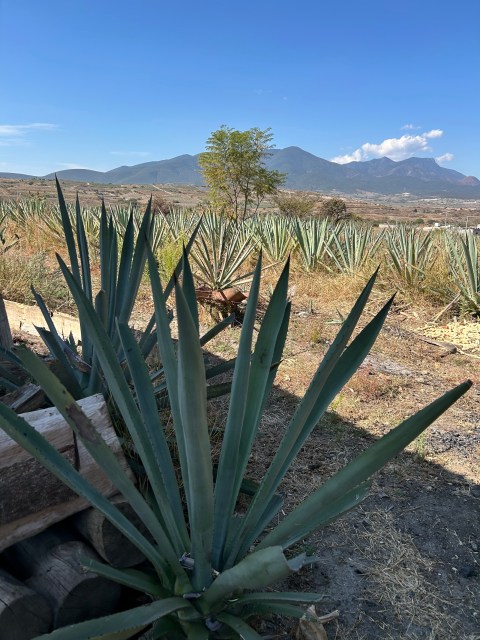
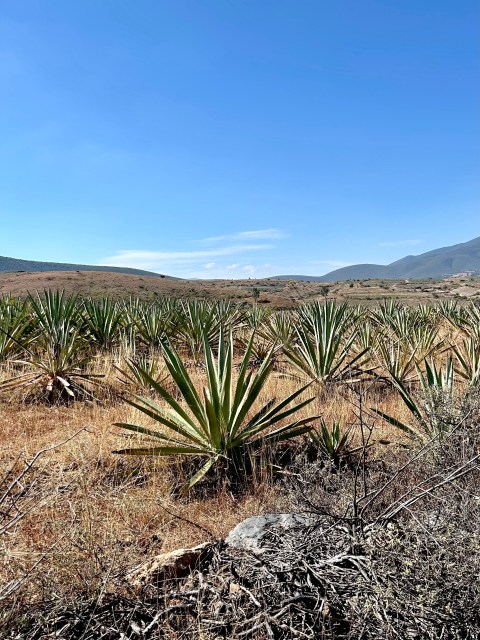
Espadin agave

Last week I visited a small, artisanal palenque in Santiago Matatlán that has been a family operation for many generations. I had the opportunity to visit because my Spanish tutor in Teotitlan del Valle knew them. In fact, they supply her family’s store and had invited her to come tour their operation. Matatlán is referred to as the Mezcal Capital del Mundo because over one hundred small-scale producers grow and make mezcal.

Sign on the roadside claiming Matlan as the Mezcal Capital

Nereo explained that agaves, in nature only flower after many years. Once enough sugars and juices are concentrated in the heart of the plant, it sends up a tall shoot adorned with flowers. After seeds mature, the entire plant dies. In cultivation, the agave or maguey is harvested right before flowering.

Harvesting

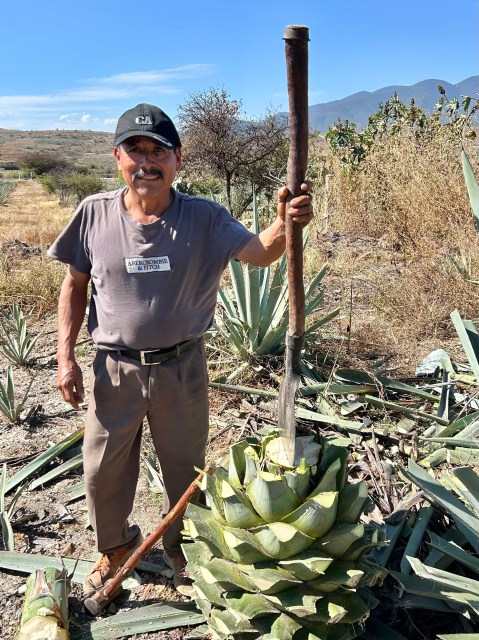
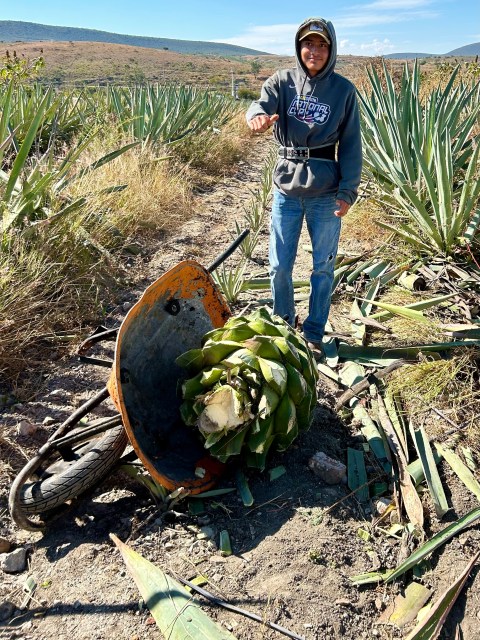
Mezcaleros  want the sweet juices at the core of the plant so they walk the rows to select agave plants with an emerging flowering stalk or quiote. Harvesting the plant is done by hand—leaves are chopped off with a machete, leaving the core or the piña—called that because it looks like a pineapple.

Nereo’s grandson harvesting Espadin plants.

It takes 6-15 kg of piña and 10 liters of water to distill 1 liter of mezcal

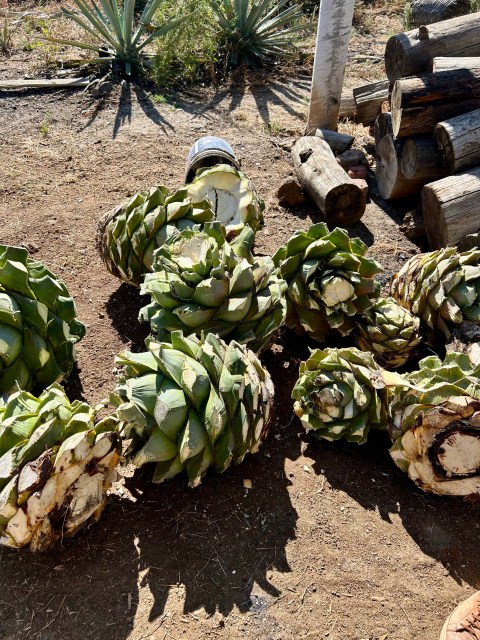
Espadin piña

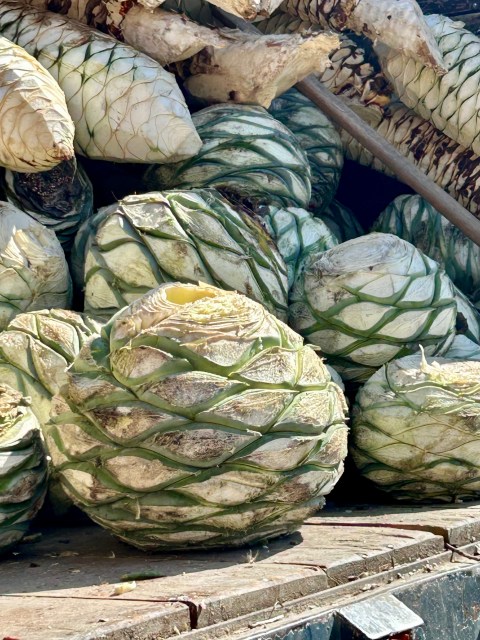
Tobala piña delivered by truck from the wild.

Roasting

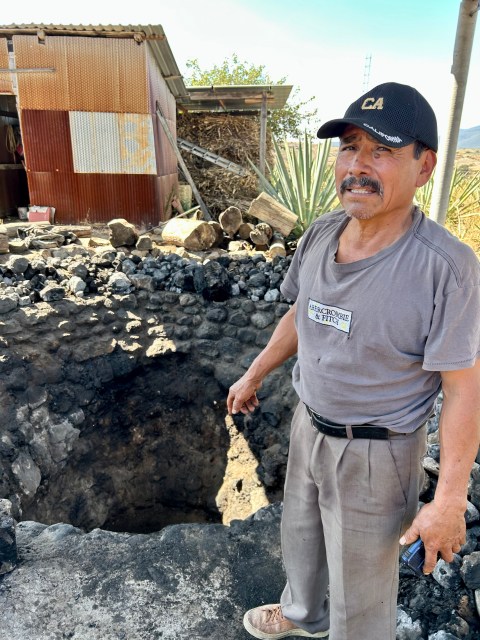
Once they have enough piñas, the mescaleros start the roasting procedure. Unfortunately, I have not watched this process, but I think a fire is started in the pit with oak or mesquite, then covered with volcanic rocks that turn bright red. Next the piñas are placed in a heap and covered with agave foliage or burlap sacks. Volcanic rocks absorb more smoke so the roasting agave aquire less smoke flavor. Apparently in different regions a slight smoke flavor is valued and other rocks are used. Nereo said that a smokey flavor is undesirable. The roasting process is monitored for 3-5 days.

Mashing piñas

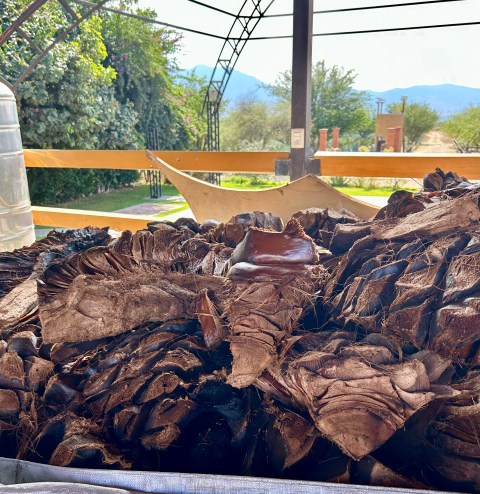
When the piñas are removed, they are brown, caramelized, sweet and stringy. (Since Nereo didn’t have a current batch, the below photo is from Don Agave’s pulque, located across the highway from Teotitlan del Valle.)
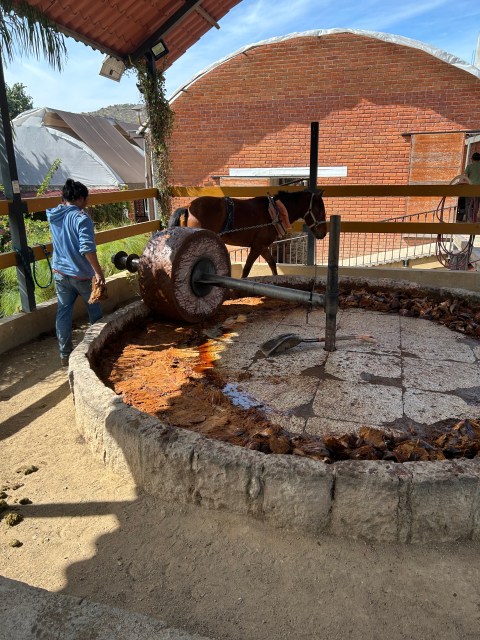
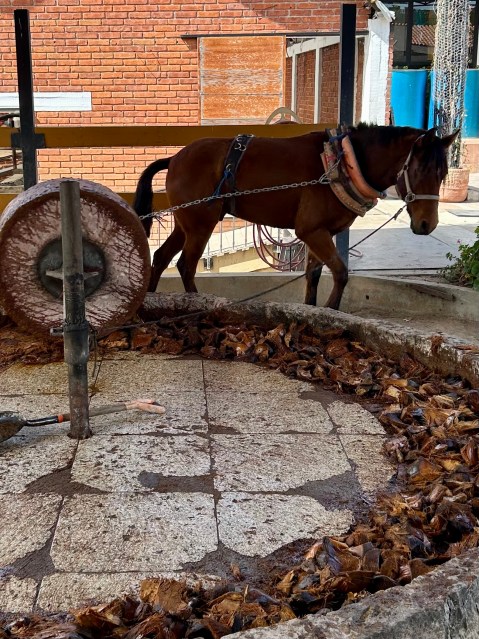
The roasted piñas are then mashed in the traditional stone mill pulled by a single horse.

Horse pulls stone mill to mash roasted maguey

Fermentation

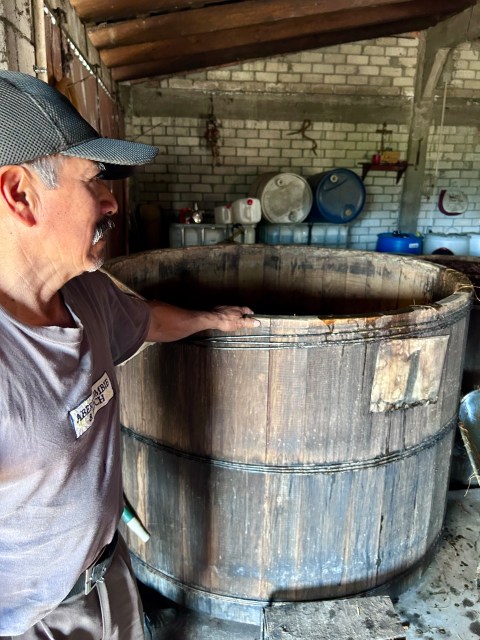
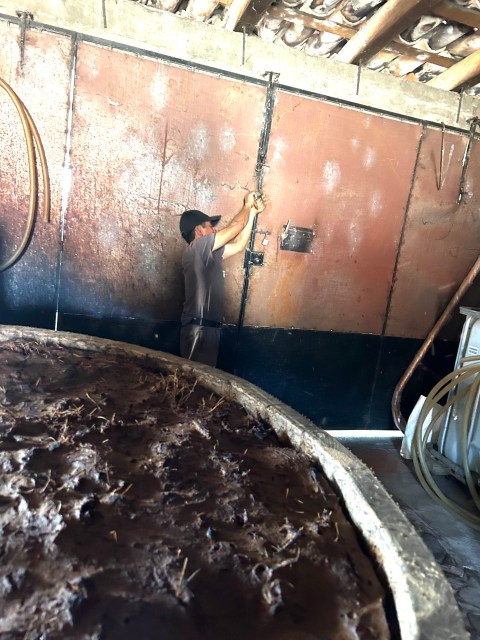
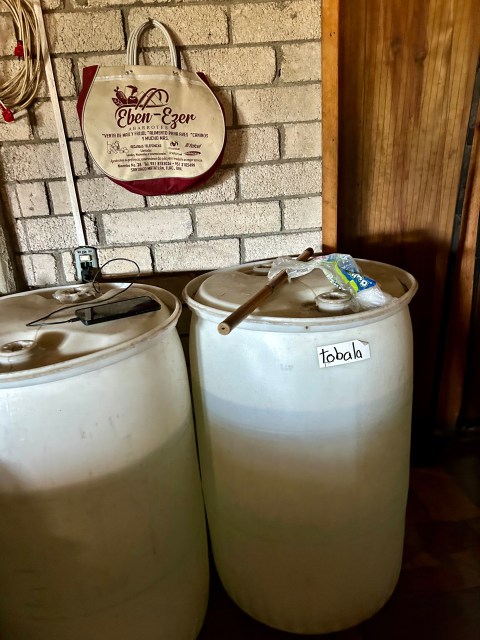
The maguey mash is forked out, carted to oak tanks, where water is added and it’s allowed to ferment for two weeks. Over the years, these tanks acquire natural yeast residue that assists with the conversion of agave sugars and juice into alcohol.

Distillation

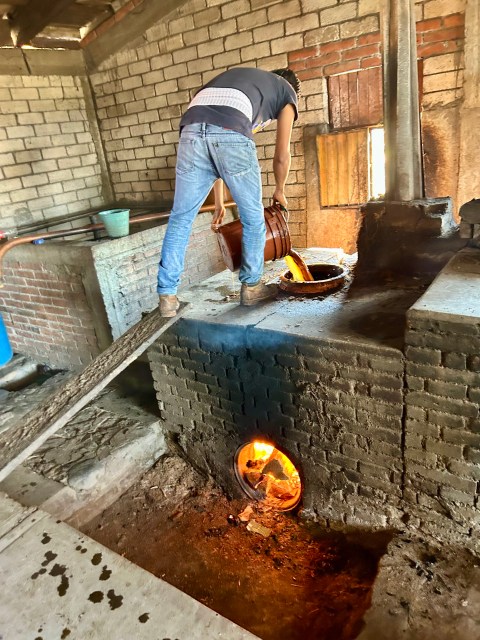
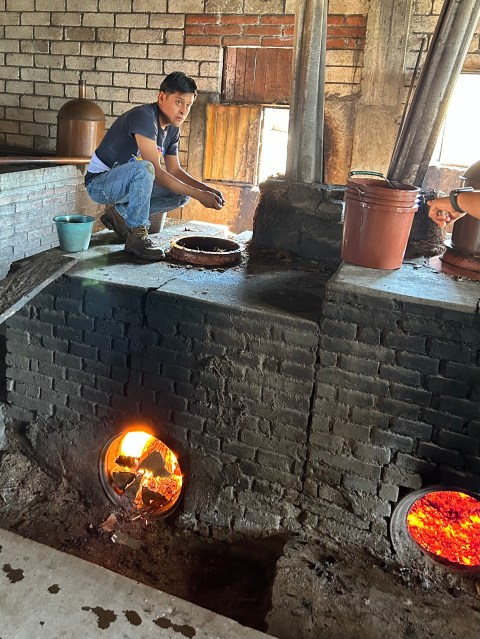
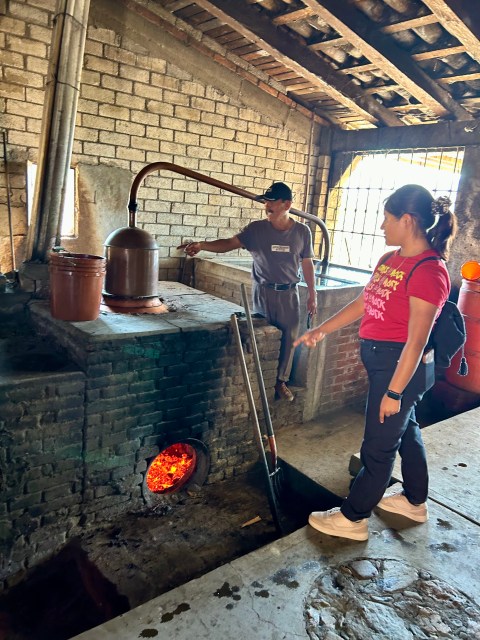
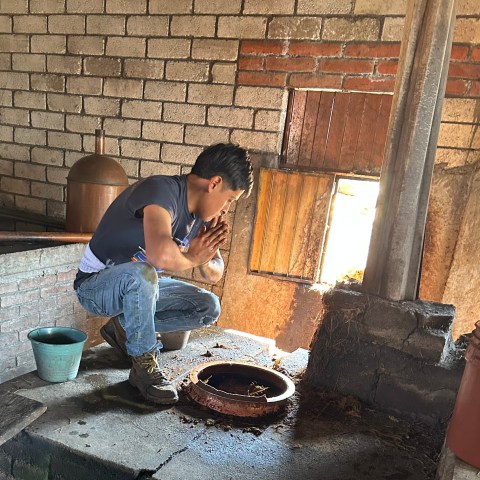
The fermented liquid is poured into a traditional still consisting of masonry ovens, copper tubes, clay pots heated from below by a wood fire. Water cools the pipes causing the alcohol vapor to condense back to liquid. the flowing water absorbs heat. A constant stream of water through the condenser ensures efficient cooling.

Nereo’s other grandson pouring the fermented liquid into the still, to begin distillation.

Angelica Mendoza asking about the distillation process.

Water cools the pipes causing the alcohol vapor to condense back to liquid. The flowing water absorbs heat. A constant stream of water through the condenser ensures efficient cooling.

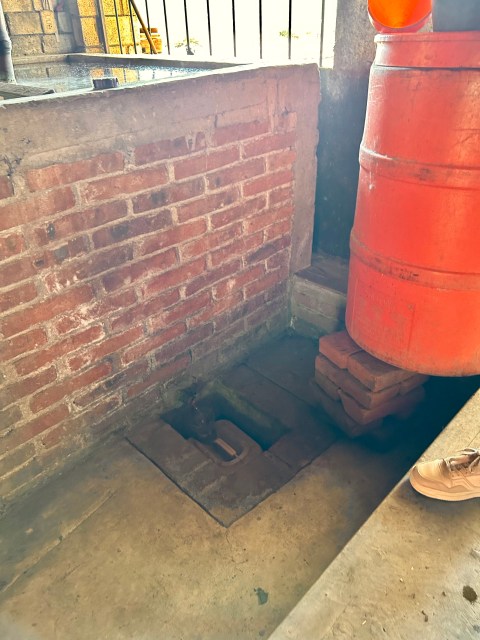
The alcohol emerges from below the last brick tank. The spigot at the base is just barely visible.

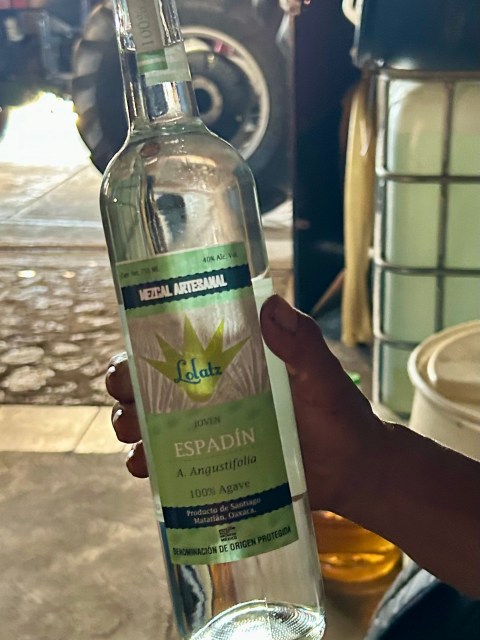
We enjoyed sampling the joven mezcal!

Cultivating Agave for Mezcal

Some types of agave reproduce asexally, making cultivation easier and more uniform. Either small hijuelos (sons) form vegetatively at the base of a mature plant, or bulbils form instead of flowers and seeds. (This latter formation also occurs in many garden plants including garlic and chives.)

Other species are used in traditional mezcal production, but are difficult to grow. Traditionally they have been collected from the wild, but as the demand for mezcal keeps increasing, wild populations are shrinking, and growers are attempting to cultivate other species.

Tobala agave

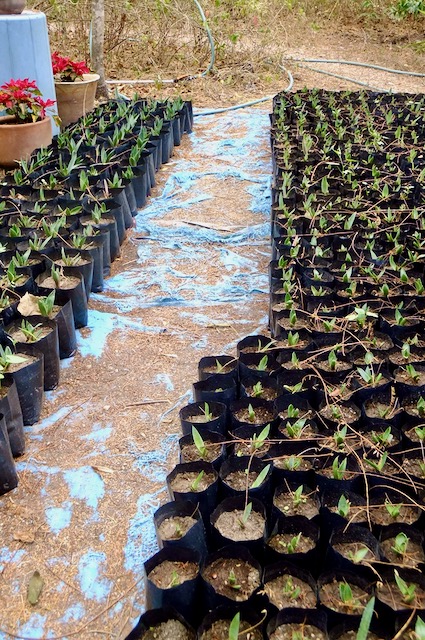
Tobalá Agave potatorum, is one I particularly enjoy. The flavor is full-bodied, a complex of notes hinting at floral and spicy. The Tobalá plant is much smaller than Espadín:, requiring up to to eight piñas to equal one of the latter. Combine that with the fact that Tobala rarely produces bublils or pups, so it must be grown from seed. Luis Mendez in Solga Vega Oaxaca is now cultivating the plants to preserve the wild population from over-harvest. A nursery in Santa Catarina Minas is also selling seedlings.
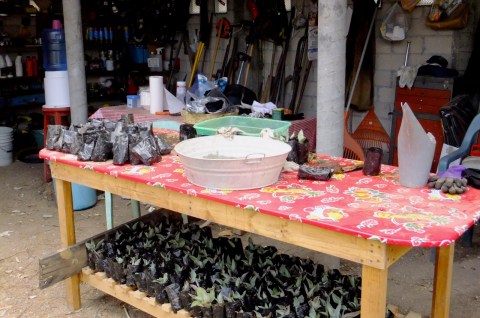
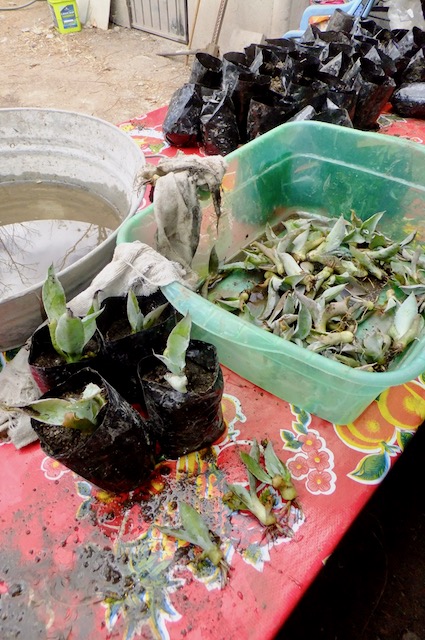
In January 2020 I helped pot up Tobalá plants for Tony Raab at Casa Raab, San Pablo Etla, Oaxaca.

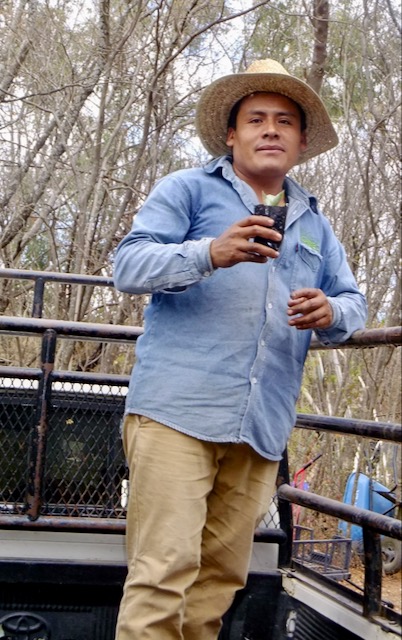
One of Tony’s workers, Rodregio.

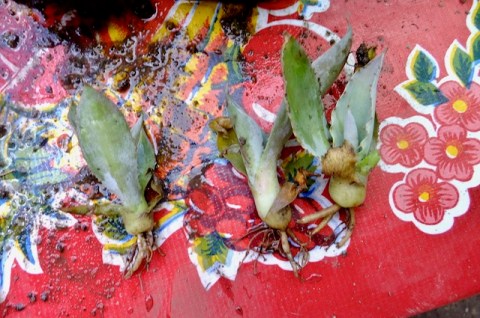
Tobala seedlings

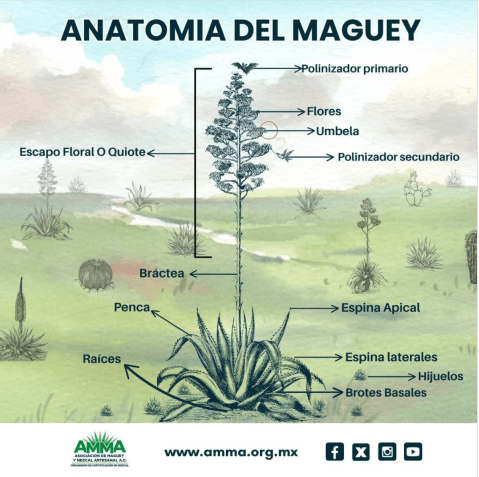
AMMA published this diagram of agave anatomy.

In my search for information on sustainable maguey preservation and cultivation, I came across this post Mescalistas: Can wild agave be successfully grown? In the future I hope to visit more maguey plantations.

Mexican Agave

Mexico is rich in biodiversity, and Oaxaca is the state with the most diversity. Agaves are richly represented here with 200 species and often grow in tropical deciduous forests or deserts. Most agave plants only flower once and then they die. Archeological sites around the country show signs of agave for medicine, food, and textiles including ropes and nets.

Maguey is the name for any number of agave species that are used for making mezcal. Although I have a passing interest in the alcoholic beverage, I am fascinated by the ethnobotany of maguey.

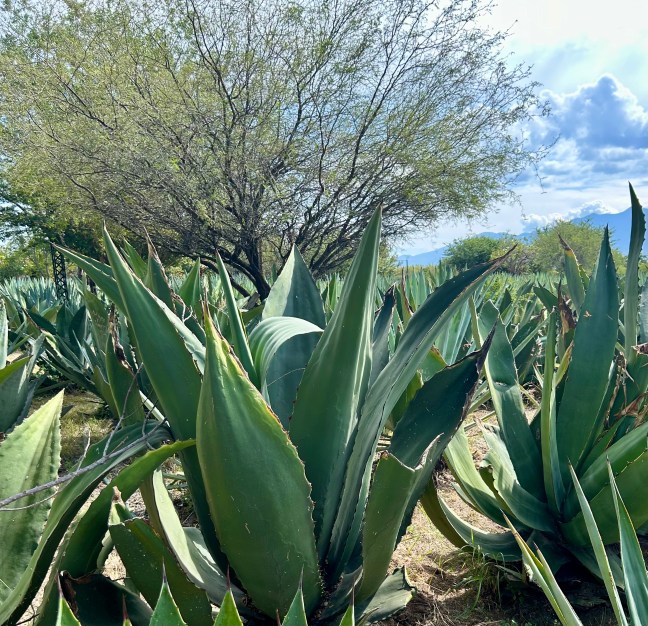
Oaxaca is the epicenter of mezcal that draws travelers and connoisseurs from around the world. Forty-two kinds of maguey can be made into distilled alcohol, and proponents of sustainable mezcal production want to see more Mexican species planted and used. Two agave species dominate the market and grow as monocrops, A.tequiliana and A. angustifolia var.oaxacaencis. (Tequila, the distilled beverage of Agave tequilana can only bear that name if it comes from the northern region of the state of Jalisco, where it is commercially grown and produced on an industrial scale in the town of Tequila.) In Oaxaca the number one plant is Espadin, or Agave angustifolia, cultivated because it matures uniformly in about 6-8 years.

Espadin, Agave angustifolia var. oaxacensis

Drive along Hwy 190 through the Tlacolula Valley to see field after field of narrow-leaved Espadin. Milpas that once flourished with maiz and squash for local consumption are now monocrops of Espadin. Commercial brands like Mezcal Benevà produce mezcal on an industrial scale and require larger fields. It matures uniformly in about 6-8 years. There are many common names for espadin including: arroqueño, coyote, cenizo, and dua-bzog, a Zapoteco name. While the species Agave americana grows throughout Mexico and even as far north as Texas in the US (where it goes by the common name century plant.) The variety A. americana oaxacensis is endemic to Oaxaca and Puebla.

Maguey for Pulque

Other maguey used in mezcal include a couple of large, dramatic plants that are significant in making a traditional fermented drink called pulque. This historic fermented product is still drunk today and is considered healthy. It is an acquired taste, being both sour and viscous!

Tepextate, Tepestate, Agave marmorata

Photo from the gardens of Don Agave in Teotitlan del Valle.

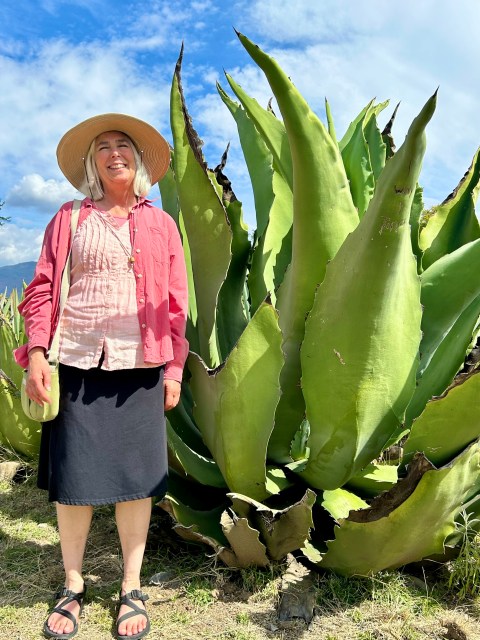
Green agave, or pulque agave, Agave salmiana,

This giant is used in mezcal production. It is also a popular ornamental found around the world in Mediterranean gardens.

Maguey verde grande, Agave atrovirens

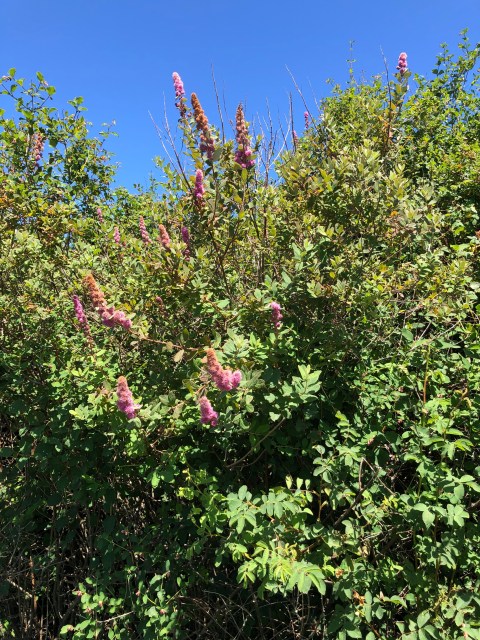
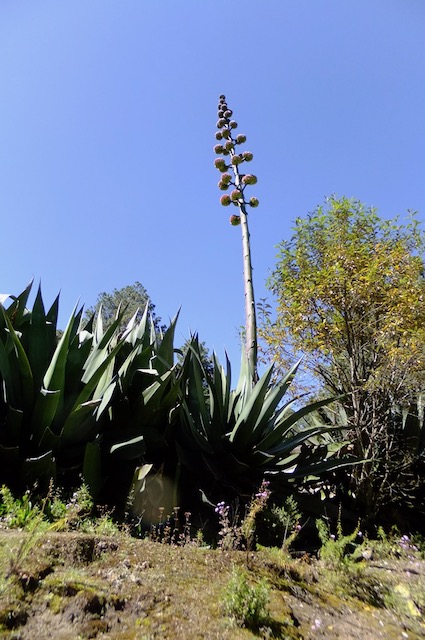
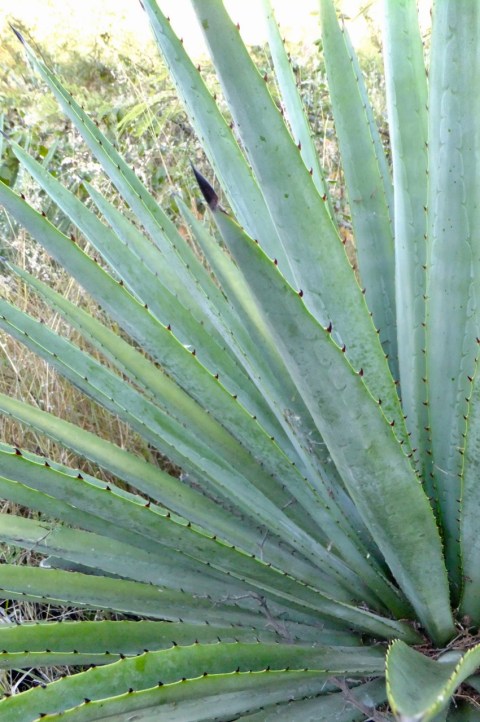
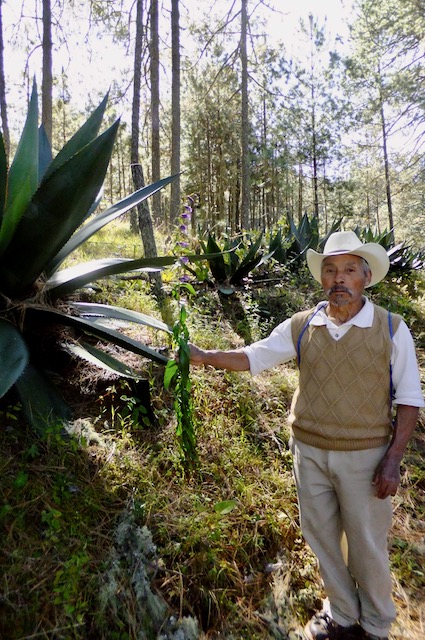
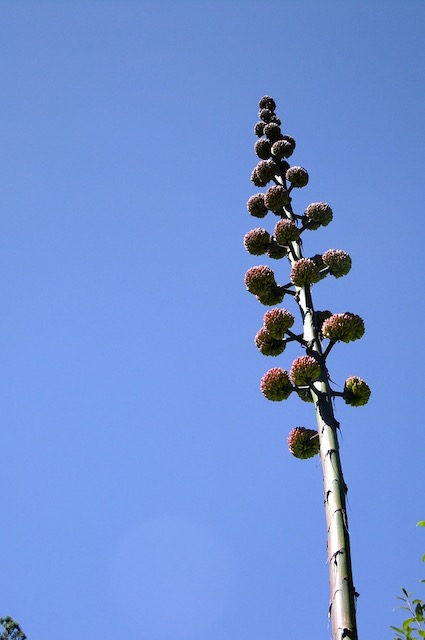
The agave at the top of the post is a photo I took while hiking between Llano Grande and Cuajimoloyas. Agave atrovirens, the largest of agaves, it can grow 6 to 8 feet tall. Maguey verde grande has a flowering spike or quiote that can grow to 15 ft. with reddish flower buds turning yellow upon opening. This species is native to Oaxaca, Puebla and Vera Cruz. I saw it while hiking in the Sierra Norte at 10,000 ft elevation. There was a row planted along the edge of a milpa of corn. When I asked Celestine, our hiking guide if this maguey was used for mezcal he said no, just pulque. But others do use it. Maguey verde grande produces hijuelos, or vegetative shoots at the base of mature plants.

The Road to Sustainablity for Mezcal

Mezcal has become the world’s favorite distilled beverage—in 2021 production increased 700% from 10 years before. That year eight million liters were produced, much of it in Oaxaca. Any industry growing that fast will have serious environmental  and cultural implications.

Although Santiago Matalan is regarded as the mezcal capital of the world, much is changing. As the need to respond to the challenges facing mezcal production increases, innovations are happening in other corners of Oaxaca and throughout the country. The crux of the matter is these solutions are long-term project with no immediate economic returns.

Challenges

  • Agaves are exclusively harvested before they flower, just as the flowering stem emerges when they are rich in sugars. Removing this quiote concentrates the sugars in the heart of the piña.
  • Removing the flowers impacts native pollinators, especially an important endangered bat species.
  • Removing the flower stem prevents seed production that increases genetic diversity.
  • Monoculture  of identical clones reduces diversity, increasing the risk of entire fields succumbing to disease and pests.
  • Overharvesting wild agaves reduces available nectar for endangered long-nosed bats.
  • Waste from mezcal production, the liquid vinzana is toxic, as are the agave fibers.
  • Water consumption: ten liters of water are required to produce one liter of mezcal

Solutions

Some local Oaxaca heroes include Luis Mendez of Sola de Vega . He has spent years experimenting with cultivating agave plants from seed and his nursery provides growers with small plants. This helps break up monocultures, prevents over-harvesting wild plants, and provides for pollinators. Besides growing agave for mezcal, he encourages people to use them for erosion control, windbreaks, and to increase biodiversity.

Fourth generation mezcalero, Graciela Ángeles Carreño, is a woman from Real Minero who was featured in a Smithsonian article about sustainable production. The Race to Save Mezcal From the World. Her family’s brand Real Minero is a sustainable choice. Mezcal tours from Oaxaca City often go to this cutting-edge plantation and distillery.

Enterprising mavericks like  Ron Cooper with Del Maguey have partnered with Zapotec producers in Oaxaca. Another mezcal aficionado is Lou Bank, founder and CEO of SACRED: Saving Agave for Culture, Recreation, Education, and Development. This nonprofit  is empowering communities. When asked about green-washing, Bank had a pragmatic response that you can read here.  SACRED has raised over US$600,000 that has supported twelve rural communities that raise maguey.

On another front, university researchers  have partnered with local growers. The Association of Magauey and Artizanal Mezcal has more information. Instead of relying  exclusively on the fast-growing Espadin in monocultures throughout Oaxaca central valley, they are pioneering cultivating more varieties and growing them from seed. Instead of over-harvesting a number of wild maguey species in the surrounding mountains, the are cultivating them. By leaving 30 % of an agave plantation to flower and only harvesting 70% of the crop, pollinators will thrive.

New pathways for utilizing the mezcal waste both the solid fibers and the liquids are being explored, especially in the construction of adobe bricks. Native maguey grows throughout Mexico, and wherever it grows rural folks and campesinos have had bootleg operations—from Sonora to Puebla.

My all-time favorite author and ethnobotanist, Gary Paul Nabhan has pioneered the sustainable efforts with Ana Valenz Zapata  a Mexican scientist. Years ago they recognized the problems facing Tequila. Now Nabhan has co-authored another book, Agave Spirits.

“Culled from decades of fieldwork and interviews with mezcaleros in eight Mexican states, Agave Spirits reveals the stunning innovations emerging today across the mezcal supply chain and offers solutions for improving sustainability and equity.” Check out their great website Mezcal-Mankind-Mutualism

Oaxaca’s central valley and city is prone to water shortages during the prolonged dry season. Recent droughts have exacerbated the situation of a growing population and failing infrastructure. Environmental issues include climate change, deforestation, and mining. Mezcal production is also part of the problem. To produce one liter of mezcal  uses ten liters of water, much of it becoming toxic in the process. The water table is dropping and wells are going dry.

The months of June through September often are blessed with abundant rainfall. Rural communities are responding by harvesting rainwater. This includes planting trees, making swales and building tanks for water storage. As mezcaleros and non-profits work together for a sustainable future, consumers can support these efforts by purchasing from innovative mezcal brands.

Late-Autumn Garden Chores

Late autumn usually brings the most precipitation to Port Townsend and the eastern part of the Olympic Peninsula. Atmospheric rivers dump rain. Strong winds blow and fallen leaves swirl. The sun is low in the sky.

The winter vegetable garden is producing, but most growth happened before the fall equinox. Garden beds covered with hoops and floating row covers will be protected from frosts. Fresh salad greens, kale, Swiss chard, and leeks  can be harvested throughout the winter. Monitor vegetables for slugs and cut worms. The wet weather favors slugs and snails. Get them now and there will be less generations come spring. Also cut worms are a problem and can be found during routine weeding.

Fruit Trees

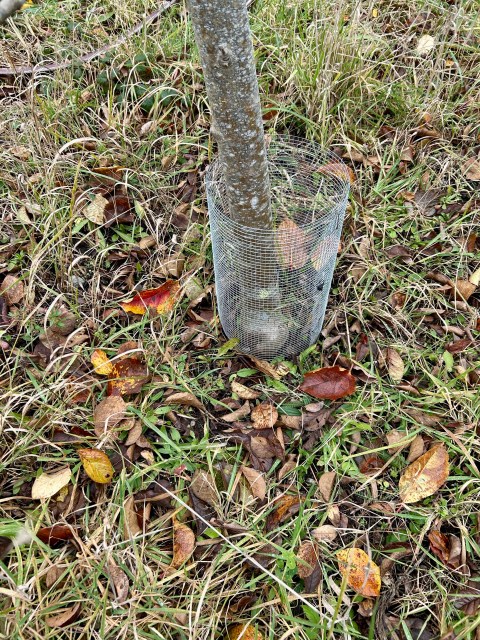
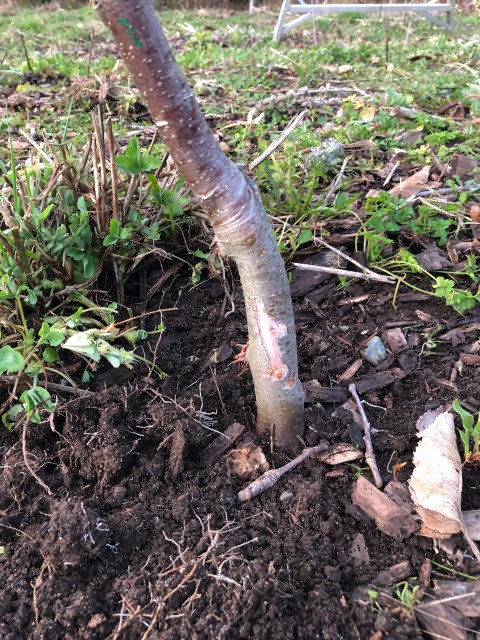
Keep the base of young trees free of tall grass. Better yet, place mulch around the trunks. Winter is the time when voles chew bark and roots. If you have a serious vole problem wrap the trunks with hardware cloth to prevent the rodents from gnawing the bark. Some gardeners even use pea gravel as a mulch to discourage voles.

Late winter is a better time for pruning apple and pear trees, ornamentals and raspberries. The reason not to prune now is because we could have a warm, sunny spell in January that could encourage plants to grow—only to be blasted by a deep cold in early February. Better to wait until mid- February for most pruning. Because wet weather promotes bacterial and other diseases, many gardeners prune plums and cherries after flowering during a sunny spell.

This is a good time for large garden projects that warm the body. Pushing wheelbarrows of manure, woodchips, and  making large compost piles. Building planter boxes and retaining walls. Cutting down dead trees or cutting up branches for firewood or hauling them to the yard-waste facility. If you live in the woods, think about a larger tree-free area around the home as future fire-prevention.

Going within

And then there are times to slow down, take walks and notice the birds. Different birds are here for the season. Watch for Pacific wren, red-breasted nut hatch, northern flicker, pine siskin, golden-crown kinglet and spotted towhee.

Winter is a good time to dream about the garden. A garden mentor once said that the garden is forgiving—we can always try again next year. It’s a time to think about rearranging perennial beds and planting more drought tolerant flowers. Or perhaps it is time to think about  simplifying a high maintenance garden. For some gardeners seed catalogs arrive in January and planning the edible gardens begin. Now you can think about how you can extend the season or create a garden sanctuary.

Gardening for the Birds

Winter is a time to step back and evaluate the garden; to appreciate how much it has grown since last year and to analyze how we can improve it. One approach is considering it from a bird’s perspective. Gardens that favor birds provide food, water, cover and a safe place to nest.

Water for drinking and bathing is essential. Place it adjacent to shrubby habitat to provide refuge from predators. Shallow moving water with a place to perch is best, but a bird bath that has clean water is also valuable.

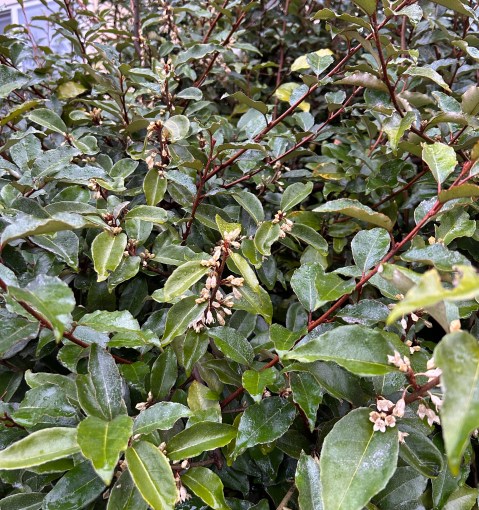
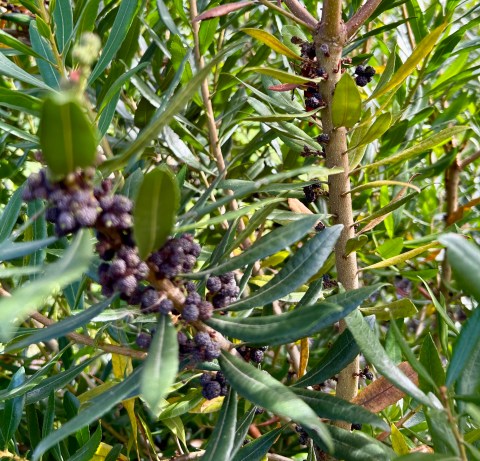
If the shrubs have berries, so much the better. Also, evergreen shrubs provide an excellent place to roost at night. Evergreen foliage provides screening from predators and insulation from winter’s cold. Above is Ebbings Silverberry, Elaeagnus x ebbingei in bloom. Hummingbirds were feeding here mid-November and new flowers keep opening. Below is Strawberry Tree, Arbutus unedo and Pacific Wax Myrtle, featured in an earlier post.

Arbutus undo

Feeding the birds

Bird feeders come to mind first and many people are committed to providing bid seed and suet. Some birds change their diet according to the season. Perennial seed-heads offer another option. Native plants have evolved with the local bird populations. In addition, perennials can be selected for architecturally interesting seed-heads. Plants in the mint family including sages, Salvia; anise hyssop, Agastache and Jerusalem sage, Phlomis. Sunflower family flowers like Joe-Pye weed, Echinacea, black-eyed Susan, Rudbeckia hirta and artichoke are attractive to birds.

Many cat owners recognize that a cat can kill up to eleven birds a year. A ‘Catio’, or cat patio is an outdoor enclosed space that protects cats from eagles and hawks and prevents cats from killing birds. Many homeowners have found ways to integrate this structure into their landscape. One of my favorite catios is that of my friends Kathleen and Pete. They constructed their catio around an existing blueberry patch, thus excluding birds from berries and cats from birds!

Watching birds is a relaxing and invigorating hobby for gardeners. People start off with bird feeders and it opens up an entire world. When David Sibley, author of The Sibley Guide to Birds, was asked why he enjoyed watching birds, he responded:

One of the most enduring attractions for me is that it gives me a chance to learn about an entire system (the natural world) by simply watching and getting to know the birds. When I can name a bird that I see, or notice subtle differences in appearance or behavior, that information gives me access to a store of knowledge about the species’ habits and preferences. I know where its travels might have taken it, what type of food it’s looking for, if it’s likely to be alone or part of a flock. In short, I know that bird and have a sense of how it fits in the world around it.

Check out The Courage of Birds: The Often Surprising Ways They Survive Winter, a new book by the birding team Pete Dunne and David Sibley.

Consider gifting a gardener/birder an online course covering everything about gardening for birds:

Cornell Lab Bird Academy

Planter boxes in the vegetable garden

Planter boxes in the vegetable garden offer many options. The first advantage we think of with tall boxes is the ease of gardening. Low planter boxes define the garden beds from paths and make upkeep easier. The boxes can be the solution to poor soil with either too much clay or sand. They offer good drainage and warm up earlier in the spring. The main reason why I am considering planter boxes is the addition of a barrier at the bottom of the box to exclude moles, and other ground dwelling mammals. Raised beds can be made of metal or concrete retaining wall blocks. Both have their advantages and disadvantages. Here we will look at wood construction.

Construction

Use 2 x 6 Doug fir as it is less expensive than cedar. It should last 5 to 10 years, especially if you can protect the wood with linseed oil or other non-toxic preservative. Boxes longer than 8 feet might bow outward, so brace the box with another board across the center. 4-ft-wide is an ideal width because the bed can be reached from both sides.

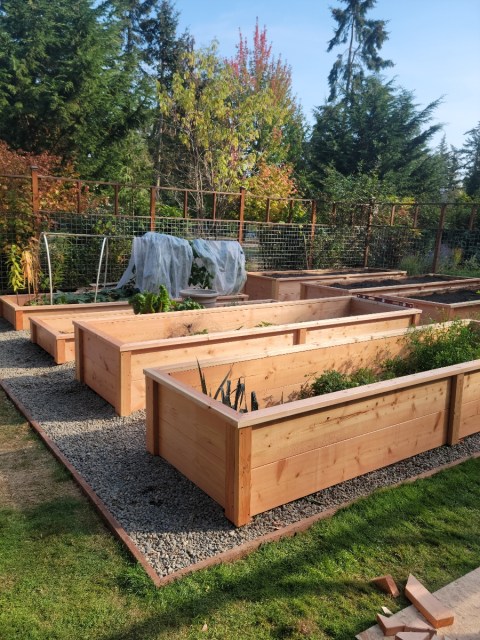
A 12-inch-high box will be adequate for most vegetables. The extra height in the photo above is for the gardener’s ease. A board across the top makes a comfortable seat for planting and weeding. Line the bottom with hardware cloth. Although ½ inch 19 gauge is stronger, ¼ inch mesh is more secure, preventing voles from entering. 6- or 8- inch-boxes are deep enough for most vegetables, especially if you don’t need to exclude rodents and moles. Root crops require at least 12 inches.

A 24-inch-deep planter box will require 2 ½ yards to fill. Filling each box with premium planting soil could become costly. The planter box should be filled with a combination of native soil and compost, or native soil and purchased mix that may be bought in bulk or in bags. Plain soil will probably get too compacted if it is heavy clay. If the boxes are replacing existing vegetable garden beds previously enriched with compost,  that soil will be excellent for the top 8 to 12 inches. The base could be filled with branches or other rough matter trail mix, rotted straw and leaves. It will settle as it decomposes. Each year add a couple of inches of compost to the top of the beds as the soil settles.

Pest Control

By enclosing the planting box, we can avoid rodent problems. Place hardware cloth below the boxes and attach them to the sides. This preventive measure may seem like overkill, but if you have been competing with small mammals in the garden you will recognize its value!

Moles are highly unusual; they spend their lives burrowing through the soil their with enlarged paws. I once saw a video of a mole underground—it looked like it was swimming! Their eyes and ears are very small to avoid getting clogged with soil. Moles are drawn to earthworms and insects that thrive in soil enriched with organic matter. They tunnel under garden beds. These tunnels can be a problem for all vegetable roots and especially root crops. Roots left dangling in a tunnel dry out. Washington State Fish and Wildlife describe these mammals and their behavior.

Then tunnels become passageways for voles or meadow mice. These rodents do chew on vegetable roots. Even rats can travel in the burrow and eat vegetables. Voles reproduce exponentially. Although hawks and snakes are tackling the problem in my garden, the vegetation provides too much cover for voles. Their population seemsto be growing. I have decided to build planter boxes next spring. Permanent beds make it easier to install the plastic hardware involved in drip irrigation and constructing hooped cloches with plastic, floating row covers, or bird-netting. All the additional hardware makes the garden feel less earthy to me. But I need to look at the garden in a new light, perhaps as a outdoor organic horticultural lab. Eventually it will soften.

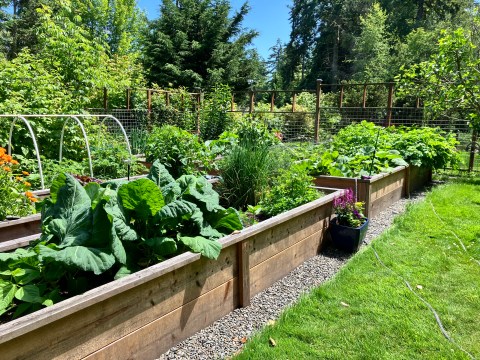
I am no expert on construction. The above photos are from Peggy and Thomas Stanlick’s garden built by Isaiah Marlow.

For more information on how to build your own planter boxes see the following:

YouTube 7 Beginner Raised Bed Mistakes to Avoid

YouTube How to Make a Simple & Cheap Raised Bed

Colorado State University Raised Bed Construction

October Garden Chores

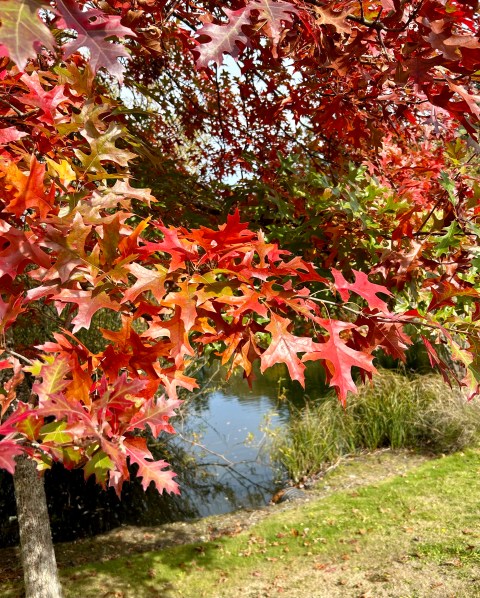
We know it’s autumn when the leaves start turning color. Here a Pin Oak brightens the landscape. It’s time to harvest winter squash and pumpkins, but if your squash isn’t quite ready, perhaps it will have time to continue ripening.

In Port Townsend, our typical first killing frost arrives by the end of November. If autumn temperatures drop slowly over time, plants get acclimated. The high concentration of sugars acts as ‘antifreeze’ in the protoplasm and this is what gives kale and other crops a sweeter flavor after the first frost. But if warm weather prevails until a sudden hard frost hits, then plants are not prepared. Sometimes in November the temperature can suddenly drop twenty degrees! Next month pay attention to the weather forecast and be ready to use floating row covers on crops and newly planted broad-leaf evergreen ornamentals. Forecasts for the next three to six months seem to be leaning toward La Niña but one forecaster described it as “a weak event”. NOAA posted this

Garden Chores

  • Leaves: Rake and compost, or save for mulch.
  • Lawns: Over-seed existing ones with white clover, yarrow, English daisy and other flowering plants for pollinators.
  • Mulch: shrubs and garden beds for winter protection and weed suppression. The increased organic matter will eventually feed the soil ecosystem. (This repeat from last month reinforces how important it is!)
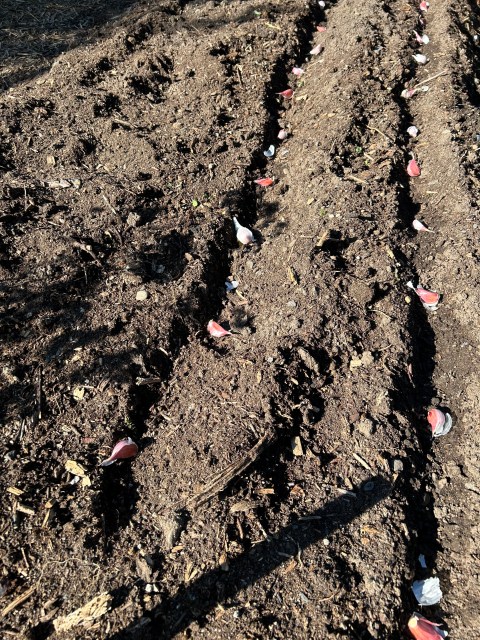
  • Plant garlic: 2” deep in well-drained soil. Space cloves 5 inches apart with the tip up. Mulch with straw. Prevent disease by rotating crop every 3-5 years. Certified disease free garlic or saving your own is best.
  • Fruit Trees: Rake and remove any diseased dried leaves, rotten- and mummy-fruits to prevent disease.
  • Apple tree pests: Examine fruits for coddling moth larvae damage. The Hortsense link offers preventative measures for next year.
Tinker and apprentice Brianna at Abundant Life Seed Foundation in 2001. Upper Salmon River squash

Winter squash can be slow to fully mature. One way to encourage this is to remove all small and new squash in September. This allows all the energy to go to the larger, more mature squash. The signs that a squash is mature include a bright yellow spot where the squash touched the ground, the stem becomes brown and corky-textured. Also, as the squash skin toughens up, it becoming duller, and even a bit waxy. It may difficult to make an indentation with your fingernail. These contribute to a good storage crop.

Tinker loved growing the Lower Salmon River winter squash. This variety of Cucurbita maxima is one of the few heritage crops from the PNW, and is known from the Salmon River area of Idaho. It has a distinctive flavor and texture. Seeds are available from Adaptive Seeds.

If you want to taste Lower Salmon River, Midori Farm grows it and the Food Co-op has some now. It takes about 90 days to mature. It can withstand a couple of light frosts although the first one will probably kill the foliage. For Cucurbita maxima aficionados, check out this Johnny’s Seeds critique of flavor and yield for varieties.

After the fall equinox, plant growth slows. We have not had frost yet in early October 20224, so crops are still growing well. Plants are able to sense cold temperatures and respond by producing carbohydrates. In vegetable crops, the high concentration of sugars acts as ‘antifreeze’ in the protoplasm and this is what gives kale and other brassicas a sweeter flavor after the first frost. For more on winter gardens see the OSU Extension Publication

Pacific Wax Myrtle: resilient native evergreen

Pacific wax myrtle, Morella californica, is native to the coastal areas of Washington state and south to California. It is considered on of the best evergreen native shrubs for our gardens. Although the flowers are inconspicuous, the waxy black fruits are popular with birds. Knock-on-wood it is still deer resistant.

This hardy native is adaptable to many conditions from full sun to shade. Although it prefers moist, well-drained soil, it can grow in a variety of soils. The root nodules have nitrogen-fixing microorganisms that allow the plant to grow in poor soil.

Once established it is completely drought tolerant. It will grow to 30 feet tall and 15 feet wide in thirty years. For the average size garden, pruning will keep it within bounds. Late winter is best for heavy pruning, then general shaping can be made with heading-back cuts through out the season. This remarkable shrub can be pruned as a formal hedge, a loose screen or even a small tree. As a screening hedge, Pacific Wax Myrtle provides habitat for a multitude of birds including Spotted towhee, several sparrows, northern flicker, robin, goldfinch and cedar wax-wing. The latter are especially delightful in winter when small flocks gather on the shrubs. The waxy berries provide vegan fat in the winter.

Morella californica blooming in May

Pacific wax myrtle is slow to grow at first and once established, it grows steadily. Here the tiny flowers are blooming. Within these red catkins are separate male and female flowers. To see a close up and more photos go to the OSU landscape plant descriptions. This website provides excellent plant descriptions. I have not found anything like it in Washington.

For the longest time I didn’t think any disease bothered this shrub, but I noticed some foliage die back and even some stems turning brown. The Pacific Northwest Pest Management Handbook describes a type of leaf blight caused by a phytopthera that only bothers this species. This fungal-like organism was first identified as a pest in 2009 on the Oregon coast. I have been growing several shrubs at my place for thirty years and have only noticed it recently. Some ways to prevent spreading the disease:

  • Avoid overhead watering.
  • Mulch with arborist chips
  • Increase air circulation at the base of the plant by removing weeds or other vegetation.
  • Remove any diseased plant material and throw it in the garbage, don’t compost it,
  • Don’t over-fertilize and don’t fertilize late in the season.
  • Sanitize tools with isopropyl alcohol, or prepare a mix of 1 part bleach to 9 parts water. Dip tool or wipe with moistened rag.
  • Water to get the shrub established and then only monthly during summers to grow a hedge or screen.

The leaves make a pleasant tasting tea that is medicinal. The active medicinal substances include an astringent resin. The root and bark can be tinctured and used for inflamed gums according to Michael Moore’s Medicinal Plants of the Pacific West. The plant’s botanical name was changed in 2006. Previously it was known as Myrica californica.

A native plant adaptable to sun or shade and varying soil conditions, one that can synthesize it’s own nitrogen is bound to be more resilient!

Rainshadow Gardening on glacial sediments

Looking at the natural history of our area deepens our sense of place and helps us grow more resilient gardens. Climate, geology and ecology have shaped the land. Tinker would always comment on the landslides along the bluff between North Beach Park and Point Wilson lighthouse. She enjoyed reading the landscape and imagining the geologic forces at work.

By looking at the bluff, we see what is below the surface of much of Quimper Peninsula, and begin to understand our soils. The above photo shows layers of deposited sediment.

Just imagine—a massive sheet of ice 3,000 ft deep covered East Jefferson County, 15,000 years ago. This last glacier bulldozed and deposited rocks, gravel, and sand. The beach bluffs reveal that much of our soil is glacial deposits. There are pockets of clay, sand and a bit of sandy loam. The thin topsoil is often sandy, gravelly loam. If this intrigues you, check out the Quimper Geological Society!

If you have ever felt your garden soil is not as good as it could be, you are not alone! Most areas of the Puget Lowlands are too young for deep topsoil. ( Of course there is prime agricultural land that formed on marine terraces or alluvial outflow from rivers.) A soil profile is a cut through section of the land revealing topsoil, layers of subsoil and  even bedrock. Soil scientists dig profiles to examine the existing soil.

The curious gardener can look online for a digital copy of the 1975 soil survey of the county, where aerial photographs are overlaid with maps roughly indicating soil types and descriptions. I have an old paper copy that I highly value.

Again, this is just a brief summary and I am no expert! The climate working on the land determines the native flora. The Puget Sound area has mild winters and cool dry summers, and is commonly known as a Mediterranean climate. Winter rains tend to be continuous and light to moderate rather than heavy downpours. The marine layer—a deep, low cloud bank is a defining feature.

Rainshadow

What makes our area unique is that the Olympic Mountains block the moisture-laden clouds coming from the Pacific. The west side is a rainforest while the northeast side, in the shadow of the mountains is rainshadow. I have seen native Opuntia fragilis on the Quimper Peninsula and on Whidbey Island. Port Townsend’s average rainfall is around 20 to 23 inches. Often the marine layer breaks apart late in the day.

Prevailing winds  from the Pacific often reach us from the south and southwest. As the clouds move around the Olympics, dumping precipitation from Olympia to Brinnon, they are wrung out by the time they reach Port Townsend. Eastern Jefferson County is largely a peninsula on a peninsula. It juts out to the northeast and catches the winds from the south. Mostly in summer winds blow from the northwest down the Salish Sea.

Arctic Blasts

In general our gardens are more prone to winter damage when arctic blasts roar down through the Fraser River Valley of British Columbia. It used to be that we only needed to track this during El Niño- Southern Oscillation years but the polar vortex is wobbling now and this leads to less predictability. Last winter we had cold temperatures that were the lowest in 30 years. Keeping an eye on the weather allows us to bring out sheets or burlap to cover plants. Even wind-blown Doug fir boughs shield vulnerable plants.

Moving here in 1988, with a background in organic horticulture, I was very curious about weather. Trying to get a grasp on seasonal cycles and weather, I asked many questions. It seemed like every season someone would say “This is the coldest summer” or “This is the wettest spring,” or “Its the driest winter”—I could not find a predictable pattern!

But there were and still are weather trends: Spring came early and lasted until the fourth of July; summer was somewhat predictable for August and September, although any day could become rainy and windy. Then autumn arrived. The snow was visible on the mountains until September. Several people who grew up here said the mountains were always snow-covered when they were children.

What I recall is the first snowfall would brighten the Olympic Mountains by mid-October, and might bring a cold snap to sea level, with occasional early frosts. Then mild weather would return for much of October. Often November would be the rainiest time of the year. Temperatures would get cooler and cooler until a frost. The darkest time of the year was and still is late November, December and January.—the sky colored many shades of gray. But then storms blew in from the south, after wrapping around the Olympics, bringing windy weather and sun-breaks in the dramatic skies. Red flowering currant could bloom as early as mid-February. There does seem to be an increased occurrence of multi-year La Nina. Nature magazine 2023.

Resilient Gardens

Climate change is real and part of gardening is responding to the changes. We live in a place for garden lovers, where flowers can bloom in the winter and a large number of evergreen shrubs thrive. The native vegetation offers a plethora of interesting plants for our gardens. Berries and fruit trees thrive in our mild climate. Winter vegetable gardens provide leeks and greens all winter. Knowing that most soils here are excessively well-drained and that we can’t rely on summer rains, drought-tolerant ornamentals are a smart choice. Tinker respected our rainshadow ecosystem. Here is how she grew resilient gardens:

  • Recognizing the importance of the soil ecosystem
  • Caring for the soil through making compost & sheet mulch
  • Selecting plant varieties that are bred for pest-resistance
  • Growing open-pollinated heirlooms that we can nurture as landraces
  • Developing a strong curiosity about our local weather
  • Committing to living lightly on the Earth, however we define it