
Before we begin, let’s distinguish between a hedge and a hedgerow. A hedge is typically made of one type of plant, often evergreen. Hedges are sheared to control the size and to form a dense green wall. This requires annual maintenance. (Lately in Port Townsend many hedges are browsed by deer, leaving the lower branches without foliage, and exposing the garden within. Homeowners wishing to re-establish the visual screen place temporary fencing to restrict access and allow the foliage to regrow.)
Although hedges are useful in tight spaces, most plants are healthier when allowed to grow loosely allowing air and light within. Hedgerows are more diverse including several species and allowing for a mixture of plant types. The biodiversity encourages more birds and pollinators. Also, hedgerows may be several shrubs deep, with small trees on the outer perimeter.
Overview: Points to consider when designing a hedgerow
Dream big and then check in with yourself about how much you can accomplish, including the initial expenses and labor and then the ongoing upkeep. It may be better to plant a 30-foot section and determine how the plants are responding rather than plant the entire 150-foot hedgerow.
The more you prep the site before planting the easier it will be to maintain.
Determine how much competition from pests (deer, voles, invasive plants) and how much loss you are willing to accept. Plan accordingly.
What to plant
I would strongly suggest using natives for the hedgerow’s backbone and adding plants from similar climates around the world as counterpoint. A combination of native and nonnative plants can offer a variety of fruits and seeds for birds. By using a combination of deciduous and evergreen plants you provide habitat for more creatures and seasonal variation, but for a dense visual screen year-round, plant all evergreens. One thing to keep in mind is a hedgerow of only one species can be more vulnerable to extremes of climate or to disease. One solution could be to form a tall row of one species and then a second row of mixed species.
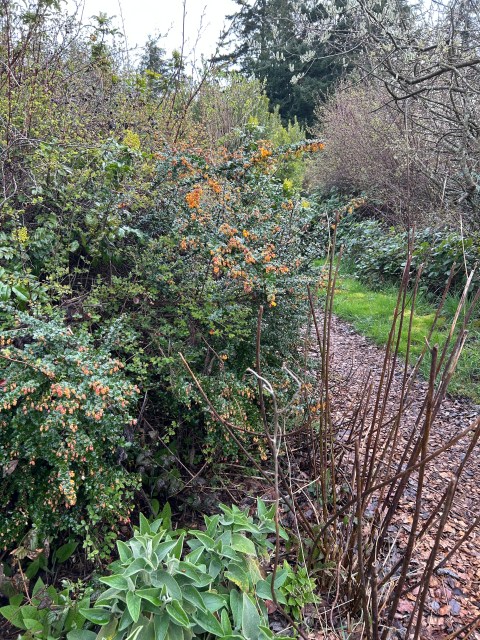
Below is a photo of a mixed plant screen including non-native Darwin’s barberry with Oregon grape in the foreground. Behind them are deciduous shrubs and immediately in front are perennial flowers. Across the path is a mowing strip and salal backed with more deciduous natives.
Trees in the hedgerow
Do you want to include trees in your hedgerow? If a windbreak is the goal, determine which direct the wind comes from. Our winter storms usually blow in from the south, wrapping around the east side of the Olympic Peninsula. In early spring when fruit trees are starting to bud, and cool-season vegetable starts are in the ground those winds can be a problem. If you need the windbreak on the south property line, consider planting trees farther apart than their mature size. The trees will slow the wind without making a wall of shade. By interspersing the hedgerow with smaller multi-trunk trees and large shrubs, sufficient sunlight will come through.
On my southern property line bitter cherry, Prunus emarginata volunteered and became established, threatening to shade out the orchard. Now every five years I have someone go through with a power hedge trimmer to lower the line of trees. (It was only after a number of years trying to control bitter cherry that I realized it spreads by rhizomes. In fact, these underground stems and roots can spread up to fifty feet from a tree and form dense thickets!)
Plant trees on the north side of the property to avoid shading surrounding gardens. Also, the coldest winter winds on the Quimper Peninsula occur when the polar vortex wobbles. A dip or a trough in the jetstream occurs and frigid air plunges south. In our case, the cold air pours down from the Fraser River Valley. Although this phenomena is not an annual event, it may become more common in time.
Potential native trees could include: shore pine, Pinus contorta var. contorta; serviceberry, Amelanchier alnifolia; Scouler’s willow, Salix scouleriana; and Garry Oak, Quercus garryana.
Patterned groups or natural mix within hedgerow
Most hedgerows are primarily functional, but if an attractive feature along a stretch of driveway is desired, consider planting several of one kind of shrub, say western mock orange, Philadelphus lewisii, interspersed with several Ceanothus thyrsifolrus” Victoria’, both drought tolerant. Or plant several Goumi, Eleagnus multiflora with beach rose, Rosa rugosa. While neither is native they provide fruit for birds and people.
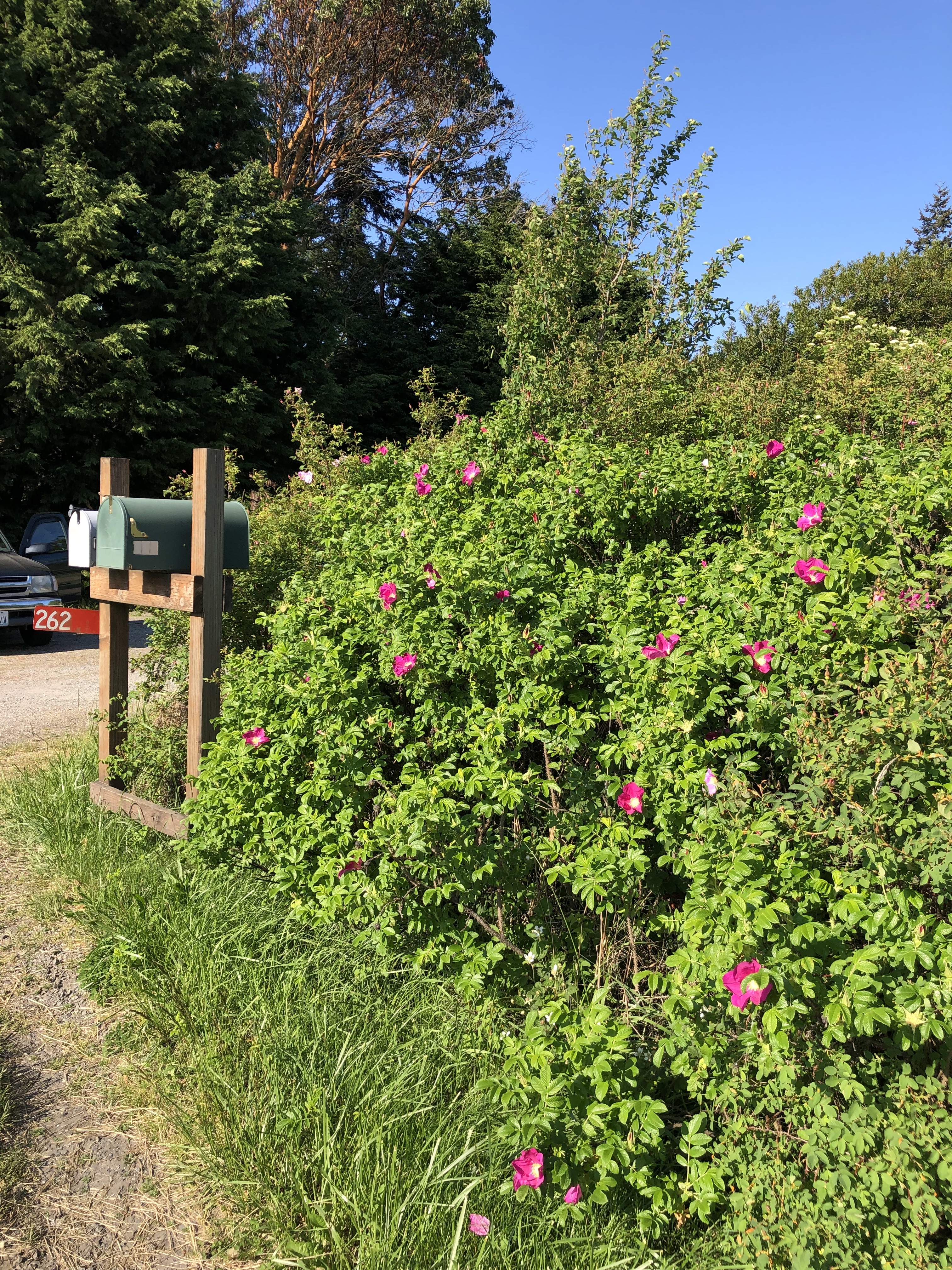
To create a more wild hedgerow, plant a mixed group of native shrubs like Nootka rose, snowberry, seviceberry, and mock-orange. Consider how long our deciduous native shrubs are without foliage and you will might want to add some evergreen shrubs, such as Pacific wax myrtle and Oregon grape.
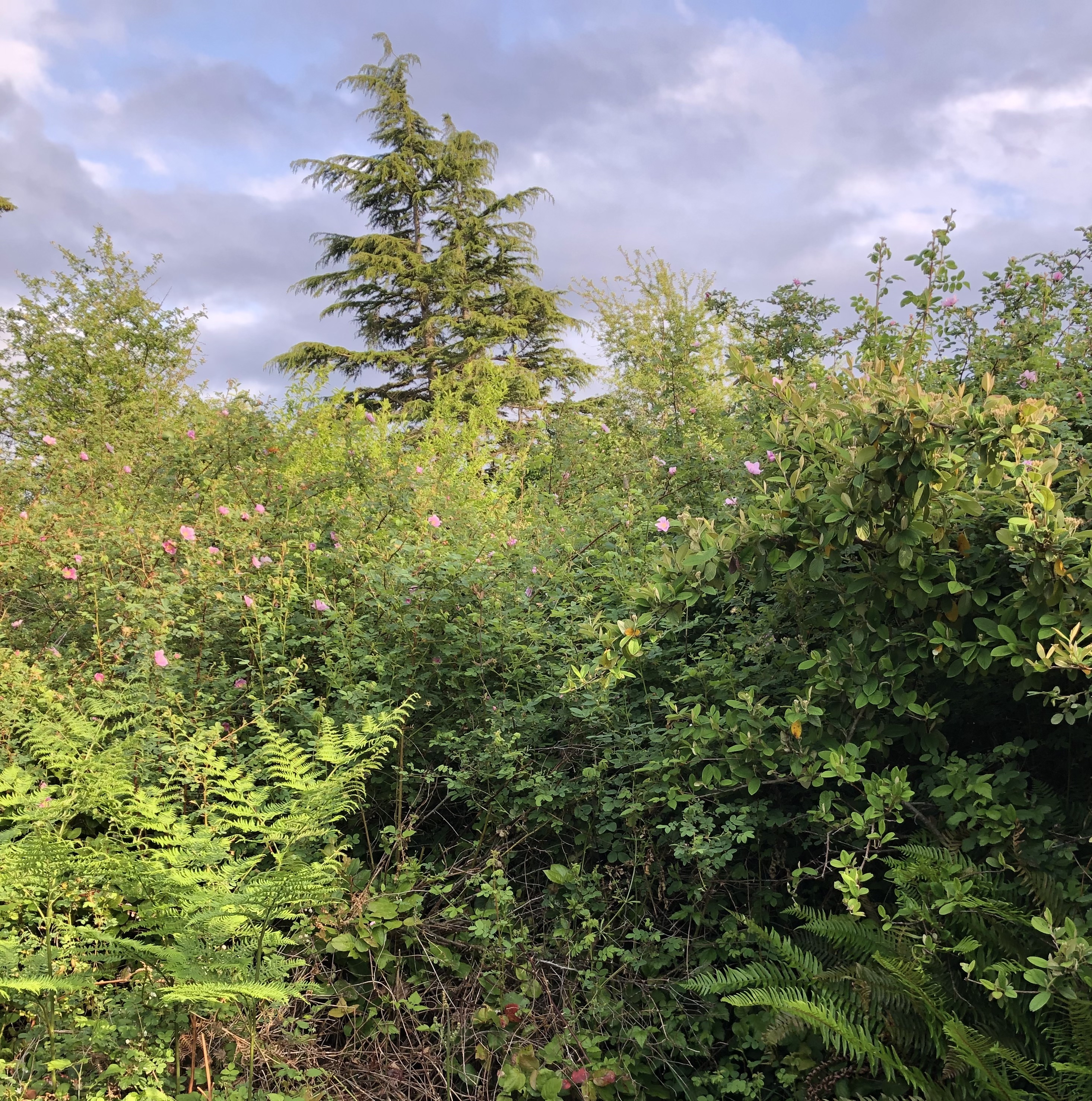
Native deciduous shrubs with an ornamental evergreen Cotoneaster.

Hedgerow of native deciduous Shrubs
Create a plant list that grow well with your soil and light conditions. Note how large they well get within a desire time frame. Are you planning for the next three years or for decades from now? Most designs are based on plants at 8 to 10 years. One thing to keep in mind is…
More elaborate designs
I sometimes like to include ecological succession in my designs. By this I mean planting fast growing woody and herbaceous perennials, perhaps nitrogen-fixing ones like tree lupine, Lupinus arboreus, that fill the space quickly and flower abundantly but then die out as the shrubs and trees fill in. Other potential plants include tree mallow, Lavatera trimestris; Lemon Queen perennial sunflower, Helianthus ‘Lemon Queen’; and Joe-Pye-weed, Eutrochium purpureum.
Shorter, pollinator-friendly additions could include California poppy, yarrow, and asters. Many herbs like rosemary and sage could be planted along the sunny edges. One important limiting factor is how much competition these perennials will have with the existing vegetation you are planting into.
Designing on paper or on the ground
Once you have a list of plants you like (See the post—) that work well with your site, design on paper or directly on the ground. How ambitious is your hedgerow design? Do you imagine planting hedgerows around the entire site? I always advise starting small and building on successes. The design can be created at once but the installation depends on a number of factors. What are your constraints? Maintenance: How will you keep down competing vegetation? Water: How will you water during the first couple of summers? Deer browsing: Fence an entire planting or individual plants? Finances: bare root seedlings or larger nursery-grown potted plants? (John Barr, a gardener extraordinaire, used to say that buying a 5-gal shrub means you are paying someone else to tend to the plant for a number of years.)
Pick out two to three kinds of native deciduous shrubs, two or three kinds of native evergreen shrubs, and one or two non-natives. Do you want to stagger plants in several rows?
Some people work better directly on the ground; it is difficult for them to imagine the hedgerow on paper. For these people, measure on site with tape measure or pace out the distances. Mark out two or three rows and then place a large rock or garden pot to indicate each plant. See the post: Hedgerow Plants for Jefferson County, available February 2026.
Road right-of-way and power lines
Many property lines end some distance from the adjacent road and are bordered by county property known as right-of-way (ROW) . Also there may be ROW between you and your neighbor that could be vacated. Learn more about it here. If you want to plant near power lines it is best to stick with shrubs. Trees growing more than 15-feet-tall should be kept away from power poles and lines. Refer to Jefferson PUD guidelines and look at the picture brochure from Puget Sound Energy.
 Sustainable Garden Design