
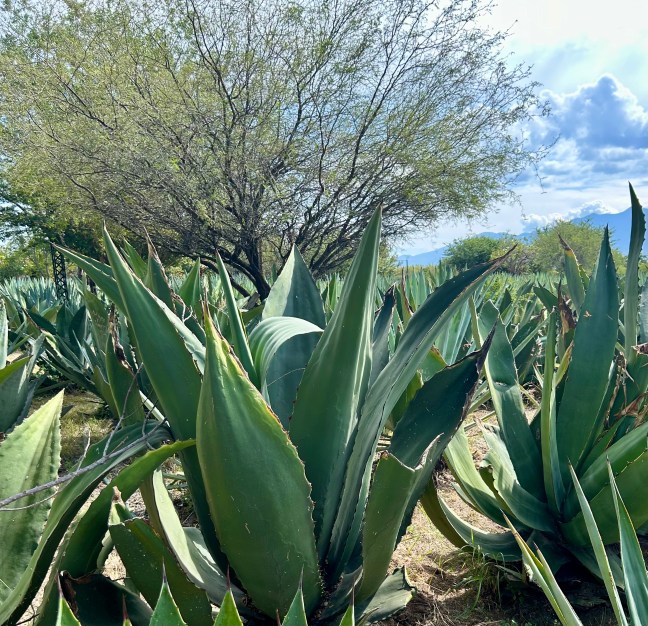
Mezcal has become the world’s favorite distilled beverage—in 2021 production increased 700% from 10 years before. That year eight million liters were produced, much of it in Oaxaca. Any industry growing that fast will have serious environmental and cultural implications.
Although Santiago Matalan is regarded as the mezcal capital of the world, much is changing. As the need to respond to the challenges facing mezcal production increases, innovations are happening in other corners of Oaxaca and throughout the country. The crux of the matter is these solutions are long-term project with no immediate economic returns.
Challenges
- Agaves are exclusively harvested before they flower, just as the flowering stem emerges when they are rich in sugars. Removing this quiote concentrates the sugars in the heart of the piña.
- Removing the flowers impacts native pollinators, especially an important endangered bat species.
- Removing the flower stem prevents seed production that increases genetic diversity.
- Monoculture of identical clones reduces diversity, increasing the risk of entire fields succumbing to disease and pests.
- Overharvesting wild agaves reduces available nectar for endangered long-nosed bats.
- Waste from mezcal production, the liquid vinzana is toxic, as are the agave fibers.
- Water consumption: ten liters of water are required to produce one liter of mezcal
Solutions
Some local Oaxaca heroes include Luis Mendez of Sola de Vega . He has spent years experimenting with cultivating agave plants from seed and his nursery provides growers with small plants. This helps break up monocultures, prevents over-harvesting wild plants, and provides for pollinators. Besides growing agave for mezcal, he encourages people to use them for erosion control, windbreaks, and to increase biodiversity.
Fourth generation mezcalero, Graciela Ángeles Carreño, is a woman from Real Minero who was featured in a Smithsonian article about sustainable production. The Race to Save Mezcal From the World. Her family’s brand Real Minero is a sustainable choice. Mezcal tours from Oaxaca City often go to this cutting-edge plantation and distillery.
Enterprising mavericks like Ron Cooper with Del Maguey have partnered with Zapotec producers in Oaxaca. Another mezcal aficionado is Lou Bank, founder and CEO of SACRED: Saving Agave for Culture, Recreation, Education, and Development. This nonprofit is empowering communities. When asked about green-washing, Bank had a pragmatic response that you can read here. SACRED has raised over US$600,000 that has supported twelve rural communities that raise maguey.
On another front, university researchers have partnered with local growers. The Association of Magauey and Artizanal Mezcal has more information. Instead of relying exclusively on the fast-growing Espadin in monocultures throughout Oaxaca central valley, they are pioneering cultivating more varieties and growing them from seed. Instead of over-harvesting a number of wild maguey species in the surrounding mountains, the are cultivating them. By leaving 30 % of an agave plantation to flower and only harvesting 70% of the crop, pollinators will thrive.
New pathways for utilizing the mezcal waste both the solid fibers and the liquids are being explored, especially in the construction of adobe bricks. Native maguey grows throughout Mexico, and wherever it grows rural folks and campesinos have had bootleg operations—from Sonora to Puebla.
My all-time favorite author and ethnobotanist, Gary Paul Nabhan has pioneered the sustainable efforts with Ana Valenz Zapata a Mexican scientist. Years ago they recognized the problems facing Tequila. Now Nabhan has co-authored another book, Agave Spirits.
“Culled from decades of fieldwork and interviews with mezcaleros in eight Mexican states, Agave Spirits reveals the stunning innovations emerging today across the mezcal supply chain and offers solutions for improving sustainability and equity.” Check out their great website Mezcal-Mankind-Mutualism
Oaxaca’s central valley and city is prone to water shortages during the prolonged dry season. Recent droughts have exacerbated the situation of a growing population and failing infrastructure. Environmental issues include climate change, deforestation, and mining. Mezcal production is also part of the problem. To produce one liter of mezcal uses ten liters of water, much of it becoming toxic in the process. The water table is dropping and wells are going dry.
The months of June through September often are blessed with abundant rainfall. Rural communities are responding by harvesting rainwater. This includes planting trees, making swales and building tanks for water storage. As mezcaleros and non-profits work together for a sustainable future, consumers can support these efforts by purchasing from innovative mezcal brands.
 Sustainable Garden Design