
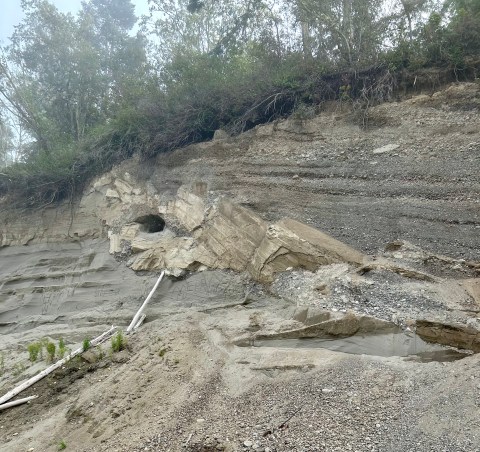
Looking at the natural history of our area deepens our sense of place and helps us grow more resilient gardens. Climate, geology and ecology have shaped the land. Tinker would always comment on the landslides along the bluff between North Beach Park and Point Wilson lighthouse. She enjoyed reading the landscape and imagining the geologic forces at work.
By looking at the bluff, we see what is below the surface of much of Quimper Peninsula, and begin to understand our soils. The above photo shows layers of deposited sediment.
Just imagine—a massive sheet of ice 3,000 ft deep covered East Jefferson County, 15,000 years ago. This last glacier bulldozed and deposited rocks, gravel, and sand. The beach bluffs reveal that much of our soil is glacial deposits. There are pockets of clay, sand and a bit of sandy loam. The thin topsoil is often sandy, gravelly loam. If this intrigues you, check out the Quimper Geological Society!
If you have ever felt your garden soil is not as good as it could be, you are not alone! Most areas of the Puget Lowlands are too young for deep topsoil. ( Of course there is prime agricultural land that formed on marine terraces or alluvial outflow from rivers.) A soil profile is a cut through section of the land revealing topsoil, layers of subsoil and even bedrock. Soil scientists dig profiles to examine the existing soil.
The curious gardener can look online for a digital copy of the 1975 soil survey of the county, where aerial photographs are overlaid with maps roughly indicating soil types and descriptions. I have an old paper copy that I highly value.
Again, this is just a brief summary and I am no expert! The climate working on the land determines the native flora. The Puget Sound area has mild winters and cool dry summers, and is commonly known as a Mediterranean climate. Winter rains tend to be continuous and light to moderate rather than heavy downpours. The marine layer—a deep, low cloud bank is a defining feature.
Rainshadow
What makes our area unique is that the Olympic Mountains block the moisture-laden clouds coming from the Pacific. The west side is a rainforest while the northeast side, in the shadow of the mountains is rainshadow. I have seen native Opuntia fragilis on the Quimper Peninsula and on Whidbey Island. Port Townsend’s average rainfall is around 20 to 23 inches. Often the marine layer breaks apart late in the day.
Prevailing winds from the Pacific often reach us from the south and southwest. As the clouds move around the Olympics, dumping precipitation from Olympia to Brinnon, they are wrung out by the time they reach Port Townsend. Eastern Jefferson County is largely a peninsula on a peninsula. It juts out to the northeast and catches the winds from the south. Mostly in summer winds blow from the northwest down the Salish Sea.
Arctic Blasts
In general our gardens are more prone to winter damage when arctic blasts roar down through the Fraser River Valley of British Columbia. It used to be that we only needed to track this during El Niño- Southern Oscillation years but the polar vortex is wobbling now and this leads to less predictability. Last winter we had cold temperatures that were the lowest in 30 years. Keeping an eye on the weather allows us to bring out sheets or burlap to cover plants. Even wind-blown Doug fir boughs shield vulnerable plants.
Moving here in 1988, with a background in organic horticulture, I was very curious about weather. Trying to get a grasp on seasonal cycles and weather, I asked many questions. It seemed like every season someone would say “This is the coldest summer” or “This is the wettest spring,” or “Its the driest winter”—I could not find a predictable pattern!
But there were and still are weather trends: Spring came early and lasted until the fourth of July; summer was somewhat predictable for August and September, although any day could become rainy and windy. Then autumn arrived. The snow was visible on the mountains until September. Several people who grew up here said the mountains were always snow-covered when they were children.
What I recall is the first snowfall would brighten the Olympic Mountains by mid-October, and might bring a cold snap to sea level, with occasional early frosts. Then mild weather would return for much of October. Often November would be the rainiest time of the year. Temperatures would get cooler and cooler until a frost. The darkest time of the year was and still is late November, December and January.—the sky colored many shades of gray. But then storms blew in from the south, after wrapping around the Olympics, bringing windy weather and sun-breaks in the dramatic skies. Red flowering currant could bloom as early as mid-February. There does seem to be an increased occurrence of multi-year La Nina. Nature magazine 2023.
Resilient Gardens
Climate change is real and part of gardening is responding to the changes. We live in a place for garden lovers, where flowers can bloom in the winter and a large number of evergreen shrubs thrive. The native vegetation offers a plethora of interesting plants for our gardens. Berries and fruit trees thrive in our mild climate. Winter vegetable gardens provide leeks and greens all winter. Knowing that most soils here are excessively well-drained and that we can’t rely on summer rains, drought-tolerant ornamentals are a smart choice. Tinker respected our rainshadow ecosystem. Here is how she grew resilient gardens:
- Recognizing the importance of the soil ecosystem
- Caring for the soil through making compost & sheet mulch
- Selecting plant varieties that are bred for pest-resistance
- Growing open-pollinated heirlooms that we can nurture as landraces
- Developing a strong curiosity about our local weather
- Committing to living lightly on the Earth, however we define it



 Sustainable Garden Design