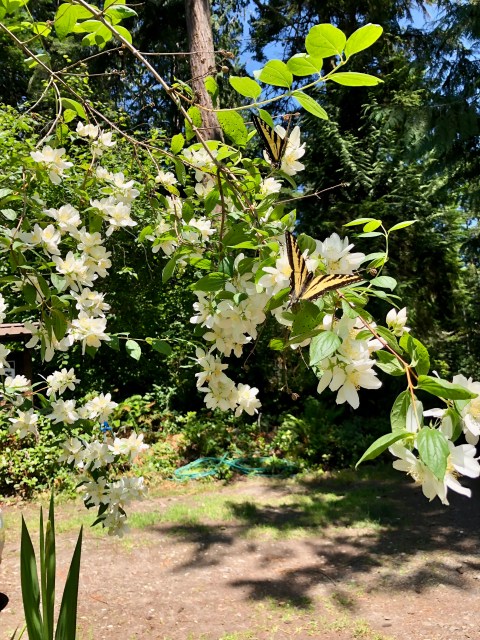
A delightful native shrub for early summer is Lewis’s mock orange, Philadelphus lewisii. This deciduous shrub has a fountain like shape and fragrant white flowers that grow in clusters.
It is equally at home in a cultivated landscape or a natural thicket. My introduction to this native came in a conservation bundle thirty years ago. When the shrubs matured and started to flower, I wondered if a mistake had been made. The flowers looked so much like the Philadelphus coronarius, a European introduction commonly seen on old farms in New England. Our native west coast mock orange is just as beautiful and better adapted!
This multi-stemmed shrub with long arching branches may grow 3-10 ft tall or more. I planted one by a shed where the rain spills off the roof and after thirty years, it is close to 15 ft tall. Since it was part of a native plant thicket planted along the roadside, I never pruned it.
Lewis’ mock orange is equally effective as an ornamental as it is in restoration plantings. It can be used in borders or grouped together for screens. In autumn the foliage turns lemon yellow.
Growing Conditions
Lewis’s Mock Orange is flexible about soil requirements. It prefers soil rich in organic matter but will grow in gravelly soil if provided moisture. Full sun will encourage more blossoms but the plant will be healthy in partial sun. This native will be drought tolerant once established.
Native Habitat
Mock orange can be found throughout the west from British Columbia to California. I am sad to say I have never seen it growing on the Olympic Peninsula but, in Nelsa Buckingham’s book Flora of the Olympic Peninsula, she says it occurs in open habitat here on the peninsula lowlands from north to east. also at mid-elevations from northeast to east.
Benefits
Pollinators love this nectar-rich plant. Birds that eat the seeds in autumn include junco, chickadee, thrush, flicker and finch.
My attitude about growing flowers changed the day I visited my friend Renee at her cabin in the Santa Cruz mountains, California. At the time I was a twenty-three-year-old horticulture student. I sat at her kitchen table, eyeing the room, when I noticed a bouquet on the kitchen table.
It was an arrangement of fragrant flowers with lavender, roses, delphinium, and baby’s breath. My internal dialog commented, “Oh those are probably from the UC Santa Cruz Farm and Garden.” It was a dismissive thought. You can’t eat them, what’s the point.
Then it dawned on me—I had picked those flowers and arranged this very bouquet, just two weeks before. My sister was then apprenticing at UCSC Farm and had invited me to gather a bouquet for Renee, a new mother. Stunned, I saw my bias. Flowers seemed frivolous, when I was on the revolutionary-edge of organic food growing in 1980.
That was the incident that changed my life, it was okay to love flowers as I always had. After getting my Horticulture degree, I apprenticed at Camp Joy in Boulder Creek, CA. I learned to sow seeds in wood flats; tend young seedlings in the greenhouse; and plant them in double-dug raised beds.
Twice a week, before the sun rose over the mountain ridge, we harvested flowers and placed them in large tin cans in the shade of the gazebo. I was taught that the key to selecting young flowers was in the reproductive parts. I became skilled at noting if a flower’s stamens were moist with fresh pollen or not. Daisy-like flowers, with their disk and ray flowers were easy, once the secret was revealed. Bending down to look closely at the yellow center one could see if the rings of tiny flower parts were all open, if so then the flower was old. But if just a couple of outer rings of disk flowers were open, it was prime for harvesting.
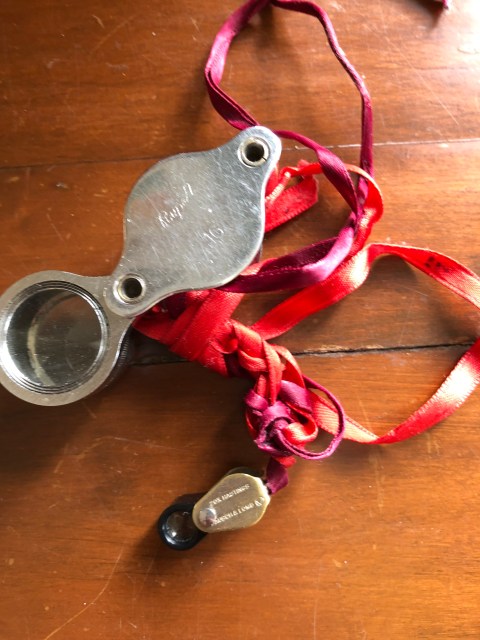
The day I purchased my 20-magnification hand lens, the world of insects opened up. Looking through this loupe was like landing on a planet. By placing the lens close to my face, my hand on my cheek bone to steady the lens, I moved in close, a spaceship landing on a miniature floral world. The intricate textures of leaves, flowers and seeds were mesmerizing. I peered deeply into a flower chamber, translucent in color, while male and female flower parts became giant. I imagined myself a tiny creature crawling over these exquisite sculptures.
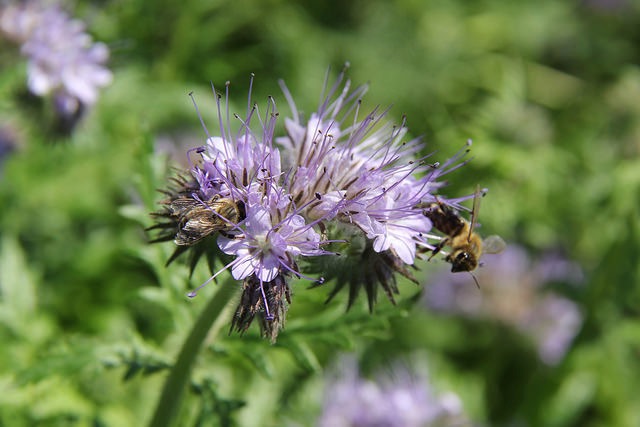
Honey bees on Phacelia
I had to study insects in the horticulture program, after all the little buggers ate our crops. But we also learned of beneficial insects–predators and pollinators. There was humor in considering the caterpillar as a juvenile delinquent chomping on the parsley leaves, but then when the caterpillar metamorphosed into the Swallow-tail Butterfly, it pollinated flowers like a mature, contributing citizen.
Getting to know insects became part of understanding the garden ecosystem. Like a bird-enthusiast with binoculars, I sought insects with my lens. This requires patience! At first recognizing the different creatures based on their anatomy—wings and mouth parts being essential clues, eventually I moved on to noting their behavior.
Over the years I have watched green lacewings laying eggs; each on a solitary stalk. These predators are so voracious, the emerging young would eat the surrounding eggs if they were not out of the way. Also, I have seen lady bug larvae that look like giant Gila monsters gobbling up aphids. And no lie, I have watched aphids pop out live babies.
Learning about pollinators in my backyard offered me the chance to slow down, and become curious. Did you know that a butterfly can taste with its feet? That when it lands on a petal that has nectar-bearing flowers that its siphon-like tongue unfurls? I have seen this. It takes patience, but watching insects is a form of miniature wildlife viewing.
Bees can see colors invisible to the human eye. Foxglove flowers have ultraviolet circles around maroon spots, marking a trail to lure pollinators deep into the trumpet bloom where a reward of pollen and nectar await.
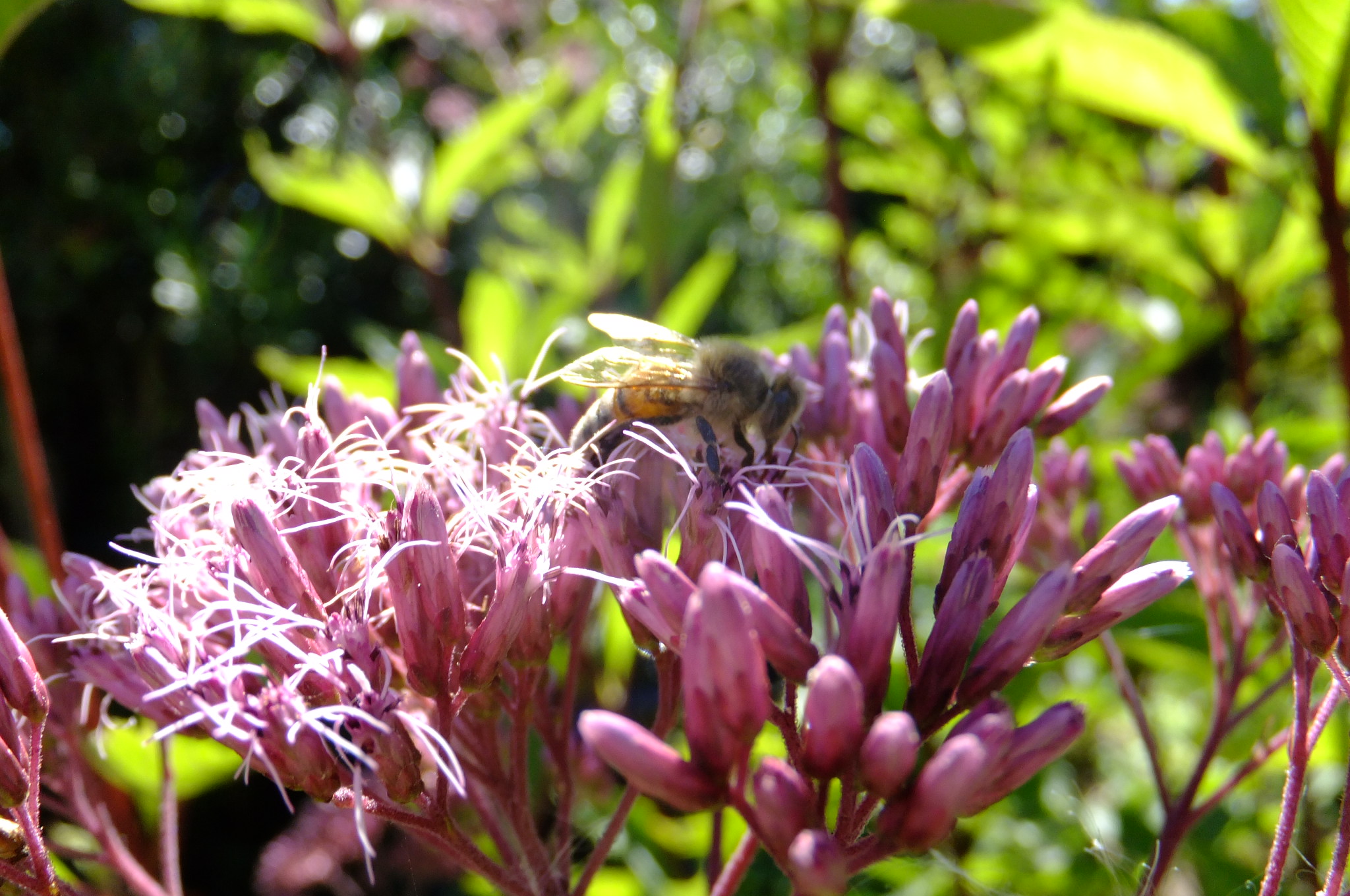
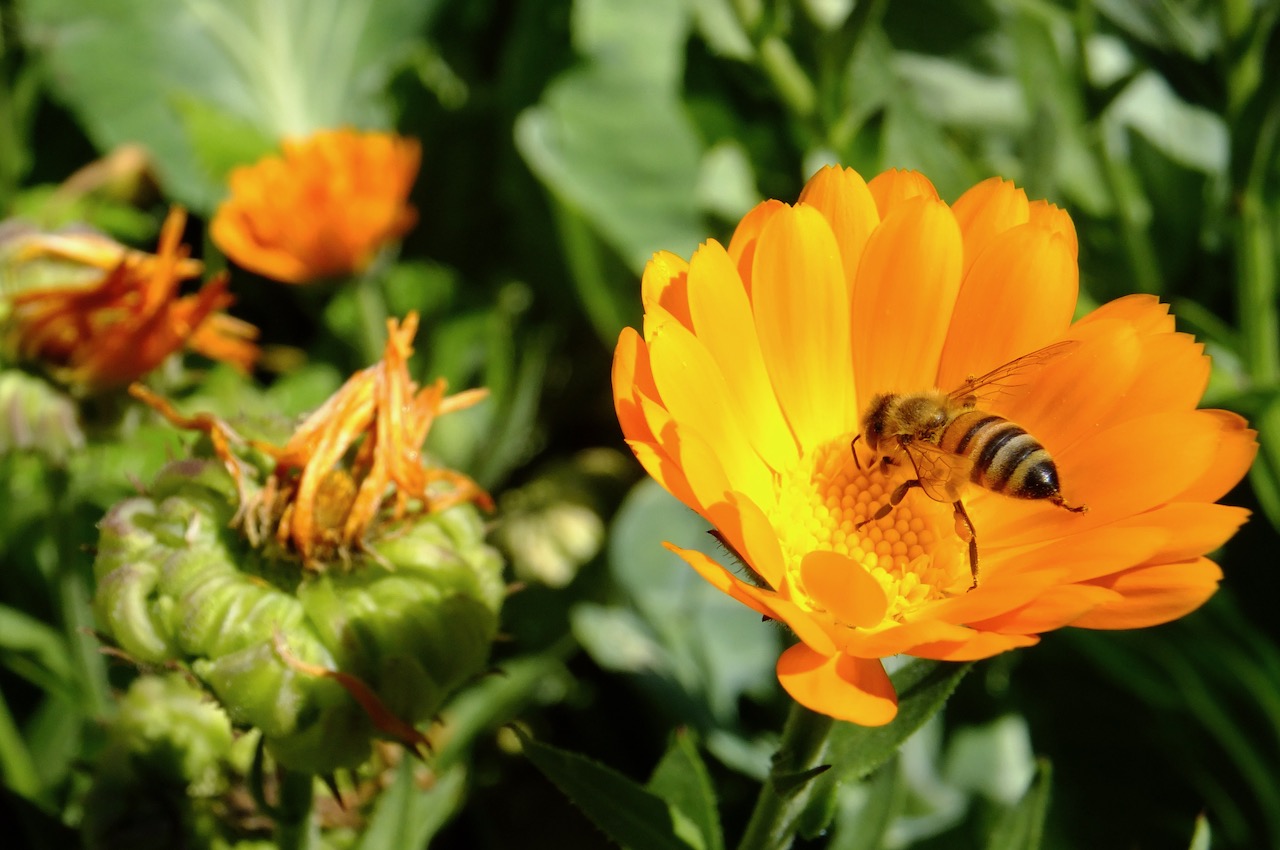
The honey bee is but one of many kinds of bee. Native to the Mediterranean, and introduced around the world, it is a generalist, pollinating many flowers. And yet, it shares a characteristic with all bees that make them the premiere partner for flower pollination—floral fidelity. This means on any given foraging trip they only gather pollen from one species. Efficient for the insect and fundamental for the plant to produce seed, bees are the most important group of insects.
Scientists now know that bees are a keystone species–creatures necessary for the survival of other organisms in an ecosystem. Keystone species are referred to as the glue that holds a system together–without them an ecosystem may not be resilient enough to adapt to climate change. There are native flowers that depend on one or two types of bee to pollinate them.
Also, bees and other pollinators are responsible for food crop pollination. According to the USDA, bees, both honey and native are responsible for the pollination of 75 percent of fruits, vegetables, and nuts in this country. Another way to look at it is one out of every four bites of food can be traced back to pollinator services.
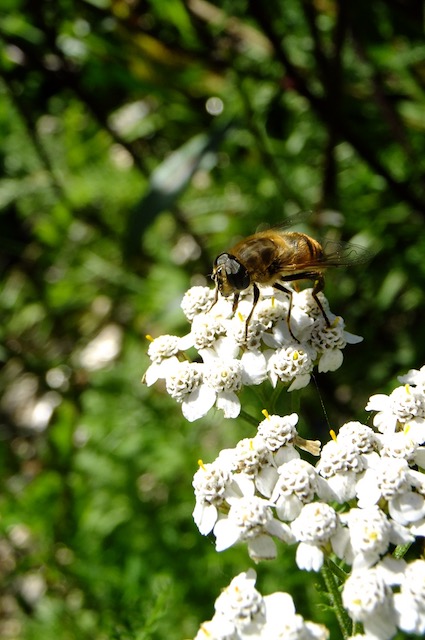
Jim Nelson at Camp Joy, a beekeeper, told me something I never forgot. “Imagine yourself tiny, the size a bee. As you approach a flat-topped white yarrow, a Sedum Autumn Joy, or a sunflower, you would see an entire field of flowers.” A bee’s-eye view of the world makes me want to plant these flowers and patiently watch the insects that come foraging.



 Sustainable Garden Design