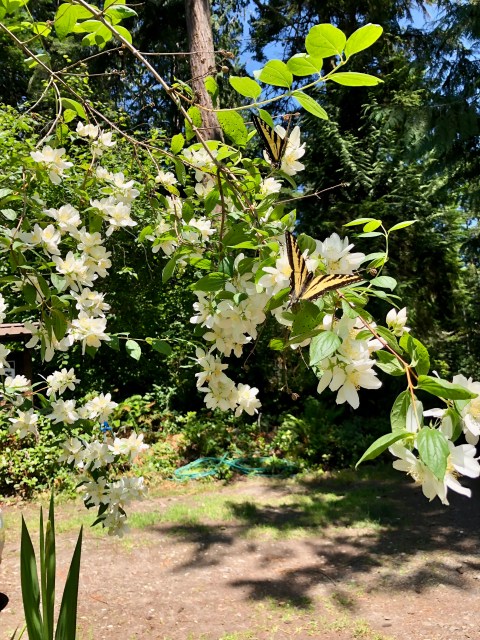
A delightful native shrub for early summer is Lewis’s mock orange, Philadelphus lewisii. This deciduous shrub has a fountain like shape and fragrant white flowers that grow in clusters.
It is equally at home in a cultivated landscape or a natural thicket. My introduction to this native came in a conservation bundle thirty years ago. When the shrubs matured and started to flower, I wondered if a mistake had been made. The flowers looked so much like the Philadelphus coronarius, a European introduction commonly seen on old farms in New England. Our native west coast mock orange is just as beautiful and better adapted!
This multi-stemmed shrub with long arching branches may grow 3-10 ft tall or more. I planted one by a shed where the rain spills off the roof and after thirty years, it is close to 15 ft tall. Since it was part of a native plant thicket planted along the roadside, I never pruned it.
Lewis’ mock orange is equally effective as an ornamental as it is in restoration plantings. It can be used in borders or grouped together for screens. In autumn the foliage turns lemon yellow.
Growing Conditions
Lewis’s Mock Orange is flexible about soil requirements. It prefers soil rich in organic matter but will grow in gravelly soil if provided moisture. Full sun will encourage more blossoms but the plant will be healthy in partial sun. This native will be drought tolerant once established.
Native Habitat
Mock orange can be found throughout the west from British Columbia to California. I am sad to say I have never seen it growing on the Olympic Peninsula but, in Nelsa Buckingham’s book Flora of the Olympic Peninsula, she says it occurs in open habitat here on the peninsula lowlands from north to east. also at mid-elevations from northeast to east.
Benefits
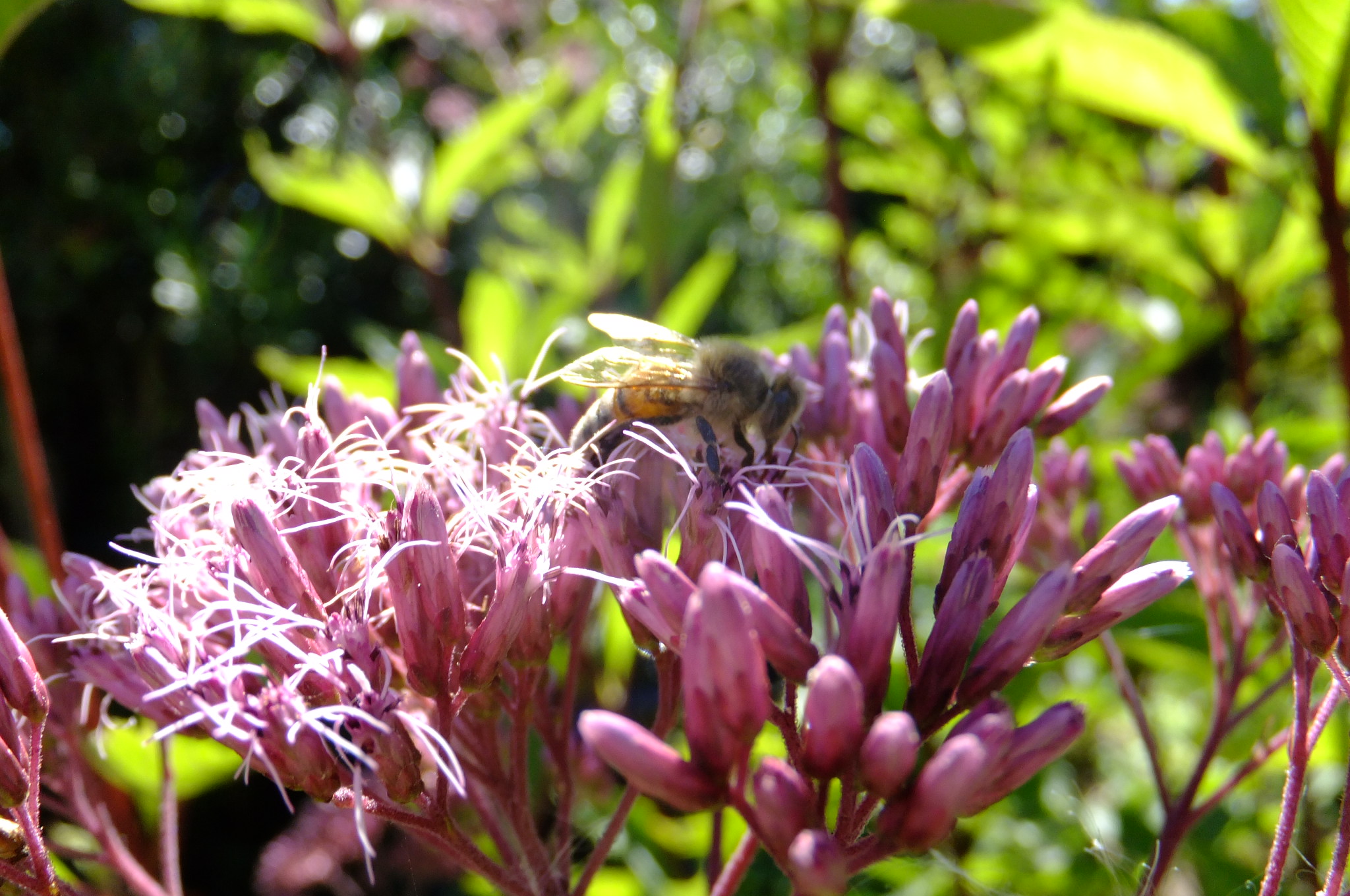
Pollinators love this nectar-rich plant. Birds that eat the seeds in autumn include junco, chickadee, thrush, flicker and finch.
My attitude about growing flowers changed the day I visited my friend Renee at her cabin in the Santa Cruz mountains, California. At the time I was a twenty-three-year-old horticulture student. I sat at her kitchen table, eyeing the room, when I noticed a bouquet on the kitchen table.
It was an arrangement of fragrant flowers with lavender, roses, delphinium, and baby’s breath. My internal dialog commented, “Oh those are probably from the UC Santa Cruz Farm and Garden.” It was a dismissive thought. You can’t eat them, what’s the point.
Then it dawned on me—I had picked those flowers and arranged this very bouquet, just two weeks before. My sister was then apprenticing at UCSC Farm and had invited me to gather a bouquet for Renee, a new mother. Stunned, I saw my bias. Flowers seemed frivolous, when I was on the revolutionary-edge of organic food growing in 1980.
That was the incident that changed my life, it was okay to love flowers as I always had. After getting my Horticulture degree, I apprenticed at Camp Joy in Boulder Creek, CA. I learned to sow seeds in wood flats; tend young seedlings in the greenhouse; and plant them in double-dug raised beds.
Twice a week, before the sun rose over the mountain ridge, we harvested flowers and placed them in large tin cans in the shade of the gazebo. I was taught that the key to selecting young flowers was in the reproductive parts. I became skilled at noting if a flower’s stamens were moist with fresh pollen or not. Daisy-like flowers, with their disk and ray flowers were easy, once the secret was revealed. Bending down to look closely at the yellow center one could see if the rings of tiny flower parts were all open, if so then the flower was old. But if just a couple of outer rings of disk flowers were open, it was prime for harvesting.
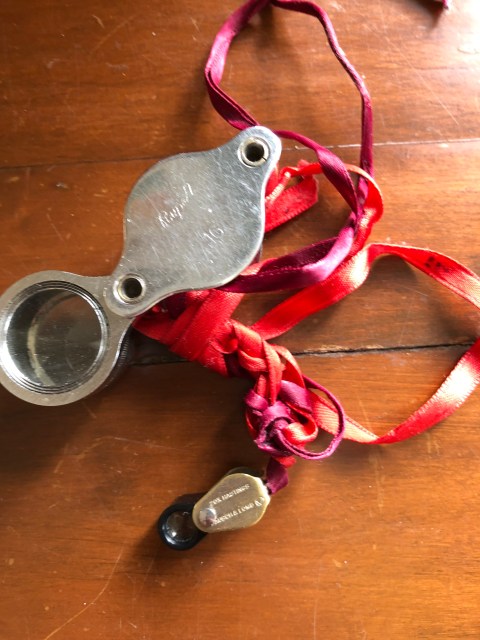
The day I purchased my 20-magnification hand lens, the world of insects opened up. Looking through this loupe was like landing on a planet. By placing the lens close to my face, my hand on my cheek bone to steady the lens, I moved in close, a spaceship landing on a miniature floral world. The intricate textures of leaves, flowers and seeds were mesmerizing. I peered deeply into a flower chamber, translucent in color, while male and female flower parts became giant. I imagined myself a tiny creature crawling over these exquisite sculptures.
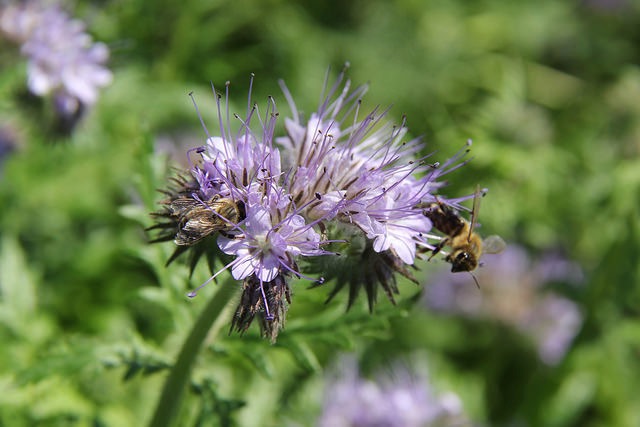
Honey bees on Phacelia
I had to study insects in the horticulture program, after all the little buggers ate our crops. But we also learned of beneficial insects–predators and pollinators. There was humor in considering the caterpillar as a juvenile delinquent chomping on the parsley leaves, but then when the caterpillar metamorphosed into the Swallow-tail Butterfly, it pollinated flowers like a mature, contributing citizen.
Getting to know insects became part of understanding the garden ecosystem. Like a bird-enthusiast with binoculars, I sought insects with my lens. This requires patience! At first recognizing the different creatures based on their anatomy—wings and mouth parts being essential clues, eventually I moved on to noting their behavior.
Over the years I have watched green lacewings laying eggs; each on a solitary stalk. These predators are so voracious, the emerging young would eat the surrounding eggs if they were not out of the way. Also, I have seen lady bug larvae that look like giant Gila monsters gobbling up aphids. And no lie, I have watched aphids pop out live babies.
Learning about pollinators in my backyard offered me the chance to slow down, and become curious. Did you know that a butterfly can taste with its feet? That when it lands on a petal that has nectar-bearing flowers that its siphon-like tongue unfurls? I have seen this. It takes patience, but watching insects is a form of miniature wildlife viewing.
Bees can see colors invisible to the human eye. Foxglove flowers have ultraviolet circles around maroon spots, marking a trail to lure pollinators deep into the trumpet bloom where a reward of pollen and nectar await.
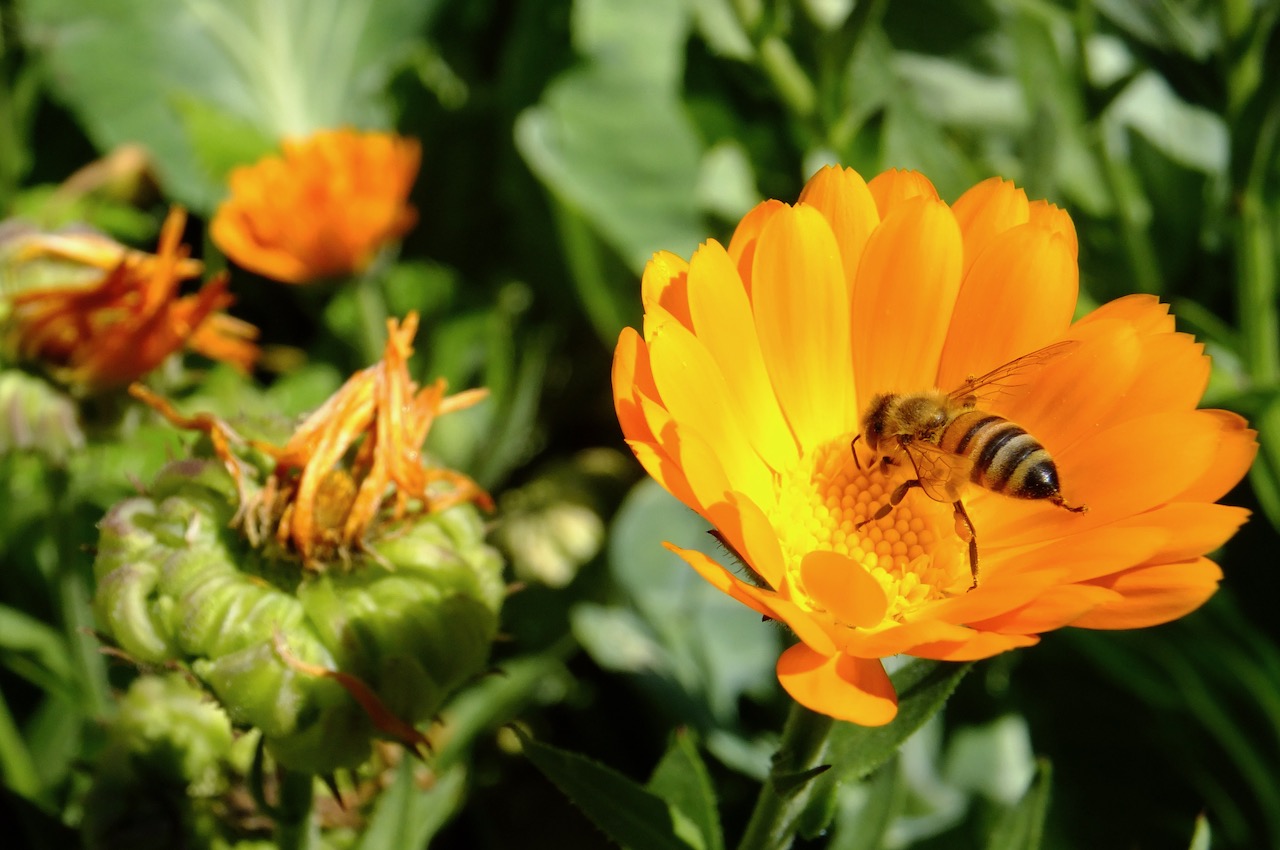
The honey bee is but one of many kinds of bee. Native to the Mediterranean, and introduced around the world, it is a generalist, pollinating many flowers. And yet, it shares a characteristic with all bees that make them the premiere partner for flower pollination—floral fidelity. This means on any given foraging trip they only gather pollen from one species. Efficient for the insect and fundamental for the plant to produce seed, bees are the most important group of insects.
Scientists now know that bees are a keystone species–creatures necessary for the survival of other organisms in an ecosystem. Keystone species are referred to as the glue that holds a system together–without them an ecosystem may not be resilient enough to adapt to climate change. There are native flowers that depend on one or two types of bee to pollinate them.
Also, bees and other pollinators are responsible for food crop pollination. According to the USDA, bees, both honey and native are responsible for the pollination of 75 percent of fruits, vegetables, and nuts in this country. Another way to look at it is one out of every four bites of food can be traced back to pollinator services.
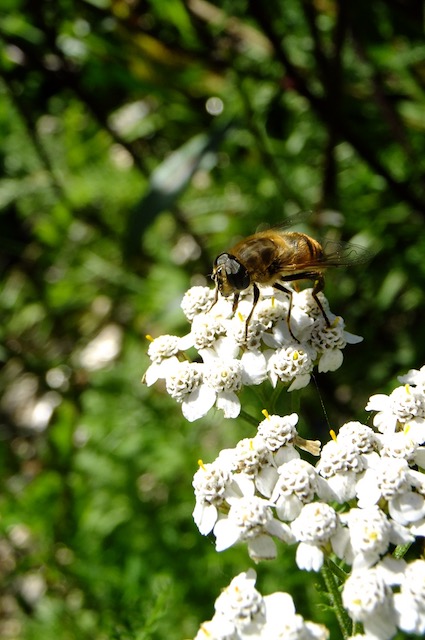
Jim Nelson at Camp Joy, a beekeeper, told me something I never forgot. “Imagine yourself tiny, the size a bee. As you approach a flat-topped white yarrow, a Sedum Autumn Joy, or a sunflower, you would see an entire field of flowers.” A bee’s-eye view of the world makes me want to plant these flowers and patiently watch the insects that come foraging.
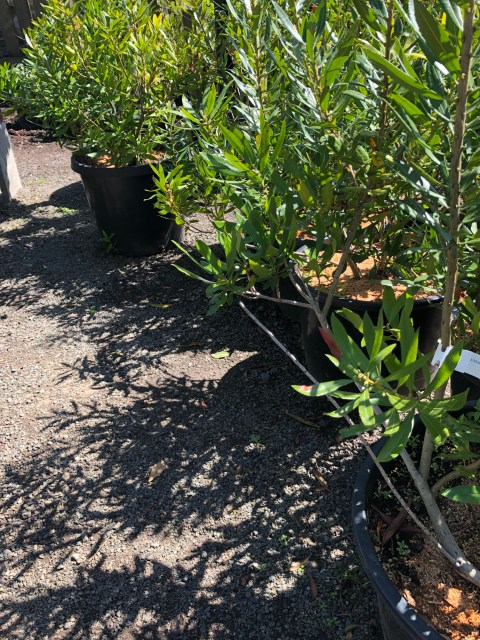
Most garden centers are temporary holding places for potted landscape plants. Freshly delivered plants from a wholesaler tend to be healthier than shrubs sitting in the yard overwinter. During dry spells in summer, note if the plants are getting watered or if the potting soil is dried out. Avoid plants that look like they have been sitting too long at the nursery.
Foliage
At the garden center, look at the foliage of the plant you are interested in. Sometimes it helps to step back and note all the plants of the same kind in pots. Look at the color. Is the overall color dark or bright green? (Of course, some plants are bred for other colored foliage including burgundy or yellow.) Avoid browning, yellowing, or wilting foliage. Are there pale or dark spots? Is the one you want fresh and healthy? A couple of sad leaves are okay—here we are looking at the overall health. Even if it is on sale, it is not worth it, unless you love tending sick plants or are a skilled gardener. Starting with the healthiest plants creates a vibrant garden.
Roots should be firm and white, not mushy or brown. They should mostly fill the pot but not be completely root-bound. A web of young roots filling the pot is okay but not thicker roots. Often at planting we use a knife to cut off slices of the rootball to allow new growth to spread out.
Structure and Overall Form
Now look at the woody stems of this young shrub. Do they join at the base? Sometimes several separate young plants are potted together to give the impression of a healthy big plant. Is it worth the price if your plant is really several juvenile ones packed together?
If the plants are healthy individuals, look at the way the stems are growing. Sometimes the plant is misshapen because all the pots were packed together and can be pruned once you get it home. Other times if you hunt through the offered plants you can find one with more uniform branching. It is worth taking the time to examine several potted shrubs. In any event, once you get the shrub home and dig a hole for it, turning it around in the hole can reveal its most attractive side to face out.
Springtime can be overwhelming. Everywhere we look something is calling out in need of attention. One of my garden mentors, Beth Nelson from Camp Joy Gardens, always said, “The garden is forgiving. If we don’t get it right this year, we can try again next year. Be patient with yourself.” Enjoy the time in the garden. Here are suggestions for where to begin:
General garden maintenance
Liquid fertilizer like fish and seaweed solution benefits plants more quickly in cold soil than the dry fertilizer.
Control weeds before they flower.
In the edible garden
Time to pull back straw mulch to allow the soil to warm.
Plant bare-root strawberries and raspberries
Transplant vegetable starts
Cover pea bed with floating row covers
Direct sow root crops like radish, spinach, chard, lettuce, mustard greens
Top-dress beds of perennial crops and flowers with well-aged compost.
Landscape care
Read our post about pruning flowering shrubs
Replenish alder chips or arborist-chip mulch. Be careful with trunks of shrubs & trees—no mulch within six inches. (Mulch can keep the trunks moist and allow disease organisms to breed.)
Add lime to lawns.
Learn to appreciate the many benefits of weeds in the lawn—think polyculture!
Mow grass leaving it about 2 1/2 inches tall.
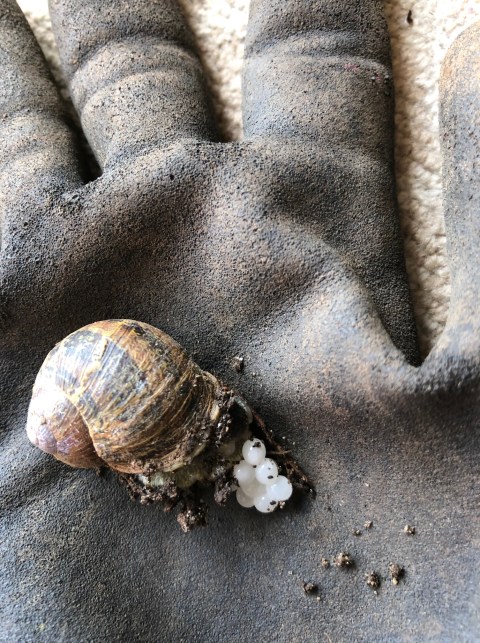
Hand pick & destroy slugs and snails. Learn to recognize snail eggs.
Sprinkle Sluggo or other nontoxic slug bait
Vegetable Starts
Start seeds indoors if you can grow healthy starts that are sturdy and dark green. Inadequate light causes the seedlings to grow spindly and fragile. Indoor lighting is dim compared with sunshine. Even a cloudy day offers more light than a typical florescent grow-light.
Once they have germinated, place the seedling trays outside on nice days. At first place them in a protected bright spot and then a day or two later, set them in full sunlight. And a light breeze will help then get sturdier. Also, by placing them outside, and bringing them in at night, the seedlings have begun the harden-off process. Otherwise, if they are greenhouse grown and then directly placed in the cold garden soil, the young plants can go into shock rather than grow.
The goal is to transplant them to the garden when they have two or three sets of true leaves. A grey, overcast day helps prevent transplant shock. If all this is too much effort, buy the vegetable starts. You can always sow your own seeds later in the season. We are so lucky here in Jefferson County to have excellent seedlings available from Midori Farm and Red Dog Farm. They are available now at the PT food Coop and Chimacum Corner Farmstand. They carry an array of vegetable varieties that thrive here.
Pruning
Shrubs that produce vigorous replacement shoots are good plants to learn pruning. These flower on one-year old wood. If you only shear them, they never flower well. Also there will be a lot of thicker woody stems. Remove any crossing branches and weak or dead stems.
Proper pruning is a combination of thinning out—removing the branch all the way back to a larger branch, and heading back—what hedge shears are good for. Most novices just do heading back cuts. The problem is the plant grows into a dense hedge with just an inch or two of vegetation on the surface. A healthy pruning jobs increases the depth of foliage by allowing light and air in to the shrub.
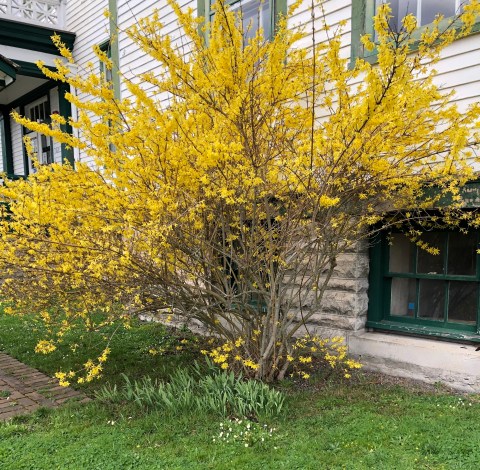
Examples are flowering currant, mock orange (or Philadelphus), forsythia, kerria and flowering quince. Wait until the flowers are faded before pruning.
Making Lists
Springtime can be overwhelming. Everywhere we look something is calling out in need of attention. One solution is making lists. Walk through the garden and write down anything that needs attention. Next set priorities. Sometimes fifteen minutes is enough time to tackle a crucial task. To borrow a term from construction industry, consider making a punch list. Keep a running list of projects that require additional help or some expertise. At the end of the day, it is satisfying to cross off items. Of course, sometimes I enjoy puttering in the garden, skipping around in a relaxed fashion. This can be a form of horticultural therapy where enjoying the clouds skittering across the sky, or watching insect behavior is just as satisfying as accomplishing something.



 Sustainable Garden Design