In Praise of Grains

Grain growing is one of the frontiers of home gardening; people start with vegetables and move to fruits; strawberries, cane fruits and home orchards. Perennial vegetables like asparagus and artichokes or culinary herbs often follow. We tend to shy away from growing grains.  Grain growing takes so much space; grains are so cheap to buy.  But, now more and more gardeners are taking up the challenge to grow their own grains.

I got my wake-up call from an article in the Washington Post on March 13, 2011 by the founder of the World Watch Institute, and Earth Policy Institute, Lester Brown:

The United States has been the world’s breadbasket for more than half a century. Our country has never known food shortages or spiraling food prices. But, like it or not, we will probably have to share our harvest with the Chinese, no matter how much that raises our prices.

A small patch of grain can be broadcast by hand.  When I do this, I feel connected with ancient people; there is something almost biblical about this practice.  Broadcasting is a meditative dance; the continual moving forward while sweeping the arm to and fro while evenly scattering the seed.  If you prefer a more accurate form of seed dispersal, one low-tech option is to use a grass seed broadcaster.  Think of sowing a lawn, but one that will grow tall and go to seed.  If you have a big sunny backyard, a 30 ft. by 30 ft. patch of winter wheat sown in the fall will produce 50 lbs. of dry wheat berries the following early summer.

The other end of the spectrum is transplanting seedlings of grain.  Before you throw up your hands in disbelief, consider this. It is possible to produce the same 50 pounds on a mere 300 sq.ft. area. That is enough wheat to make a one-pound loaf of bread every week of the year. If your space is limited, try this Grow Biointensive technique.  Mind you, it is part of an entire process described in How to Grow More Vegetables: THAN YOU EVER THOUGHT POSSIBLE, ON LESS LAND THAN YOU CAN IMAGINE. John Jeavons and the Ecology Action staff have quantified the yields of grain grown by transplanting seedlings.  So, I’ll leave you with these seeds of inspiration and in the fall instead of planting cover crops for the winter; consider sowing some amber waves of grain.

Keep an eye out for more about grains–easy choices for the novice; harvesting with an Austrian Scythe; how flailing can be graceful, and more surprises.

Why am I Fascinated by Olive Oil?

Why am I fascinated by olive oil? Maybe it’s my Italian heritage and the fact that I just returned to California after thirty years of living elsewhere. Or, perhaps it is because I am drawn to the 100-mile diet concept and the potential for making cooking oil makes me giddy. Whatever the reason though, I can’t look at the ubiquitous olive tree in a parking lot without breaking into a smile.

Once you start looking, olive trees grow everywhere in California. The Spanish padres brought them when they headed north from Baja California. I remember driving through a region not far from Ensenada, called Santo Tomas that was all olive orchards. In fact, the most common variety of Olive is the Mission. But, I’m going to stick with where I am in northern California.

I’ve had my eye on about sixty trees that flank one of the roads through the vineyard where I live. Maybe I’ll take some photos from the tower.  I started researching and writing this last November.  Last week I had the opportunity to learn something new about olives that inspired me to rework this and share it with you.

Okay, so this is what I discovered in my eagerness to learn the secrets of successful olive oil making. I was thinking along the lines of local production and self-reliance. I visited the mill where the Frey’s had pressed their olives the week before. I called and wanted to watch olives being pressed into oil.

At the Olivino press in Hopland, I was stunned by the technology and the science involved in creating fine olive oil. I never expected to find a state-of-the-art facility right here in Mendocino County. Yvonne Hall, co-owner and plant manager was obviously a very busy woman. When she realized I was willing to return a few hours later when she had time to talk, Yvonne was really helpful, giving me a tour, answering my many questions, and spelling words out so I could write it all down.

Now, I didn’t realize that the thrust of this olive oil movement was from wine growers who wanted to create an olive oil based on the Lucchese oil from Tuscany, considered by many to be the finest olive oil in the world. Yvonne and her partners went to Italy to find the best equipment. What I was witnessing was a renaissance of olive oil fifteen years into its unfolding. People have gone to Italy and brought back the same varieties that are grown there in Tuscany. I had thought Mendocino was on the far northern edge of this crop and the varieties were selected based on similar climates, but no this is a world-class creation. They are growing and pressing olives in Napa and Sonoma counties also.

The good thing, from my local-foods approach is that Olivino has a community press day or days when small farms can bring whatever amount of olives they grew and throw them in the press. No guarantee that what you take home is from the specific olives raised on your land, but you are getting local oil. So I thought what I would see was so local appropriate technology and was shocked to discover a marvelous highly competitive art from unfolding.

Let me just interrupt right here and tell you something about me. If you are going to follow this blog, you should know that I have an endless curiosity when I explore something new. I have to devour the entire body of knowledge, whether it is building my own house, understanding Fideicomiso–the Mexican laws for buying property, or growing wild mushrooms.  So, be forewarned; I might go off on tangents from time-to-time.

I want to write about the bright green oil pouring from the machine and the floral taste of the fresh oil with a final note of pungency at the back of my throat; but if I wait for all that I may never post this! Consider this just the first glimpse of my passion with olives.   By the time this blog has a following, I will be posting regularly. The tiny olive flowers are just beginning to bud here at a thousand foot elevation.

GMOs and Dr. Vandana Shiva

Dr. Vandana Shiva, highly articulate ecofeminist, author of numerous books including Soil Not Oil: Environmental Justice in an Age of Climate Crisis, challenges the false claims of a current advertisement by Monsanto.

9 billion people to feed. A changing climate. Now what? Producing more, conserving more, improving farmers’ lives. That’s sustainable agriculture. and that’s what Monsanto is all about.

You have seen the propaganda printed in countless magazines.  Shiva Vandana takes on Goliath, point by point, in “Climate Change and Agriculture: Biodiverse Ecological farming is the Answer, Not Genetic Engineering,” published this February, by Climate StoryTeller.org

A Changing Climate: Industrial globalized agriculture is heavily implicated in climate change by contributing to the three major greenhouse gases, carbon dioxide, nitrogen oxide and methane. Vandana Shiva quotes the specific increases from pre-industrial times to now, according to the Intergovernmental Panel on Climate Change.

Producing more: The claim of higher yields has been proved wrong by a recent study titled, Failure to Yield by Dr. Doug Gurian Sherman of the Union of Concerned Scientists, who was former biotech specialist for the U.S. Environmental Protection Agency and former adviser on GM to the U.S Food and Drug Administration. Sherman states, “Let us be clear. There are no commercialized GM crops that inherently increase yield. Similarly there are no GM crops on the market engineered to resist drought, reduce fertilizer pollution or save soil. Not one.”

Conserving More: Contrary to their claims, the GMO industry is stealing, not conserving genetic information. Navdanya’s recent report titled, “Biopiracy of Climate Resilient Crops: Gene Giants are Stealing Farmers’ Innovation of Drought Resistant, Flood Resistant and Salt Resistant Varieties,” shows that farmers have long ago bred corps that are resistant to climate extremes. The industry claims of isolating a “drought tolerant” gene are also unfounded.

Vandana counters,  “Drought tolerance is a polygenetic trait. It is therefore scientifically flawed to talk of ‘isolating a gene for drought tolerance.’ Genetic engineering tools are so far only able to transfer single gene traits. That is why in twenty years only two single gene traits for herbicide resistance and Bt. toxin have been commercialized through genetic engineering. Furthermore, genetic engineering leads to soil carbon reduction when crops are herbicide resistant. Weeds are sprayed instead of turned under the soil or composted, thus soil carbon is reduced, not conserved.

Improving life for farmers: The painful fact of 200,000 Indian farmers committing suicide in the last decade is linked to debt created by the high cost of GMO cotton seed. Shiva provides statistics and compares prices.

Quinoa

Ecology Action Garden at Golden Rule siteI wrote this for the Abundant Life Seed Foundation Newsletter back in 1999 when I worked there.

Quinoa (pronounced keen-wa) known to the Incas of the Andes as “Mother Grain” is an attractive plant, nutritious crop, and a delicious food.  If you have ever cooked this psuedograin you have seen the funny little squiggle or partial spiral of the seed’s germ.  Let’s take a look at this interesting crop.

The plant grows high in the mountains of South America, in an area known as the altiplano, where it withstands extremes of climate– not only freezing temperatures and poor soil but also high intensity of sunlight.  The Queche Indians, heirs to the Inca legacy, have grown the “mother grain” for 3,000 to 5,000 years and developed many varieties adapted to various conditions.

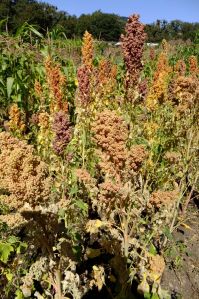
It is not a true grain from the grass or cereal family, but a member of the Goosefoot family.  Quinoa is related to spinach, orach, and beets, but most closely linked to the weedy edible lamb’s quarters and epazote the pungent, culinary herb from Mexico.  Like them, Quinoa has leaves with toothed margins and a powdery texture. The plants grown at the Abundant Life trials garden grow 3 to 5 feet tall.  As the autumn air turns crisp, the foliage turns a stunning array of yellows and purples. The flowers have no petals–they look like tiny green balls with dense, pyramid shaped clusters of seeds, that mature into an attractive golden color.

The individual millet-sized seeds are flat on two sides.  You may recall washing the “grain” before preparing it.  That’s because the seed coat has saponins, a bitter property that protects it from the intense sunlight and repels insects and birds.

Most quinoa exported from South America has been mechanically buffed to remove the saponins in the outermost edge of the kernel, (thus is nonviable as seed stock) in a process known as pearling.  Some seeds bypass the machines, so it is still advisable to rinse it before cooking.

The embryo of quinoa takes up a greater portion of the seed than normal cereal grains, so the protein content is higher.  The National Academy of Sciences calls it “one of the best sources of vegetable protein in the vegetable kingdom”.  It is also high in calcium and iron.

Quinoa is prepared by simply boiling but traditionally it was used as flour or dry roasted.  Try this recipe next time instead of plain rice:  Place 4 cups of water in a pot with 1/4 c wild rice and a piece of dried kombu or other sea vegetable (for flavor and nutritious trace elements).  Bring to a boil and after 10 minutes add 1c short grain brown rice.  Lower heat and cook another 25 minutes Add 3/4 c of rinsed quinoa.  Let it simmer  15-20 minutes  Enjoy the nutty, nutritious flavor of quinoa as a regular part of your diet.

Dryland Farming Project

This is an exciting project that I wrote about two years ago for the PT Co-op Newsletter.  You can see it on their website.

The early morning sunlight illuminates the heads of grain: golden barley, blue-green triticale, and vibrant green wheat.  Walk along the public trail near Collinwood Farm and you will see a hand painted sign announcing the Dryland Farming Project, a trial plot for staple crops. This is an exciting experiment, not only in growing crops, but also in community involvement.

For many years the idea has been a handful of seeds in the mind of Tinker Cavallero. She has an uncanny knack for being right ahead of the curve in sustainable living. Now she’s exploring the limits of what staples can be grown locally with little inputs, especially without irrigation. “We need to research ways that we can locally and sustainably grow staple crops such as grains, legumes, and seed crops,” she said. Tinker is proposing selecting strains of wheat, beans, and other staples through the old-fashioned technique of seed saving.

The Quimper Peninsula receives very little rain, about seventeen inches on average. We are also learning that the Chimacum aquifer is at risk of being overdrawn. And of course, more development means more wells, and there’s a limit to the water held in the aquifer. Additionally, sandy soils low in organic matter are common in our region.

The seeds of an idea were just waiting for a time and place to germinate. Ian Keith, owner of five acres of land lacking the infrastructure for water, wanted to see the land farmed. The land is located above Collinwood Farm and has been fallow for many years. Community organizer and member of Local 2020’s Food Self-Sufficiency group, Judy Alexander, believed in the idea and wanted to be part of the project; she encouraged people to invest in a cooperative to share the initial expense and the harvest. Tinker contributes her five years of experience at Abundant Life Seed Foundation as garden co-manager, her three years experience running a CSA at Collinwood Farm, and her experience co-managing a seed farm in New Zealand for a year. She was also co-manager at Frog Hill Farm where she experimented in spinach seed trails in conjunction with the Organic Seed Alliance.

Tinker has the experience to carry the project forward and the support of several experts. Kevin Murphy, PhD (remember his CSA at Collinwood Farm 10 years ago?) and Steve Jones from the WSU Extension in Mount Vernon will help with different wheat varieties. Several farmers are on board to consult about dried beans and corn.

The project has presented an opportunity for a real exploration in the dynamics of leadership. There is no hierarchy. Participants have self-selected for different responsibilities by communicating through an online Google group, from locating seed sources, to directing work parties, to bringing snacks and organizing potlucks. Tinker’s daughter, Kia Ochun, got so involved in the project she ended up researching the different grains and staples for her high school senior thesis. You can read her crop descriptions posted on signs at the field.

Every Friday and Saturday from five to ten people have shown up to participate in preparing the ground, sowing seed, and weeding the quack grass. The atmosphere on Friday morning is vibrant with people working together. Bob Aoili, a farmer who managed the market garden at Corona Farm, says, “I love the organic-ness of the group, that we can do something without too much structure. And also that each person has a different insight about farming that inspires them.” Another member added, “Here is a group of people who didn’t know each other before we came together and we vary in age from under 10- years-old to over 60. And we have so much fun together!”

“It is my hope,” Tinker said, “that through our trials we can start to create crops that will produce reasonably well and in the process learn methods and varieties best suited for our conditions.” She continued, “I can imagine trials of flax, rape seed, soup peas, fava beans, spelt, barley, buckwheat, oats, quinoa, millet, as well as naked seeded pumpkin seeds and sunflower seeds.” At this point an acre of staple crops are vigorously growing.  The first crop to harvest will be the barley.  Come by and see the first stages of a dream for dryland farm crops.

Other farmers are involved in similar projects. Finn River Farm is currently doing wheat trials and their winter wheat is growing strong. Stay posted for further developments of the Dryland Farming Project in the Port Townsend area.

Vibrant Salad Greens


I was asked to write this for the Port Townsend Farmer’s Market in 2004.

Here at the Farmer’s Market the day’s harvest is arranged–bunches of arugula and flat leaf spinach, undulating leafy heads of butter lettuce, and salad mix.  The basket is full of perfect miniature leaves–frilly or rippled, green and white, or maroon tinted.  So many shapes–spoon like or narrow, round to oblong–they delight the senses.

Traditional mesclun includes several lettuces, chicories, and arugula. Oriental salad greens include several mustards and other members of the brassica  family. Today’s salad mix may also include a variety of herbs, wild greens, spinach, Swiss chard and edible flowers, but these are beyond the scope of this article.

Mesclun ( pronounced mes-CLOON), is the Nicoise dialect word for a mixture of tender, young salad greens. Renee Shepherd, who used to eat her way through southern Europe, tasting vegetables to include in her seed catalog, says “In France, big baskets of these mixed baby leaves are offered at every greengrocer’s stall, to buy by the kilo for instant no-work salads”.  If the price puts you off, consider this– you can add several handfuls of this zesty mix to a regular green salad.

SALAD PREP

For those of you who would rather prepare a salad with heads and bunches of greens to create your own combination, here are a few tips on salad preparation.  Wash leaves in a bowl of water to let the dirt settle out. Dry salad greens to keep them crisp.  There’s nothing worse than a soggy salad.

There are several ways to dry greens:1) Place a linen towel in a colander and wrap the greens; let them drip.2) Open a towel and wrap greens lengthwise hold the folded end and whirl. The excess water will spray out in all directions, especially on you. I learned this the hard way as a teenage ‘salad girl’ at a restaurant.3)salad spinners– wire salad baskets with handles can be used but they often bruise the greens.  Instead choose a plastic one.

These spinners always bring out the kid in me. I love to twirl the handle as fast as can be and let go to watch it spin wildly.

Small inner leaves can be kept whole. Tear  large lettuce leaves or cut them with a non-corrosive knife.  Handle them gently as the delicate leaves bruise easily.  Toss the salad by hand.  Most people add the dressing directly to the salad.  Be careful not to overdo it, as the purpose of a vinaigrette is to enhance the greens.

See the bullet for a description of some of the most popular salad greens.

Create your own salad dressing by adding 3 parts oil to 1 part vinegar and then adjust it to taste after adding herbs and seasoning.  Lemon, lime and orange juices are acidic and add a fresh spark. Consider combining olive oil with flaxseed, walnut or hazelnut oil. Different dressings highlight different greens. Remember that the essence of dressing is to bring forth the salad’s flavor and add a touch of piquancy.  Below is a recipe for a salad with spicy Oriental Greens.

Island Delight Salad Dressing: Recipes From a Kitchen Garden–Shepherd’s Garden Seeds. My sister used to garden for Renee and this is her favorite recipe.

Dressing:

3 tablespoons lemon juice

2 tablespoons honey

4 teaspoons soy sauce

1 1/2 teaspoons freshly grated ginger

1 small clove of garlic, finely chopped

large pinch of white pepper

1/2 cup canola oil.

Vibrant Greens for Salad

LETTUCE

Romaine/ Cos leaves upright, oblong ,prominent rib, full flavored hearts.

Butterhead/Bibb undulating exquisite leaves have a butter flavor.

French Crisp/ Batavia loose young plants become more dense as they mature–like people. Compact crunchy crispness of the romaine with the shape of the butterhead.

Looseleaf very popular; for its eye appeal with colorful, tender, crumpled leaves. Delicate and sweet flavor.

CHICORY

Curly Endive/Frisee/French Escarole finely cut leaves, have a frilly appearance,  mildly bitter and sometimes nutty flavor.

Raddichio/Belgian Endive tangy flavor, heading chicory. Red varieties deep crimson colored with white ribs.

MUSTARD GREENS

Arugula/Rouquette dark green leaves with a strong distinctive flavor, anyone who knows this vegetable either loves it or hates it. I won’t tell you my opinion, I’ll let you try it and decide for yourself.

Pak-choy well known for its succulent white leaf stems and dark green leaves.

Giant Red Mustard flavor both pungent and sweet, leaves have purple-red overlay.

Mizuna mildest mustard green with only a hint of spicy flavor.  Finely divided margins create a feathery effect. Attractive white veins and thin juicy stalks.

Red Russian Kale deeply ruffled gray-green leaves. with a purple veins, the sweetest and most tender variety of kale.

Tat-soi small, spoon shaped leaves, crunchy and sweet.     leaves grow in flat rosettes.

I had a Rendevous with a Tropical Beach

Here is something I wrote in January 2003.  I always have urges to head south of the border this time of year…

I had a rendezvous with a tropical, sunlit beach that I had to let go.  Instead, I am here on the western rim of the Olympic Peninsula; where the Pacific surf pounds at La Push.  Expecting rain, or at least heavy clouds dragging across tall conifers; I am stunned by this clear blue February sky. The sun shines so brightly on the water that it hurts my eyes.  I believe I can find the solitude and inspiration that drove me here.  Walking beaches has long been my solace.

Eagerly I make my way over the jumbled array of giant downed trees dashed against the shore.  Gingerly I jump log to log.  The tide is high, with very little beach exposed, and yet I need to walk.  Pausing at the water’s edge, I wait and watch the sets of waves and eye a tree trunk that juts into the surf.  The tide recedes.  I race around the log before the powerful rush returns.  The brute force of crashing waves roils and roll nearby giant tree trunks.  La Push is an Indian reservation.   I remember the Quileute story about high tide being caused by the “kelp-haired, child snatcher from the sea”.  I lose my nerve.

Back up the beach I retreat to the strewn, stable logs of the high-tide mark.  There are old, gray weathered trunks and wet, raw ones.  Bright red catches my eye as I climb around one.  The color is bright red.  Cedar? No, a portion of the bark remains; the texture lacks the long flaking strips along vertical grooves. What tree could be so red? It’s a red alder! The bark has been scraped off, bleeding pigment into the wood.  I pause; so this is the dye that comes from Alder.

Stepping back from the water’s edge, I take in the surroundings.  The view to the south includes new luxury cabins built to remind us of ancient longhouses, with lean-to rooftops.  Beyond the settlement, the crescent of beach gives way to rocks, rising to cliffs.  The surf throws itself at these rocks, and crashes back to the sea.  Further south stand jagged remains of sea stacks, reminders of the sea’s power.

The northern edge of the beach abruptly stops at a heavy rock jetty that shields the Bogachiel River.  Past here the town of La Push is gathered along the mouth of the river. (The name La Push is a variation of the French “la bouche” )  Directly across from the Bougachiel stands James Island, a fist of rock with sharp conifers silhouetted against the sky.  This is the fortress where the people retreated when the Nuu cha nulth (Nooka) of Vancouver Island came raiding.  This is the place where they buried their chiefs.  Now it is attached to the shore by a necklace of power-lines highlighted by orange balls.

Hours later, I return to the shore as the sun sets.  I stand where I can see it slip into the Pacific beside the island.  The orange disc expands and flattens as it reaches the sea.  Minutes stretch as the sun pauses before sinking into its own wake of fire on the water.  Together they slide below the horizon.  The colors that follow are suffused with golden light; above is the palest green, while many shades of salmon streak the western sky.   In the silence that follows, I feel calmness settling my busy mind.

Then I realize the quiet I sense is full of sound.  A distant fog horn blows in the stillness between the pounding of shore breaks.  That pounding will be my soothing companion as I drift in and out of sleep throughout the night.  Perhaps tomorrow the coast might be shrouded in fog, but for now, all is golden clear on First Beach.


.  Pausing at the water’s edge, I wait and watch the sets of waves and eye a tree trunk that juts into the surf.  The tide recedes.  I race around the log before the powerful rush returns.  The brute force of crashing waves roils and rolls nearby giant tree trunks.  La Push is an Indian reservation.   I remember the Quileute story about high tide being caused by the “kelp-haired, child snatcher from the sea”.  I lose my nerve.


low tide and walking the beach, reflecting

questions about direction…thoughts drifting

the thunder of waves crashing and bringing me to the present

examining one wave as it moves, watching how it begins to crest and how the offshore breeze flings the crest back until it billows bright white against the translucent green of the wave curling and tumbling headlong foaming


Creating Wild hedgerows

Here is an article I wrote in the early 1990’s for the Port Townsend Leader.  Read it and go outside. Plan now and soon you can plant bare root native trees and shrubs.

One of my favorite sights in Jefferson County is the hedgerows of deciduous shrubs. Driving along the roads, I see thickets of oceanspray and snowberry and feel glad to live here. Hedgerows are distinctly rural; woody native plants that grew up along the margins of fields, escaping the tractor mowers because they root close to the fences. Over time the old barbed wire fences fall in disrepair. The mowed strip along the roadside also creates a habitat.

The old pastures and woods give way as new houses are constructed. We bulldoze hedgerows to make way for lawns. The wild plants can be too vigorous for a tidy little garden, but they really have a charm that marks this as distinctly the Pacific Northwest. Look closer and the vegetation will tell if it’s of the rainforest or native to the rainshadow.

Hedgerows are always changing with the seasons: Indian Plum and red flowering currant herald spring, followed by serviceberry and later roses. Midsummer calls forth the oceanspray’s frothy bloom while hummingbirds sip the orange honeysuckle. The golden hues of cascara and Scoulers Willows in autumn mix with the scarlet and orange hues of choke cherry and vine maple. Snowberries; plump and white, and the shiny black fruit of twinberry feed the birds in winter, and the seasons go round.

I want to establish hedgerows along the margins of my property. They make good windbreaks and privacy screens, and are natural birdfeeders. In two, maybe three years they are established; native plants take little effort to maintain – they hold their own against the invasive weeds and they survive on rainwater.

What made me start thinking about this was the flyer I got in the mail from the Jefferson County Conservation District.

Every year they sell bare-root seedlings. Native trees and shrubs are sold in bundles of ten for only $7.50. They offer plants for areas with low rainfall such as ocean spray and for wetter areas they offer cascara.

Order the plants now; then go outside to take a critical look around and decide on your strategy. You have a month before they arrive.

There are two basic ways to work with the bare-root seedlings; plant them in their permanent home or plant them all together so they are easier to tend. Restoration planting on a large scale relies on planting many and risking the odds that enough will survive on their own with little maintenance. Home landscaping on the other hand, implies fewer plants receiving more individual attention. Remember, these plants are only the size of a pencil when they arrive.

What works best for me is planting the trees and shrubs in rows to create a nursery bed. Since they are all in one place, it is easier to weed and water them for a few years. I started my nursery about five years ago and each winter, when the shrubs are dormant, I dig some more and plant them around my property. Right now I have willows, serviceberry, and red twig dogwoods that need to be moved.

When we get a warm spell in winter, I like to tackle some of the overgrown grass around my place and create new planting areas. I can work with the mattock rooting up clumps of grass and thistle, knowing that in a week the ground will still be dormant. That way I can take it slow and enjoy the process rather than feel overwhelmed and rushed by rapidly growing weeds.

An even easier way to deal with the weeds or sod is to lay cardboard, old carpet, or plywood over the area. Cover this with a layer of hay, leaves, or brush as a mulch. This organic material will slowly decompose and can go into the compost or garden when you are ready to dig up the dead sod.

A permaculture technique, that I have yet to try, is a no dig approach. Lay down cardboard, then place a thick layer of organic mulch -up to eight inches and leave it for a year. When the sod is dead spade right through to the ground and make a wedge for the bare-root plant.

” Grow Your Own Native Landscape” is an excellent guide to help you choose the right plants and learn their characteristics and growth requirements. It is available for $5.50 from W.S.U. Cooperative Extension. I called Al Latham at the Conservation District. Even though the deadline is passed, he said there is still time to order the seedlings. Call them at 385-4105. Enjoy creating your own wild thickets.

One of my favorite sights in Jefferson County is the hedgerows of deciduous shrubs. Driving along the roads, I see thickets of oceanspray and snowberry and feel glad to live here. Hedgerows are distinctly rural; woody native plants that grew up along the margins of fields, escaping the tractor mowers because they root close to the fences. Over time the old barbed wire fences fall in disrepair. The mowed strip along the roadside also creates a habitat.

The old pastures and woods give way as new houses are constructed. We bulldoze hedgerows to make way for lawns. The wild plants can be too vigorous for a tidy little garden, but they really have a charm that marks this as distinctly the Pacific Northwest. Look closer and the vegetation will tell if it’s of the rainforest or native to the rainshadow.

Hedgerows are always changing with the seasons: Indian Plum and red flowering currant herald spring, followed by serviceberry and later roses. Midsummer calls forth the oceanspray’s frothy bloom while hummingbirds sip the orange honeysuckle. The golden hues of cascara and Scoulers Willows in autumn mix with the scarlet and orange hues of choke cherry and vine maple. Snowberries; plump and white, and the shiny black fruit of twinberry feed the birds in winter, and the seasons go round.

I want to establish hedgerows along the margins of my property. They make good windbreaks and privacy screens, and are natural birdfeeders. In two, maybe three years they are established; native plants take little effort to maintain – they hold their own against the invasive weeds and they survive on rainwater.

What made me start thinking about this was the flyer I got in the mail from the Jefferson County Conservation District.

Every year they sell bare-root seedlings. Native trees and shrubs are sold in bundles of ten for only $7.50. They offer plants for areas with low rainfall such as ocean spray and for wetter areas they offer cascara.

Order the plants now; then go outside to take a critical look around and decide on your strategy. You have a month before they arrive.

There are two basic ways to work with the bare-root seedlings; plant them in their permanent home or plant them all together so they are easier to tend. Restoration planting on a large scale relies on planting many and risking the odds that enough will survive on their own with little maintenance. Home landscaping on the other hand, implies fewer plants receiving more individual attention. Remember, these plants are only the size of a pencil when they arrive.

What works best for me is planting the trees and shrubs in rows to create a nursery bed. Since they are all in one place, it is easier to weed and water them for a few years. I started my nursery about five years ago and each winter, when the shrubs are dormant, I dig some more and plant them around my property. Right now I have willows, serviceberry, and red twig dogwoods that need to be moved.

When we get a warm spell in winter, I like to tackle some of the overgrown grass around my place and create new planting areas. I can work with the mattock rooting up clumps of grass and thistle, knowing that in a week the ground will still be dormant. That way I can take it slow and enjoy the process rather than feel overwhelmed and rushed by rapidly growing weeds.

An even easier way to deal with the weeds or sod is to lay cardboard, old carpet, or plywood over the area. Cover this with a layer of hay, leaves, or brush as a mulch. This organic material will slowly decompose and can go into the compost or garden when you are ready to dig up the dead sod.

A permaculture technique, that I have yet to try, is a no dig approach. Lay down cardboard, then place a thick layer of organic mulch -up to eight inches and leave it for a year. When the sod is dead spade right through to the ground and make a wedge for the bare-root plant.

” Grow Your Own Native Landscape” is an excellent guide to help you choose the right plants and learn their characteristics and growth requirements. It is available for $5.50 from W.S.U. Cooperative Extension. I called Al Latham at the Conservation District. Even though the deadline is passed, he said there is still time to order the seedlings. Call them at 385-4105. Enjoy creating your own wild thickets.

Mushroom hunting

During my morning meditation, I heard the wild turkeys for the first time this season. Rosy pink clouds floated in the eastern sky as I got up from the zafu.

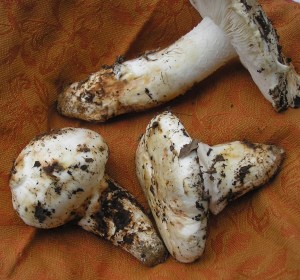
A friend came to the house and invited me mushroom hunting. Matsutake hunting, that is. This guy hunts them regularly. The elusive mushroom rarely breaks the surface of the tan oak duff. The mushroom hunter showed me the slight mound of dried leaves that is the telltale sign.  As we hiked and bush-wacked the hillside, we found bits and shreds of white flesh; Matsutake chewed and discarded by deer.  We would do the mushroom crouch, searching for small heaps of leaves.  He showed me how to reach down and pull the stipe from the ground, carefully brushing off the mycelium and with a quick and sure motion replacing the disturbed leaves. Often I would come across colorful gems white, red, gray; other fungi that we didn’t stop to identify. We were on a mission.

He showed me how the young caps with their veils intact look like toasted marshmallows. At first, I thought he was crazy, but then I could imagine the irregular brown markings as looking charred and the swollen mushroom could be a marshmallow bloated from an open fire.

The best thing about learning this art (mind you, I haven’t tasted them yet!) is the smell.  Johnny mentioned it right when we started out, but I was focusing on visual cues.

I could smell something familiar, but elusive. He said it was the mycelium underground, not the mushroom itself.  Then, after finding several and subconsciously taking in the fragrance, I could recognize it.  He described the smell, “like cinnamon and old socks”. Bingo! To me it has the scent notes of drying valerian, (the botanical source of Valium), the cinnamon too subtle for me.

Recognizing scents is like hearing a bird-call and someone identifying the bird. If you are not primarily an auditory learner, it doesn’t lodge in the memory. When the guide translates the call and says listen for the “lee-lee-oh” all of a sudden we have something to remember.