Quinoa Continued

The folks at Golden Rule Garden, a project of Ecology Action contributed two gallons of recently grown and dried quinoa to the Ecology Action 40th Anniversary Celebration, last weekend. Ellen Bartholomew, garden manager, warned me that I needed to repeatedly wash the quinoa seeds (technically a pseudograin because it is not from the grass family, rather it is related to spinach, Swiss chard and the edible weed, lambsquaters). Well, I didn’t listen.

These were her instructions:

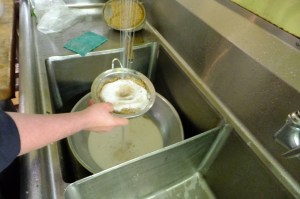
Place 1 to 2 cups quinoa in a blender. Fill with water almost to the top. Blend at low speed for a minute or two. Drain the sudsy water, add fresh water rinse twice and repeat. Repeat again. Do this however long it takes for the water to come out clear, not sudsy.

Now the problem is, as you probably know, quinoa is high in saponins, a chemical constituent that is not essential for basic metabolism, but worth it to the plant to produce for some reason. Saponins taste bitter. I love bitter food and I spit out quinoa that was not properly rinsed. The birds in the field don’t eat quinoa, so the saponins are protection against predation. Good strategy.

There is not a blender in this otherwise complete catering kitchen. So I used the high-pressure dish washing faucet to rinse and rinse. Well, after an hour and a half of trying to wash about 10 cups on the day of the event, I got frustrated.  This is not something you can do in advance because in less than 24 hours the moistened quinoa will sprout. Finally, when Fenanda and Luke, interns at Golden Rule, showed up at the Frey’s kitchen, I understood. Luke calmly placed some of the quinoa in a large mixing bowl and added water almost to the top.Voila! The colorful calyx of each tiny seed floated to the surface and Luke poured them off. I had not been adding enough water. Quinoa also has a hard shiny coat surrounding each seed. Fenanda and Luke washed away the bitter principle and we all ate the most delicious, nutritious home-grown quinoa!

Red Grape Press

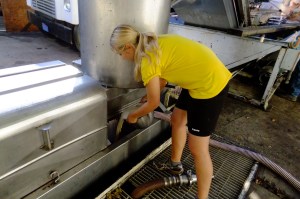
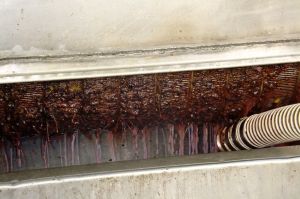
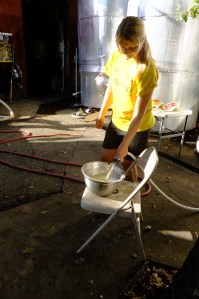
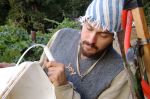
Red grapes are pressed with their skins, providing more tannins and antioxidants. Christine, one of the French interns, is adding yeast. Normally this step is more automatic, but yesterday when I took the pictures the machine wasn’t working. The yeast and water was in a large tank with a hose attached to it. Christine was filling up bowfuls and adding them to the wine.

Pressing Grapes at America’s Oldest Organic Winery

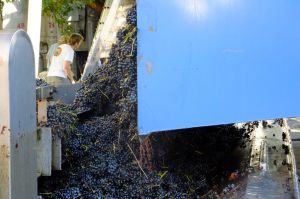
Gondola unload

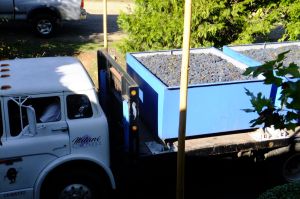
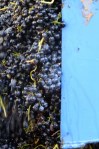
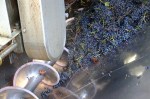
The rains came twice in early October, disrupting the harvest. Even so, the Frey family is remarkably calm.  After thirty years of farming, they know how to adapt to nature’s variables. Last year was the shortest season ever, between early rains and early frost. Now the family and a handful of interns and helpers are working around the clock to bring in the harvest and transform it to sulfite-free organic wine. Here is a photo collage of the process.

The Symphony of Rain

The first rains of the autumn season have come to Redwood Valley.  It is hard not to rejoice in the moisture.  The ground is saturated, a relief from the drought of summer.  And yet this is agricultural country and the rains are early. The grapes are on the vine. So the farmers are not happy.

The sound of rain pattering leaves, the mummer of raindrops gently falling on surfaces, then the rising to a crescendo near and far, this is the music of the rainy season. A waterfall gushes from the gutter on the roof. And all the more delightful because sparkling spring-like days will intersperse the cold gray days of the rainy season.

Biodynamic Preparation 501

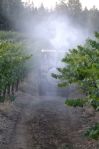
Early one morning, I saw Daniel Frey driving the golf cart he uses on the ranch. He was pulling a spray rig. All of a sudden, I realized he was about to spray a BD prep over the grapes!  When he got to the end of a row, he stopped a moment and we had time to talk.

He told me how much he loved the whole ritual of making and applying the preparations. He got up before dawn to grind granite into a powder finer than flour. Then he put a small amount in a 55-gallon tank of water and stirred it in a special pattern to enhance the vitality. First he stirred and stirred until he created a vortex in the water, then he broke the vortex by stirring in the opposite direction. This procedure went on for an hour. He chants or tones a note going up an octave and then when the vortex is broken, reversing the tone and going down.

The prep had been buried in the ground in a cow’s horn all summer.   I asked if it was true that BD Preparations work on the same principle as homeopathic remedies—using an amount so small that it is sub-molecular and works on a vibrational level. He agreed, and said the essence is so fine that the spray need not get on all the grapes, every sixth row was enough to stimulate the whole population of grapes.  He then told me that he uses the golf cart because the plant spirits prefer the quiet.

The First Grapes of the Season

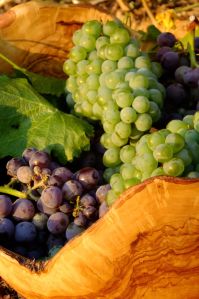
The grapes are Sauvignon Blanc and an unknown red table grape. Last night the Frey’s had a wine club gathering and this was left over.  I took the bowl outside as the sun was coming over the ridge. The closest vineyard, outside the kitchen door, is Cabernet Sauvignon, and they are ripening too— look at those grapes.

I’ve been living here for a year now, and so I’m more attuned to the vineyard and am not afraid to seek answers I have about the harvest. Sauvignon Blanc and Cabernet Sauvignon are two of the earliest maturing varieties.                                                           As the oldest organic winery in the country, Frey winery (pronounced fry) is pioneering the way.  I’ll share what I learn along the way.

Harvesting and Threshing Quinoa

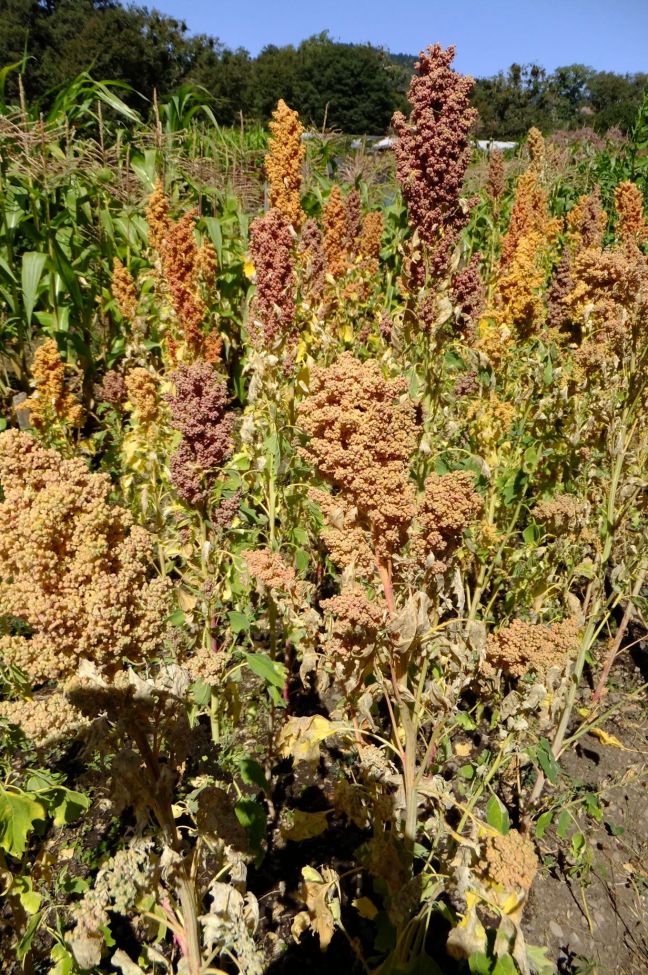
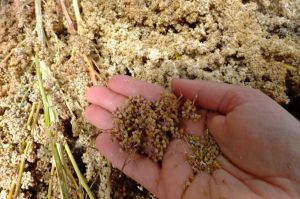
I read the email this morning.  Fernanda said they had harvested quinoa and would start threshing it today. An intern from Ecuador, Fernanda had told me about growing up in Riobamba, in the Andes, where her mother has a restaurant that serves traditional food, including quinoa. Last week I took a picture of her standing beside the quinoa, a variety from the USDA seed bank, a multi-hued one. Fernanda led me to the drying loft of the barn, where bundles of rye, teff, and garlic were hung to dry. I arrived at the garden at lunchtime so, she got me started and went to take a break. I was excited to get started. The last time I cleaned quinoa was when I worked at the Abundant Life Seed Foundation fifteen years ago.

Another Ecology Action intern, Luke, showed me how they first weigh the whole plant to calculate the dry biomass, an important step in collecting data for their research in determining yields. Then the seeds are gently stripped off the stem to avoid gathering unnecessary bits of stem and debris.  One batch I worked on was not completely dry. The colored stems were so heavily ribbed that they reminded me of rainbow chard when it has bolted. Much of the seed stayed wrapped in the dried chaff, yet the grain (pseudograin see archives) looked completely mature. The other batch was much faster to process because the stems were brittle.  I rubbed the dried flower heads between my hands and let the seed fall into a bowl. I worked alone for a few minutes and then two volunteers returned to work on amaranth.

Later, Ellen Bartholomew, the garden manager at this site, one of Ecology Action’s research gardens, joined me. She showed me a faster way to process grains.  After stripping the dried seed heads, we pushed the quinoa through seed screens.  The best arrangement was  #5 on top and the fine mesh on bottom. The most mature quinoa fell through by shaking the screen, whereas we needed to rub the remainder through the screen. The stems and coarse material remained on top. The finest chaff sifted through the fine mesh screen, leaving very little debris to remove in the last step.

Winnowing is a skill that reminds me of a chef tossing an omelet.  I remember working as a cook in an Italian restaurant and told to practice with a skillet of dry beans. By flipping the wrist I learned how to turn a pan of sautèd veggies without a spatula. Holding a bowl lightly with two hands and standing in front of an electric fan on low, I tossed the quinoa; the chaff sailed through the air, onto the floor. Quinoa is a good one for beginners to learn with because the chaff is so much lighter than the seed, thus it separates easily. To make sure the seed is evenly dry, the quinoa will be kept at the temperature it will later be stored at before being placed in a sealed container. If they are not damp, and don’t stick to each other, unlikely in this dry air, then they will be ready to go into storage containers. Ecology Action does lots of quinoa trials; this mountain valley provides the ideal growing conditions, hot days and cool nights.

Seed Industry History and Opinions

The roots of heirloom seed companies can be traced from the mid-1800s when seeds were part of the public trust, to the disappearance of family-owned seed businesses in the 1970s, to the renaissance of heirloom and organic seed companies today.

An article in Acres USA, “Seeds of Sustainability”, by Bill McDorman, author, and founder of two seed companies, and Stephen Thomas, provide not only a historic overview, but also, offer provocative thoughts about where the market is headed.

Over 50 small and family-owned companies were acquired by multinational conglomerates after the Plant Variety Protection Act included seeds as intellectual property that could be privately owned in 1970.

Ten years later, a supreme court ruled that patenting life-forms based on their genetic code could legally be privately owned. Seed company mergers and buyouts followed until there were few regional, independent companies left.

Major seed companies choose to focus on breeding new high-yielding hybrids. The major drawback of hybrid seed is that its progeny are unpredictable, requiring farmers to purchase seed each year.  Seed companies dropped countless old fashioned, open-pollinated varieties that could be saved and focused on traits that benefited agribusiness, uniformity maturity, toughness to withstand shipping and long shelf life. These varieties thrived when grown with heavy chemical inputs.

Modern plant breeders call the ancient, holistic approach to selecting and saving seed horizontal resistance. “This technique considered the overall health and quality of a broad population of plants along with its adaptation to regional growing conditions,” explained Mc Dorman.  Plant breeders discarded this in favor of vertical resistance, seeking specific genes to confer quantifiable improvements for specific problems.  (Whether or not it is possible to isolate individual genes for specific characteristics is a hotly debated subject)  Mc Dorman explains, “The problem with vertical resistance is pests can more easily evolve to overcome the resistance conferred by single genes.”

The gap in the marketplace created a niche for the germination of small, independent seed companies and non-profit organizations in the 1980s. Bountiful Gardens had its start at this time, as did, Seed Saver’s Exchange, Johnny’s, Territorial, Garden City Seeds, and many others. These small, independent companies were alike in being started by visionaries with commitment to maintaining seed diversity while they differed in their mission of who they served.  The emerging seed businesses branched at this juncture: some focused on preserving a wide array of open-pollinated and heirloom seeds and making them available to as many people as possible.

Some seed companies targeted primarily market gardeners and small-scale farmers. While providing open-pollinated seeds, they also offered hybrids and several of the more savvy entrepreneurs even cultivated trial gardens to introduce new sustainable varieties.

Other companies targeted home gardeners and homesteaders; they kept a low overhead, stayed small and choose not to promote their products through glossy catalogs. Some choose to keep their prices down while others were trendsetters.

ORGANIC SEED

The seed industry’s next growth spurt came in the 1990s, prompted in part by the National Organic Program (NOP) requirement for certified organic growers to buy certified organic seed, when available. Tom Stearns, founder of High Mowing Seed Company, has been written up in “Seeds of Success” by Cheryl Cesario, also in the January 2011 issue of Acres U.S.A. Although a highly informative piece about a leader in the field, it is beyond the scope of this article.

Here is one insight to ponder from Stearns: “ Many of the hybrid varieties on the market today are developed under high input conditions.  Even for seeds produced organically, they were most likely developed in chemical agriculture systems. How can these varieties then thrive in organic systems?”  Stearns continues,  “Even if the hybrid seed crop is grown organically, the genetics just aren’t there.  It’s like milking a Black Angus because she is the only cow around.  The organic farmers in this country don’t have the right seed genetics to support true organic farming methods.”

Mc Dorman corroborates, “Organic seed is becoming just another industrial market niche. One-size-fits-all hybrid organic seeds, produced by multinational giants are beginning to flood the market.”

While the NOP requirement for organic seed is hailed as an incentive to banish chemicals from organic farming, some growers are concerned that the rush to procure organic seed must not be at the cost of losing more heirloom diversity.  The challenges to offering organic seed are as follows, the seed companies face higher production costs, added expense of certification for organic handling, and reluctant farmers.  The organic farmers and market gardeners in turn are confronted with inadequate seed supply, greater expense for seed and the risk of growing untested varieties when their livelihood and reputation are at stake.

What many people seem to be acknowledged is that open-pollinated, organic varieties hold a promise for us to adapt to an increasingly unpredictable climate.  As a culture we can’t expect the farmers and seed companies to take all the risks. Some see the need for the government in the form of the land grant colleges to usher in the transition. Organizations like the Organic Seed Alliance are actively working toward breeding what they call “heirlooms of tomorrow”. Some people suggest that the successful organic foods industry help fund the transition. Finally, it may come down to individuals who step forward to make the commitment to saving and breeding their own seed.

Where Our Food Comes From: A Book Review

Where Our Food Comes From: Retracing Nikolay Vavilov’s Quest to End Famine

By Gary Paul Nabhan, 2009. GPN is an ethnobiologist, conservationist, farmer and author of eight books.

Most of the crops we depend on for food were domesticated in ancient times, in just six regions on five continents.  This is the story of a brilliant Russian plant breeder who devoted his life to food security through exploring those regions to glean seeds and essential agrarian knowledge. Nabhan followed in Vavilov’s footsteps and met with scientists that continue this important seed conservation work.  He also talked with traditional farmers in the field on each of those continents.  Vavilov is recognized today for three primary contributions:

Establishing a seed bank from the hundreds of thousands of seed he collected.

Mapping the world’s centers of biodiversity for food crops, utilized today by conservation organizations as Biodiversity Hotspots.

Recognizing the importance of, and recording the knowledge of regional farmers about their crop varieties.

My favorite story was about a 90-year-old plant geneticist from Kazakhstan who told Nabhan how Vavilov changed his life.  One day the great scientist was coming to his town to look at the forests of wild apple trees in the surrounding hills. At the time, Dr. Aimak Dzangaliev was a sixteen-year-old stable boy who was invited to accompany Vavilov and translate for him. Dzangaliev was so impressed by the genius that he saved money and studied for ten years, until one day his dream came true and he studied under Vavilov; he went on to become Kazakhstan’s expert on wild apple diversity.

An example closer to home is the account of Vavilov collecting wild sunflower seed in Texas.  He brought the seed back to his staff of oilseed breeders who worked on crossing the sunflower with the cultivated Helianthus annuus, our common garden sunflower. One plant geneticist, Pustovoit, continued breeding sunflowers for thirty years, using that same wild relative. He developed a strain, a stable hybrid sunflower with unusually high levels of polyunsaturated oils that became an oilseed crop in the Soviet Union. Many years later, farmers from Texas, USA, came to the agricultural research station where Pustovoit’s daughter gave them seed to take back to Texas, where it now grows as a crop.

The food crops indigenous to the US include wild rice, sunflowers, Jerusalem artichokes, tobaccos, low-bush blueberries and amaranths. Vavilov lectured in the US and spoke of crops unknown to his audience of American scientists, including tepary bean, maypops, maygrass, sumpweeds and chenopods, little barley and Chicksaw plums.  To learn more about these crops see another of Nabhan’s books, Renewing America’s Food Traditions.

One insight that Vavilov showed the world was that crops don’t grow in a vacuum where they are randomly attacked by insects and diseases. Vavilov looked at plant pathology from an evolutionary, geographic context. That was part of his fascination with what we now call biodiversity hotspots. Vavilov deduced that  “…those centers still held ancient diverse forms of crops that had co-evolved with pests and diseases over many millennia.”

Nabhan relates that to this day whenever there has been major crop failure caused by disease or insect pests, plant specialists have gone in search of the crop’s wild relatives and ancient landraces; somewhere in the world’s centers of diversity they have found the seeds of genetic resistance.  Although much diversity has been lost, farmers and scientists around the world are working to preserve food systems. Where Our Food Comes From is an urgent reminder to save traditional farming along with the seeds.