
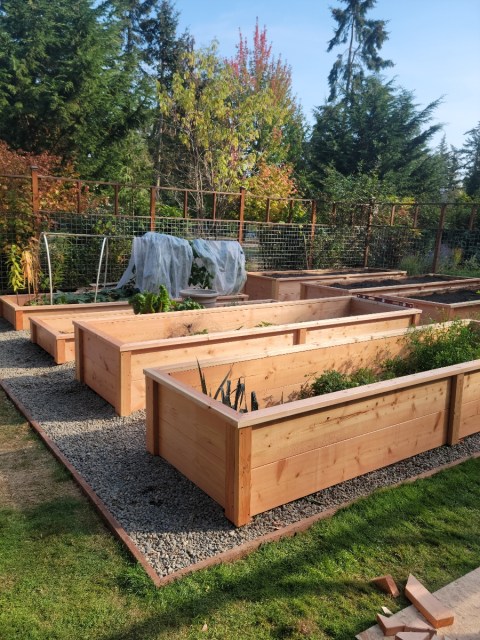
Planter boxes in the vegetable garden offer many options. The first advantage we think of with tall boxes is the ease of gardening. Low planter boxes define the garden beds from paths and make upkeep easier. The boxes can be the solution to poor soil with either too much clay or sand. They offer good drainage and warm up earlier in the spring. The main reason why I am considering planter boxes is the addition of a barrier at the bottom of the box to exclude moles, and other ground dwelling mammals. Raised beds can be made of metal or concrete retaining wall blocks. Both have their advantages and disadvantages. Here we will look at wood construction.
Construction
Use 2 x 6 Doug fir as it is less expensive than cedar. It should last 5 to 10 years, especially if you can protect the wood with linseed oil or other non-toxic preservative. Boxes longer than 8 feet might bow outward, so brace the box with another board across the center. 4-ft-wide is an ideal width because the bed can be reached from both sides.
A 12-inch-high box will be adequate for most vegetables. The extra height in the photo above is for the gardener’s ease. A board across the top makes a comfortable seat for planting and weeding. Line the bottom with hardware cloth. Although ½ inch 19 gauge is stronger, ¼ inch mesh is more secure, preventing voles from entering. 6- or 8- inch-boxes are deep enough for most vegetables, especially if you don’t need to exclude rodents and moles. Root crops require at least 12 inches.
A 24-inch-deep planter box will require 2 ½ yards to fill. Filling each box with premium planting soil could become costly. The planter box should be filled with a combination of native soil and compost, or native soil and purchased mix that may be bought in bulk or in bags. Plain soil will probably get too compacted if it is heavy clay. If the boxes are replacing existing vegetable garden beds previously enriched with compost, that soil will be excellent for the top 8 to 12 inches. The base could be filled with branches or other rough matter trail mix, rotted straw and leaves. It will settle as it decomposes. Each year add a couple of inches of compost to the top of the beds as the soil settles.
Pest Control
By enclosing the planting box, we can avoid rodent problems. Place hardware cloth below the boxes and attach them to the sides. This preventive measure may seem like overkill, but if you have been competing with small mammals in the garden you will recognize its value!
Moles are highly unusual; they spend their lives burrowing through the soil their with enlarged paws. I once saw a video of a mole underground—it looked like it was swimming! Their eyes and ears are very small to avoid getting clogged with soil. Moles are drawn to earthworms and insects that thrive in soil enriched with organic matter. They tunnel under garden beds. These tunnels can be a problem for all vegetable roots and especially root crops. Roots left dangling in a tunnel dry out. Washington State Fish and Wildlife describe these mammals and their behavior.
Then tunnels become passageways for voles or meadow mice. These rodents do chew on vegetable roots. Even rats can travel in the burrow and eat vegetables. Voles reproduce exponentially. Although hawks and snakes are tackling the problem in my garden, the vegetation provides too much cover for voles. Their population seemsto be growing. I have decided to build planter boxes next spring. Permanent beds make it easier to install the plastic hardware involved in drip irrigation and constructing hooped cloches with plastic, floating row covers, or bird-netting. All the additional hardware makes the garden feel less earthy to me. But I need to look at the garden in a new light, perhaps as a outdoor organic horticultural lab. Eventually it will soften.
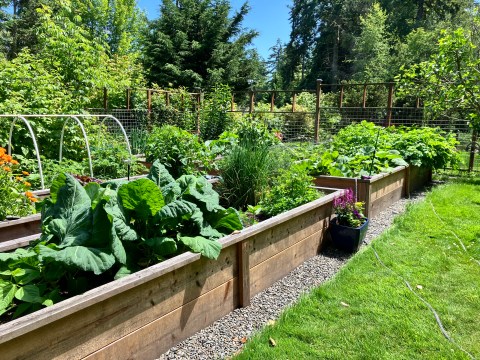
I am no expert on construction. The above photos are from Peggy and Thomas Stanlick’s garden built by Isaiah Marlow.
For more information on how to build your own planter boxes see the following:
YouTube 7 Beginner Raised Bed Mistakes to Avoid
 Sustainable Garden Design