October Garden Chores

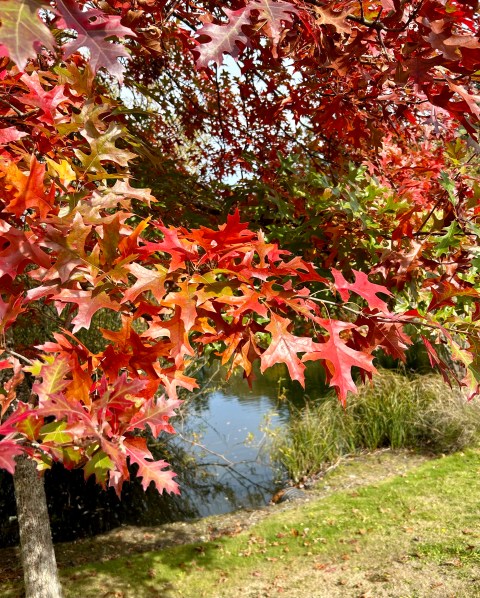
We know it’s autumn when the leaves start turning color. Here a Pin Oak brightens the landscape. It’s time to harvest winter squash and pumpkins, but if your squash isn’t quite ready, perhaps it will have time to continue ripening.

In Port Townsend, our typical first killing frost arrives by the end of November. If autumn temperatures drop slowly over time, plants get acclimated. The high concentration of sugars acts as ‘antifreeze’ in the protoplasm and this is what gives kale and other crops a sweeter flavor after the first frost. But if warm weather prevails until a sudden hard frost hits, then plants are not prepared. Sometimes in November the temperature can suddenly drop twenty degrees! Next month pay attention to the weather forecast and be ready to use floating row covers on crops and newly planted broad-leaf evergreen ornamentals. Forecasts for the next three to six months seem to be leaning toward La Niña but one forecaster described it as “a weak event”. NOAA posted this

Garden Chores

  • Leaves: Rake and compost, or save for mulch.
  • Lawns: Over-seed existing ones with white clover, yarrow, English daisy and other flowering plants for pollinators.
  • Mulch: shrubs and garden beds for winter protection and weed suppression. The increased organic matter will eventually feed the soil ecosystem. (This repeat from last month reinforces how important it is!)
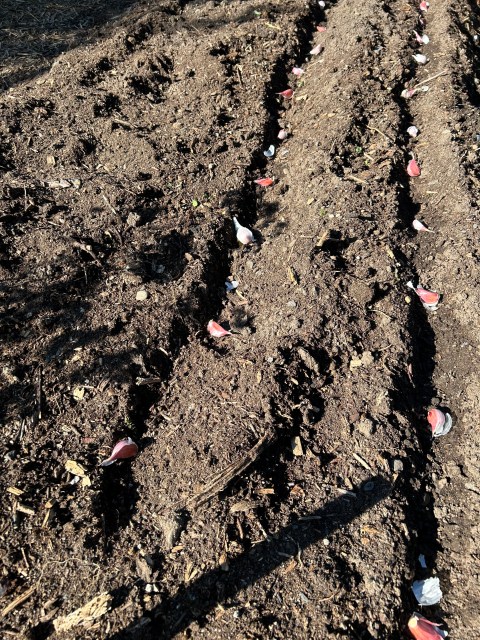
  • Plant garlic: 2” deep in well-drained soil. Space cloves 5 inches apart with the tip up. Mulch with straw. Prevent disease by rotating crop every 3-5 years. Certified disease free garlic or saving your own is best.
  • Fruit Trees: Rake and remove any diseased dried leaves, rotten- and mummy-fruits to prevent disease.
  • Apple tree pests: Examine fruits for coddling moth larvae damage. The Hortsense link offers preventative measures for next year.
Tinker and apprentice Brianna at Abundant Life Seed Foundation in 2001. Upper Salmon River squash

Winter squash can be slow to fully mature. One way to encourage this is to remove all small and new squash in September. This allows all the energy to go to the larger, more mature squash. The signs that a squash is mature include a bright yellow spot where the squash touched the ground, the stem becomes brown and corky-textured. Also, as the squash skin toughens up, it becoming duller, and even a bit waxy. It may difficult to make an indentation with your fingernail. These contribute to a good storage crop.

Tinker loved growing the Lower Salmon River winter squash. This variety of Cucurbita maxima is one of the few heritage crops from the PNW, and is known from the Salmon River area of Idaho. It has a distinctive flavor and texture. Seeds are available from Adaptive Seeds.

If you want to taste Lower Salmon River, Midori Farm grows it and the Food Co-op has some now. It takes about 90 days to mature. It can withstand a couple of light frosts although the first one will probably kill the foliage. For Cucurbita maxima aficionados, check out this Johnny’s Seeds critique of flavor and yield for varieties.

After the fall equinox, plant growth slows. We have not had frost yet in early October 20224, so crops are still growing well. Plants are able to sense cold temperatures and respond by producing carbohydrates. In vegetable crops, the high concentration of sugars acts as ‘antifreeze’ in the protoplasm and this is what gives kale and other brassicas a sweeter flavor after the first frost. For more on winter gardens see the OSU Extension Publication

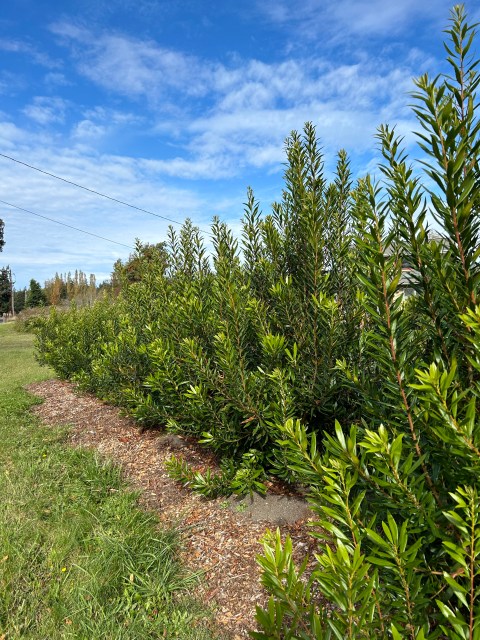
Pacific Wax Myrtle: resilient native evergreen

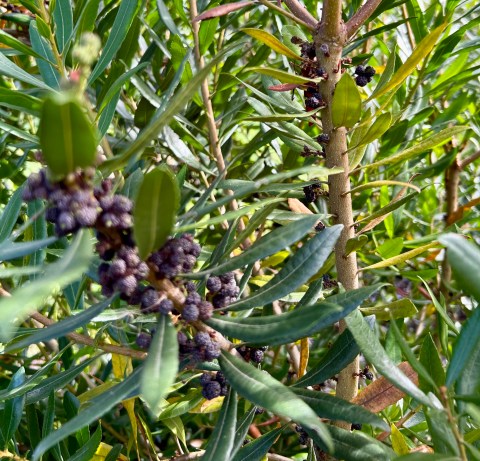
Pacific wax myrtle, Morella californica, is native to the coastal areas of Washington state and south to California. It is considered on of the best evergreen native shrubs for our gardens. Although the flowers are inconspicuous, the waxy black fruits are popular with birds. Knock-on-wood it is still deer resistant.

This hardy native is adaptable to many conditions from full sun to shade. Although it prefers moist, well-drained soil, it can grow in a variety of soils. The root nodules have nitrogen-fixing microorganisms that allow the plant to grow in poor soil.

Once established it is completely drought tolerant. It will grow to 30 feet tall and 15 feet wide in thirty years. For the average size garden, pruning will keep it within bounds. Late winter is best for heavy pruning, then general shaping can be made with heading-back cuts through out the season. This remarkable shrub can be pruned as a formal hedge, a loose screen or even a small tree. As a screening hedge, Pacific Wax Myrtle provides habitat for a multitude of birds including Spotted towhee, several sparrows, northern flicker, robin, goldfinch and cedar wax-wing. The latter are especially delightful in winter when small flocks gather on the shrubs. The waxy berries provide vegan fat in the winter.

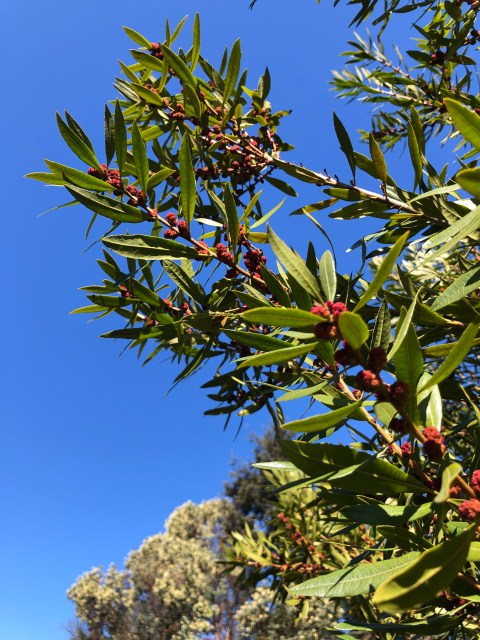
Morella californica blooming in May

Pacific wax myrtle is slow to grow at first and once established, it grows steadily. Here the tiny flowers are blooming. Within these red catkins are separate male and female flowers. To see a close up and more photos go to the OSU landscape plant descriptions. This website provides excellent plant descriptions. I have not found anything like it in Washington.

For the longest time I didn’t think any disease bothered this shrub, but I noticed some foliage die back and even some stems turning brown. The Pacific Northwest Pest Management Handbook describes a type of leaf blight caused by a phytopthera that only bothers this species. This fungal-like organism was first identified as a pest in 2009 on the Oregon coast. I have been growing several shrubs at my place for thirty years and have only noticed it recently. Some ways to prevent spreading the disease:

  • Avoid overhead watering.
  • Mulch with arborist chips
  • Increase air circulation at the base of the plant by removing weeds or other vegetation.
  • Remove any diseased plant material and throw it in the garbage, don’t compost it,
  • Don’t over-fertilize and don’t fertilize late in the season.
  • Sanitize tools with isopropyl alcohol, or prepare a mix of 1 part bleach to 9 parts water. Dip tool or wipe with moistened rag.
  • Water to get the shrub established and then only monthly during summers to grow a hedge or screen.

The leaves make a pleasant tasting tea that is medicinal. The active medicinal substances include an astringent resin. The root and bark can be tinctured and used for inflamed gums according to Michael Moore’s Medicinal Plants of the Pacific West. The plant’s botanical name was changed in 2006. Previously it was known as Myrica californica.

A native plant adaptable to sun or shade and varying soil conditions, one that can synthesize it’s own nitrogen is bound to be more resilient!

Rainshadow Gardening on glacial sediments

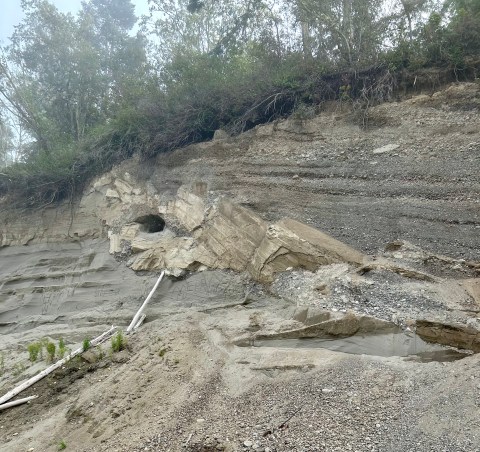
Looking at the natural history of our area deepens our sense of place and helps us grow more resilient gardens. Climate, geology and ecology have shaped the land. Tinker would always comment on the landslides along the bluff between North Beach Park and Point Wilson lighthouse. She enjoyed reading the landscape and imagining the geologic forces at work.

By looking at the bluff, we see what is below the surface of much of Quimper Peninsula, and begin to understand our soils. The above photo shows layers of deposited sediment.

Just imagine—a massive sheet of ice 3,000 ft deep covered East Jefferson County, 15,000 years ago. This last glacier bulldozed and deposited rocks, gravel, and sand. The beach bluffs reveal that much of our soil is glacial deposits. There are pockets of clay, sand and a bit of sandy loam. The thin topsoil is often sandy, gravelly loam. If this intrigues you, check out the Quimper Geological Society!

If you have ever felt your garden soil is not as good as it could be, you are not alone! Most areas of the Puget Lowlands are too young for deep topsoil. ( Of course there is prime agricultural land that formed on marine terraces or alluvial outflow from rivers.) A soil profile is a cut through section of the land revealing topsoil, layers of subsoil and  even bedrock. Soil scientists dig profiles to examine the existing soil.

The curious gardener can look online for a digital copy of the 1975 soil survey of the county, where aerial photographs are overlaid with maps roughly indicating soil types and descriptions. I have an old paper copy that I highly value.

Again, this is just a brief summary and I am no expert! The climate working on the land determines the native flora. The Puget Sound area has mild winters and cool dry summers, and is commonly known as a Mediterranean climate. Winter rains tend to be continuous and light to moderate rather than heavy downpours. The marine layer—a deep, low cloud bank is a defining feature.

Rainshadow

What makes our area unique is that the Olympic Mountains block the moisture-laden clouds coming from the Pacific. The west side is a rainforest while the northeast side, in the shadow of the mountains is rainshadow. I have seen native Opuntia fragilis on the Quimper Peninsula and on Whidbey Island. Port Townsend’s average rainfall is around 20 to 23 inches. Often the marine layer breaks apart late in the day.

Prevailing winds  from the Pacific often reach us from the south and southwest. As the clouds move around the Olympics, dumping precipitation from Olympia to Brinnon, they are wrung out by the time they reach Port Townsend. Eastern Jefferson County is largely a peninsula on a peninsula. It juts out to the northeast and catches the winds from the south. Mostly in summer winds blow from the northwest down the Salish Sea.

Arctic Blasts

In general our gardens are more prone to winter damage when arctic blasts roar down through the Fraser River Valley of British Columbia. It used to be that we only needed to track this during El Niño- Southern Oscillation years but the polar vortex is wobbling now and this leads to less predictability. Last winter we had cold temperatures that were the lowest in 30 years. Keeping an eye on the weather allows us to bring out sheets or burlap to cover plants. Even wind-blown Doug fir boughs shield vulnerable plants.

Moving here in 1988, with a background in organic horticulture, I was very curious about weather. Trying to get a grasp on seasonal cycles and weather, I asked many questions. It seemed like every season someone would say “This is the coldest summer” or “This is the wettest spring,” or “Its the driest winter”—I could not find a predictable pattern!

But there were and still are weather trends: Spring came early and lasted until the fourth of July; summer was somewhat predictable for August and September, although any day could become rainy and windy. Then autumn arrived. The snow was visible on the mountains until September. Several people who grew up here said the mountains were always snow-covered when they were children.

What I recall is the first snowfall would brighten the Olympic Mountains by mid-October, and might bring a cold snap to sea level, with occasional early frosts. Then mild weather would return for much of October. Often November would be the rainiest time of the year. Temperatures would get cooler and cooler until a frost. The darkest time of the year was and still is late November, December and January.—the sky colored many shades of gray. But then storms blew in from the south, after wrapping around the Olympics, bringing windy weather and sun-breaks in the dramatic skies. Red flowering currant could bloom as early as mid-February. There does seem to be an increased occurrence of multi-year La Nina. Nature magazine 2023.

Resilient Gardens

Climate change is real and part of gardening is responding to the changes. We live in a place for garden lovers, where flowers can bloom in the winter and a large number of evergreen shrubs thrive. The native vegetation offers a plethora of interesting plants for our gardens. Berries and fruit trees thrive in our mild climate. Winter vegetable gardens provide leeks and greens all winter. Knowing that most soils here are excessively well-drained and that we can’t rely on summer rains, drought-tolerant ornamentals are a smart choice. Tinker respected our rainshadow ecosystem. Here is how she grew resilient gardens:

  • Recognizing the importance of the soil ecosystem
  • Caring for the soil through making compost & sheet mulch
  • Selecting plant varieties that are bred for pest-resistance
  • Growing open-pollinated heirlooms that we can nurture as landraces
  • Developing a strong curiosity about our local weather
  • Committing to living lightly on the Earth, however we define it