

Tinker was involved with Abundant Life Seed Garden from its inception in the 1980’s until 2001. She and John Gilardi were garden managers in the latter years. In the above photo, Tinker and an apprentice named Nicole are stripping the flower heads of dried amaranth to remove the seeds. Next steps include winnowing and screening. Later amaranth was one of the crops Tinker experimented with in the dryland farm project.
Amaranth’s importance is twofold—its super nutritious and easy to grow.
Unlike grains, the seeds of amaranth contain all the necessary amino acids. The protein content is 16 percent, more than rice or wheat. Like quinoa, this offers complete protein for vegans. Amaranth is considered a pseudograin (only plants in the grass or Poaceae family are considered true grains)
Grain Amaranth comes from one of three species. All are white-seeded whereas the leafy greens amaranth tend to have black seeds and may become weedy.
A. cruentus, Purple Amaranth: Day-length neutral and most widely adapted. Typically white-seeded from Mexico, this is made into “Alegria”, the popped seeds mixed with molasses pressed into a small cake or bar.
A. hypochondriacus, Prince’s-feather is day-length sensitive. I know little about this species.
A. caudatus , Love Lies Bleeding is native Peru. Sometimes called Inca wheat, it is an important staple in the Andes.
While young foliage can be confused with weedy amaranth, (A.hybridus, A. viridis, A. retroflexus. A. spinosus.) grain amaranth has apical panicles, or seed heads forming only at the top. Grain amaranth can withstand drought conditions because their roots can grow several feet deep.
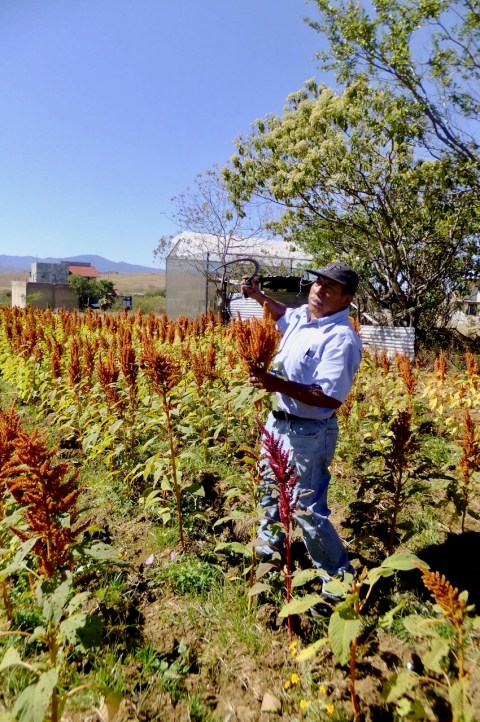
Early strains of A. cruentus were cultivated as far back as the time of the first maize in Oaxaca. The Jardin Etnobotanico de Oaxaca includes a section of early cultivated food crops. I was lucky to volunteer in the garden during the winter of 2019 and had the privilege to work with Roberto Chavez Rendon. Here he is with an early strain of Amaranthus cruentus.

Open-pollinated grain amaranth species can be variable. Many selected strains have full heads laden with seeds. Seed breeders are selecting for shorter plants that don’t shatter. University breeders are developing F-1 hybrids for food production.
Although claims vary, Amaranthus cruentus and A. hypochondriacus were cultivated before 1,000 BC in Mexico. Grain amaranth was an important food source from the Aztecs until European missionaries put a stop to eating or using amaranth in ritual. It is again popular and is best known as “Algeria” , the popped seeds mixed with molasses and pressed into a small cake or bar. An NGO in the Etla Valley of Oaxaca, Puente a la Salud promotes food sovereignty with a focus on grain amaranth not only for cakes but to add as an ingredient in many dishes ground into flour; boiled and used as a thickener in soups; toasted and popped as a cereal. They encourage farmers to grow the crop and teach communities how to make appropriate tech ovens and poppers for cottage industries with amaranth.
Amaranth has the potential to be an important crop as we move into greater climate change. It is drought-, heat- and pest-tolerant. The nutty flavor can add more nutrients to oatmeal or ground into gluten-fee flour. Try growing this beautiful plant in the edible landscape, or in rows for production. Available from Adaptive Seeds, Bountiful Gardens and Johnny’s selected Seeds.


 Sustainable Garden Design