
Honey bees, the most popular bee species, with their matriarchal colony and delicious golden product are but one kind of bee. Before the European colonists came with hives, there were no honey bees in this country. Forgotten pollinators are the mostly unseen bees and other insects that live among us. Such keystone species are the glue that holds ecosystems together. Honey bees come from dry lands around the Mediterranean and are not inclined to forage in cool weather. This makes them unreliable pollinators for orchards during our damp and chilly Pacific Northwest springs. One type of native bee that thrives in our climate is known as the mason bee. This bee does exist on the Olympic Peninsula. Tinker Cavallero argued with me that I should not be introducing mason bees that were not native here. I went ahead because I wanted the assurance that my trees would be pollinated. (How often do we make choices that are good for us individually but not necessarily good for the planet?) after discovering how mismanagement of mason bees can be more harmful than beneficial, I decide not to buy more.
Raising mason bees requires providing clean nesting boxes. Ten years ago we learned that ‘bee hotels’ were breeding grounds for disease. If you insist on raising them use tubes with straw inserts that can be disposed. Better yet, use native plant stems or other hollow plant stems. In the next article I will provide more information. In the meantime, learn about our native bee populations by checking out a great book by our local native pollinator expert, Eric Mader. Attracting Native Pollinators
I wrote the following after much research. I wanted to understand the life history of mason bees. Insect watching for me is akin to bird watching; it’s another way to deepen a sense of place.
Natural history of a mason bee, Osmia
Her active life as an adult lasts no more than four weeks, and in that time, she may lay 30 eggs. Although this one Osmia only lives a short time, other mason bees continue to emerge until May, time enough to pollinate the apples and pears even if the weather is windy and cool.
It is springtime in Puget Sound. The days have been warming up consistently to above 50 degrees. Osmia, a mason bee awakes from its dormancy. This adult female is sequestered within a tunnel; a place that has been home for almost eleven months; from egg, to larvae, to pupae. Now she lies inside the clay abode, a fully formed adult with six legs folded beneath, while wings wrap over her pinched-waist and abdomen. The once-spacious tunnel is snug. She stretches one leg.
The fresh air of spring penetrates the mason bee’s solitary chamber, and stirs her metabolism. The urge to leave the cocoon grows stronger and she begins chewing her way out. Once out of the cocoon, she chews through the walls of clay that separates her from the outer world then crawls toward the light through other chambers recently evacuated by her siblings.
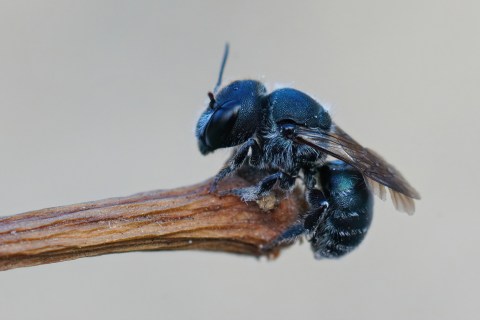
As she emerges from the tunnel, the light of day hits the mason bee. This metallic blue bee is almost a half-inch long, about the size of a honeybee, but more robust. She is covered in black hairs. To the uninitiated, she could be mistaken for a housefly. But her antennae are long and her eyes are definitely sleek, not bug-eyed like flies. Not only that, but she has two sets of transparent wings, whereas flies appear to have one.
Soon after she flies from the nest, a male approaches her. He has emerged a few days before from an adjacent tunnel. He is smaller and unlike the female, his abdomen is smooth, not covered in hairs; he does not contribute to pollination. After meeting his need for food by foraging for pollen his hormones urge him to mate. Not long after that he dies. After mating, the female bee’s job is to locate a nest site.
The fertilized bee goes looking for nourishment in the form of pollen and nectar. Bees forage through a sense of smell and sight. Scent plumes released by flowers attract her from afar. As Osmia draws close the flower reveals colors in the ultraviolet end of the spectrum that indicate where the pollen is. The earliest spring natives providing the bees with pollen include Indian plum and flowering currant.
Once fortified, she flies within a 300-foot radius of where she emerged, searching for a suitable nesting site. She may stay close to her home cavity–often mason bees are gregarious, or she may disperse. This Osmia is looking farther afield for a nesting site.
In the wild that would be an above ground cavity, maybe a hollow twig—brambles or elderberry twigs could work–or an abandoned insect burrow in a tree trunk.
A protected site is what she seeks. A patch of exposed soil should not be too far away.
The best nest site for Osmia would warm up early from the sun but be protected from rains. Here on the Quimper Peninsula, a bit of land thrust out on the northeast edge of Washington’s Olympic Peninsula, late winter rains come from the south and can be driven by wind.
She needs a tunnel about six-inches long for the brood she will lay. The diameter should be ¼ – 3/8 inch. In addition, this bee needs something to seal the brood chamber. Just as a mason requires a certain mixture of binder and moisture for his mortar to set, Osmia will need to find moist soil. Sand won’t work.
The mason bee flies into many potential cavities looking for the right home. Plants flattened in the winter are potential sites. Hollow perennial flower stems would be fine, just something that is not much bigger than her body. In the garden she might choose raspberry canes or Joe Pye weed. The bee hoovers before a potential cavity and then moves on. Now she sizes up a hollow stalk, grips the edge with her hind legs, folds her wings and enters. A moment later she backs out. The tunnel is just right. This bee does a zigzag flight dance memorizing the location and surrounding landmarks, before starting the next chapter of her short life.
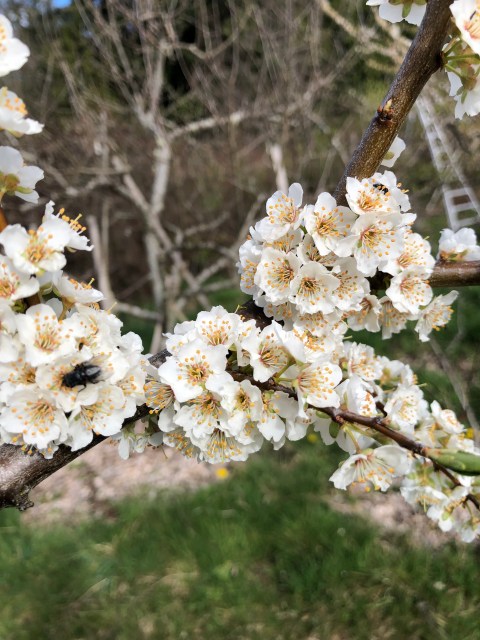
Now that she has found her nest, her brood work begins. In March the earliest blooms in the orchard are Asian plums and then European plums. Back to the flowers, Osmia brushes up against pollen as she sips nectar. Minute hairs on her abdomen catch the pollen. The nectar gets regurgitated when she flies back to her nest.
The mason bee brushes the pollen off with her legs and mixes it with nectar to form a nutritious cake for each egg. It could take as many as twenty trips to gather enough pollen to form one ball of pollen; and then she lays an egg on it. The pollen cake within the chamber will dwarf the egg and provide the worm-like bee larvae with all the food she needs. Just as butterflies have complete metamorphosis and grow from caterpillar, to pupal cocoon, to butterfly, so too all bees undergo complete change.
Once she deposits her egg on the pollen ball, she seeks mud to seal off this compartment. In this way she forms a linear tube of four or five egg chambers. The ones farthest from the entry will all be female. Carrying the mud between her mandibles and front legs she returns to the chamber allowing enough space for the offspring to mature into a full adult. She releases the mud, packs it down, and flies off for more mud. Taking about ten trips to build one partition, wall building can take all day. If the weather conditions allow and the necessary food and mud are close by, the mason bee might lay two eggs on a particular day.
Her active life as an adult lasts no more than four weeks, and in that time, she may lay 30 eggs. Although this one Osmia only lives a short time, other mason bees continue to emerge until May, time enough to pollinate the apples and pears even if the weather is windy and cool.
Larvae will emerge from an egg in a couple of days. This blind little worm will grow to about half an inch long after consuming the pollen cake in ten days. Without leaving its brood chamber it then spends most of its life in a cocoon waiting for next spring.
Adult mason bees activity lasts from March to May in the Pacific Northwest. Although this bee only lives a short time, other mason bees continue to emerge until May, time enough to pollinate the apples and pears even if the weather is windy and cool.
Larvae will emerge from an egg in a couple of days. This blind little worm will grow to about half an inch long after consuming the pollen cake in ten days. Without leaving its brood chamber it then spends most of its life in a cocoon waiting for next spring.
Adult mason bees activity lasts from March to May in the Pacific Northwest. Although this bee only lives a short time, other mason bees continue to emerge until May, time enough to pollinate the apples and pears even if the weather is windy and cool.
BULLET SIDEBOX
Xerces Society is a nonprofit organization that protects insects and other invertebrates. Consider their suggestions for garden maintenance. Pick one or two suggestions and try them.
5-Steps to Healthier Pollinator Habitat
1. Mulch less. Leave areas of dirt that can become mud.
2. Consider letting fall cleanup wait until spring. Perennial flowers & ornamental grass with hollow stems are most useful in horizontal position.
3. Leave tree stumps.
4. Place brush pile in unobtrusive places.
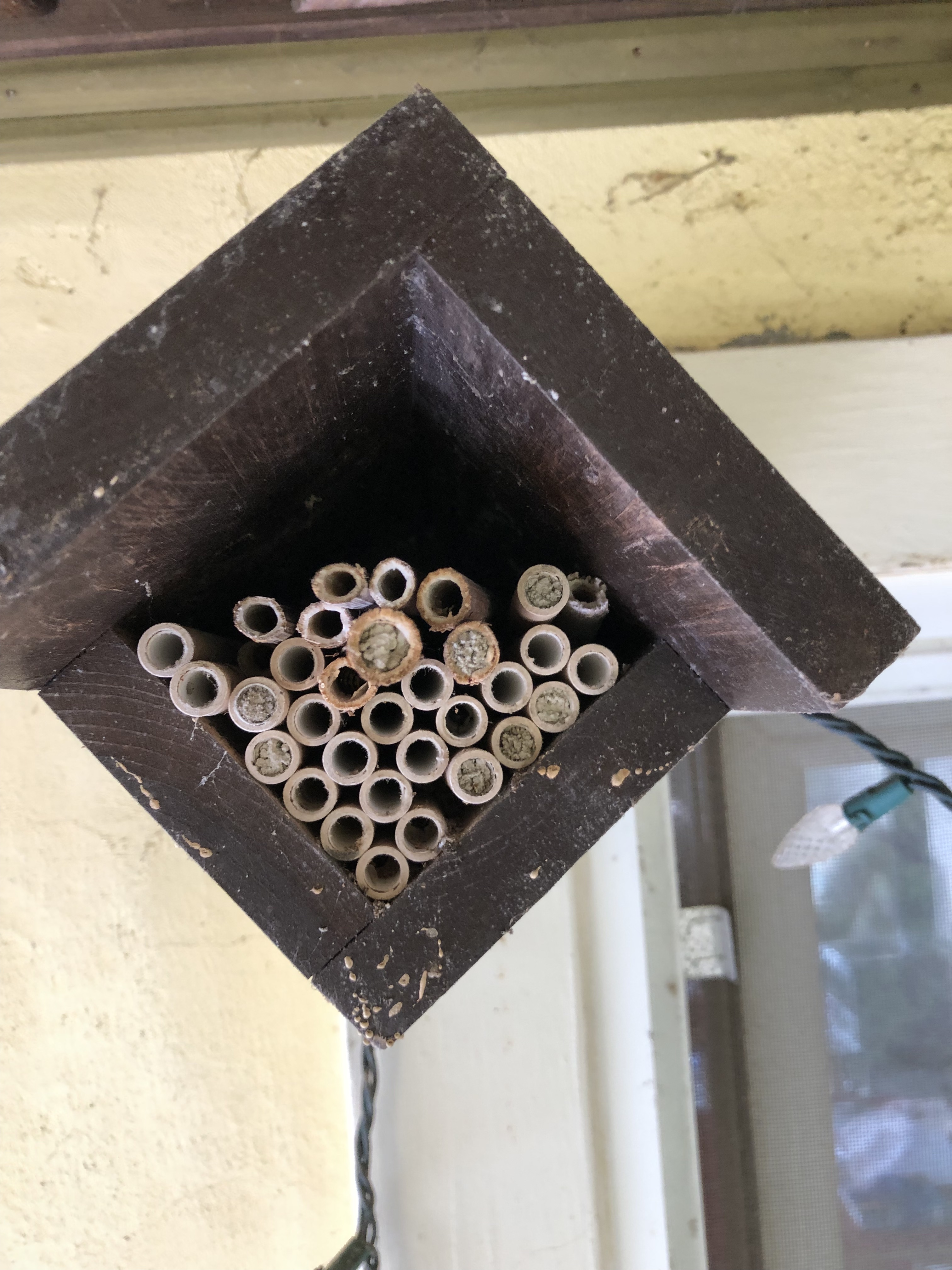
5. Make a new nest every other year and hang next to the old. Bundle up garden stems of raspberry or Joe Pye Weed, Eutrochium. Or use bamboo canes ¼ inch wide and cut behind the node. Discard the old one after the adults break through the mud and before they re-use the same tubes.
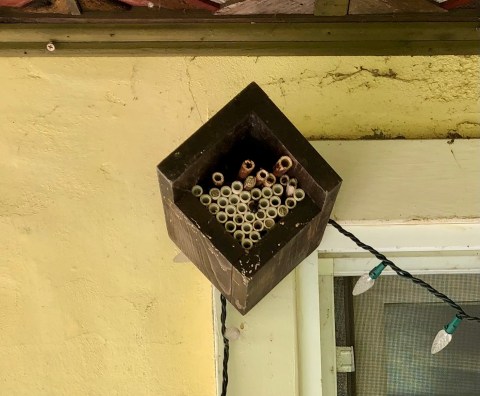
Instead of mason bee hotels, think camping shelters.

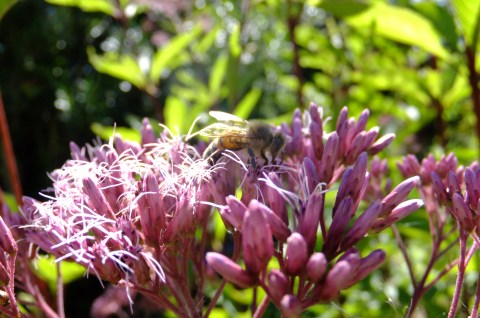
As an aside: Joy-Pye-Weed, formally known as Eupatorium now Eutrochium, is an attractive pollinator plant. It blooms in July and provides nectar for honey bees and others. One of the reasons I love it–besides it being a dramatic, predictable perennial flower–is that it grew wild in Massachusetts in wetlands and as a teenager I would harvest it for dried flower arrangements.

 Sustainable Garden Design